
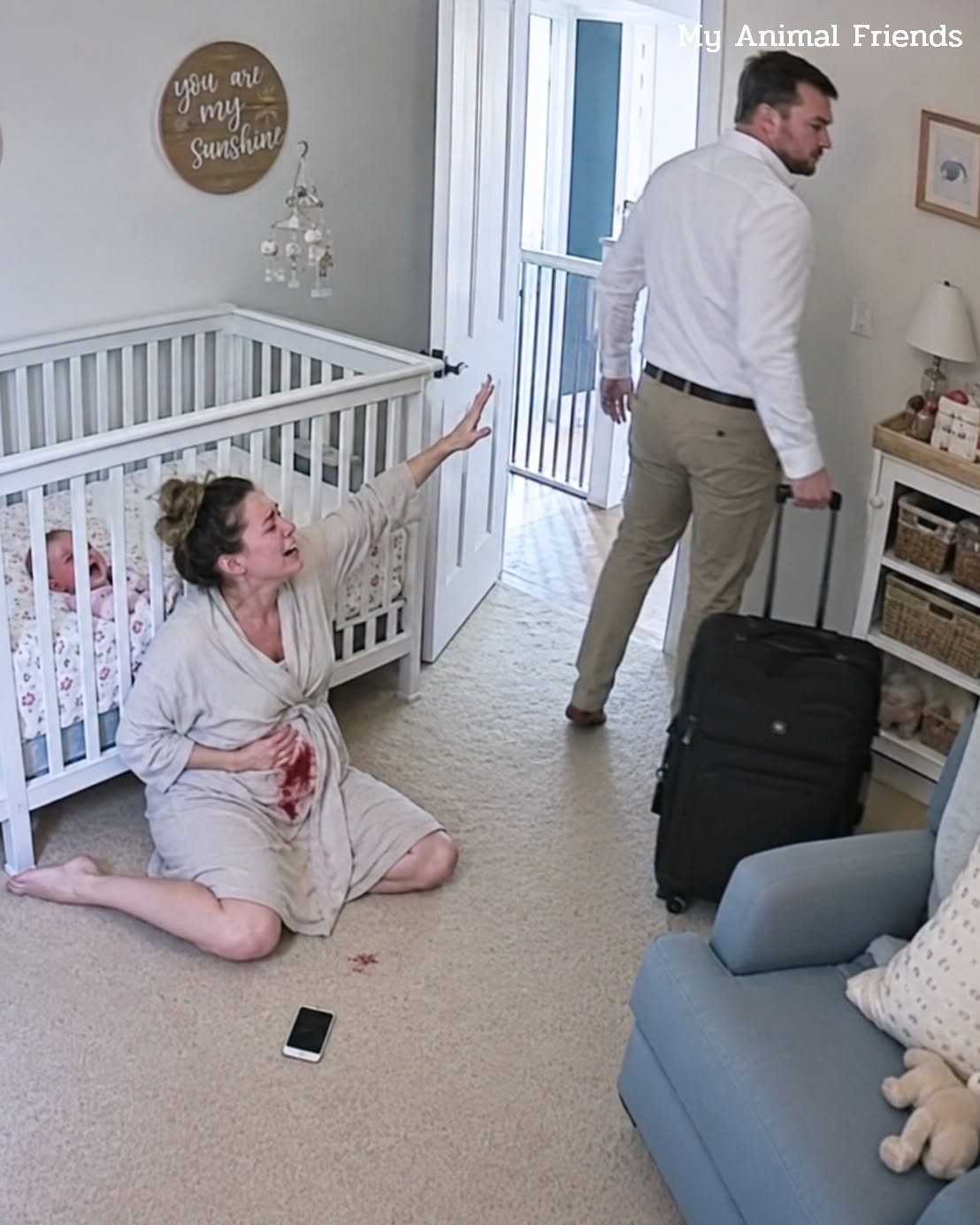
He Left Me Bleeding After Birth for His Birthday Trip—But the Nursery Recording Revealed the Secret He Tried to Hide
The door opened slowly.
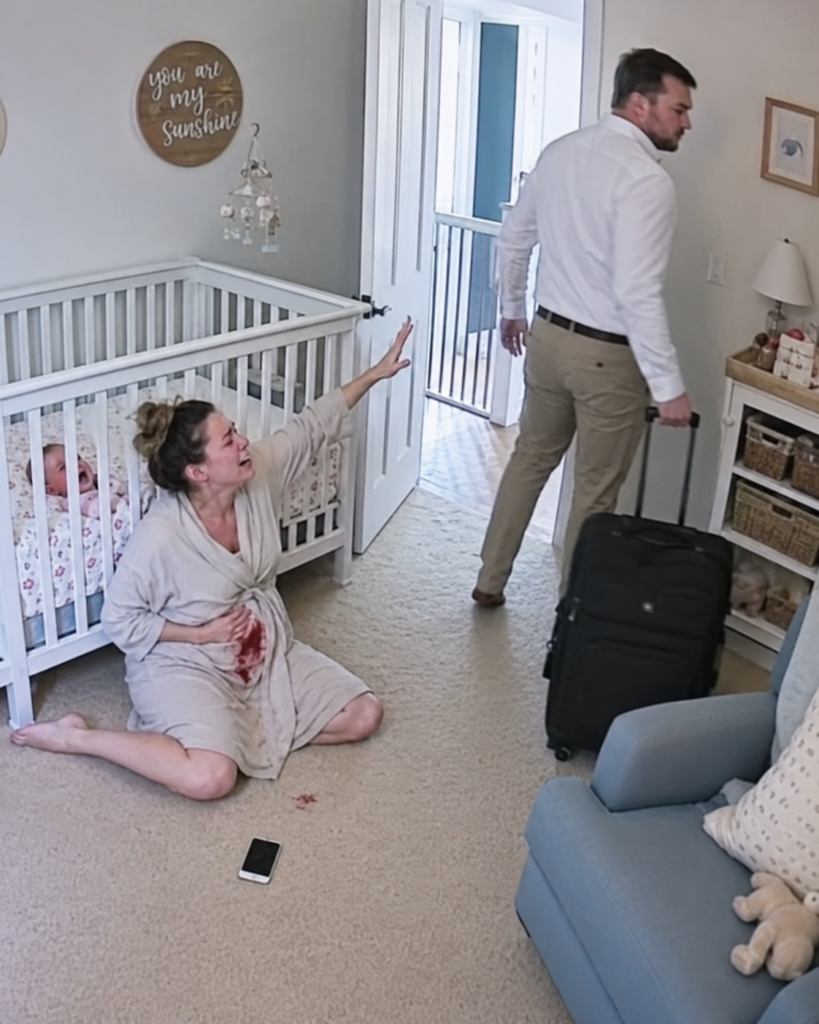
For one terrifying second, I thought Ethan had come back.
A foolish little spark of hope flickered through the darkness pressing at the edges of my vision. Maybe guilt had turned him around. Maybe he had only made it to the end of the street before realizing his wife was on the floor, his newborn son was crying, and no birthday weekend in the mountains could matter more than that.
But the footsteps were too light.
“Emma?”
The voice was female. Familiar. Shaken.
I tried to answer, but my throat had gone dry. My cheek was pressed against the nursery carpet, and all I could see were the legs of Noah’s crib, the tiny blue blanket Ethan’s mother had folded over the rail, and the terrible red stain spreading beneath me.
“Emma!”
Leah Mercer appeared in the doorway with a foil-covered casserole dish in her hands.
Leah lived two houses down, a retired school nurse who had brought muffins when we moved in and knitted Noah a pale yellow hat before he was born. She had never been the kind of neighbor who barged into people’s homes. She was polite to the point of formality, always ringing twice and waiting on the porch.
But now she dropped the casserole dish onto the hallway table with a clatter and rushed into the nursery.
“Oh, honey,” she whispered.
Her voice changed immediately. The softness vanished, replaced by calm, quick command.
“Emma, stay with me. Look at my face.”
I tried.
Her face blurred, came together, blurred again.
“Noah,” I breathed.
“I’ve got him. You hear me? I’ve got him.”
She moved fast, faster than I would have believed possible for a woman in her sixties. One hand pressed clean towels against me while the other reached for my phone on the floor. When the screen didn’t respond to her swipe, she pulled her own phone from her cardigan pocket.
“This is Leah Mercer at 214 Willow Bend Road,” she said, her voice sharp and steady. “I need an ambulance immediately. Young mother, eight days postpartum, heavy bleeding, weakness, possible hemorrhage. Newborn present. Yes, she’s conscious, but fading.”
The word hemorrhage floated above me like something from another life.
I wanted to tell her Ethan said it was normal.
I wanted to tell her he said his mother knew better, that women bled after giving birth, that I was ruining his special day. But all I managed was a small sound that didn’t even feel human.
Leah knelt beside me again.
“Emma, squeeze my fingers.”
I tried. My fingers barely moved.
“That’s good,” she said anyway. “That’s good, sweetheart.”
“Noah,” I said again.
Leah glanced toward the crib. Noah’s cries had become frantic, hiccupping little bursts that tore at me more than the pain did.
“I’m going to pick him up for one second, then I’m right back,” she said. “You keep looking at me.”
She lifted him carefully, holding him close against her shoulder. The moment he felt warmth, his crying softened into broken whimpers.
“He’s all right,” Leah said. “He’s perfect. You did that, Emma. You brought him here, and he is safe.”
Safe.
The word cracked something inside me.
I had been so afraid that my first failure as a mother would be leaving him alone in that room. I had imagined him crying until his tiny voice gave out, imagined Ethan’s mother finding us tomorrow and saying, with that cold disappointed sigh of hers, that I should have handled things better.
But Noah was in Leah’s arms.
He was safe.
Sirens wailed in the distance.
I must have closed my eyes, because Leah’s voice grew louder.
“No, no, no, Emma. Stay with me. Tell me your baby’s name.”
“Noah,” I whispered.
“That’s right. Noah. Beautiful name. Tell me what color his blanket is.”
“Blue.”
“Good. And what day is it?”
I didn’t know.
I knew Ethan was driving toward the Great Smoky Mountains. I knew he had steak reservations and a cabin with a hot tub. I knew there was blood on the carpet and a birthday post online that said ZERO drama.
But I didn’t know what day it was.
The sirens grew louder. Doors slammed. Heavy boots pounded through the house. Strangers filled the nursery, asking questions I couldn’t answer.
“How long has she been bleeding?”
“When did she give birth?”
“Where’s the husband?”
Leah’s silence lasted only a second too long.
“He left,” she said finally. “I don’t know when.”
One of the paramedics leaned closer to me. He had kind eyes and a gray mustache.
“Emma, can you hear me?”
I blinked.
“We’re going to take care of you.”
The ceiling moved above me as they carried me down the hallway. I caught a glimpse of the framed wedding photo Ethan insisted we hang near the front door. In it, he was smiling like a man who had won something. I was laughing at him, my veil caught in the wind, one hand pressed over my heart.
I remembered that moment clearly. I remembered thinking I had never been safer.
Then the front door opened wide, bright afternoon sunlight spilled across my face, and the world disappeared.
When I woke, I was in a hospital room.
Everything was white.
White walls. White sheets. White light. A soft beeping sound marked time somewhere near my left shoulder. My mouth tasted like cotton, and my body felt too heavy to belong to me.
For a moment, panic rushed through me.
“Noah?”
“He’s here.”
My mother’s voice broke on the words.
I turned my head.
Mom sat in a chair beside the bed, her hair loose around her face, mascara smudged beneath both eyes. She was wearing the gardening shirt she used on Saturdays, the one with sunflowers across the pocket. She must have left home without changing.
In her arms was Noah.
He was bundled in a hospital blanket, his tiny face turned toward her chest, his mouth making small searching movements in sleep.
“He’s okay?” I asked.
“He’s perfect.” Mom stood carefully and brought him closer. “Leah rode in the ambulance with him. She wouldn’t let him out of her sight until I got here.”
A sob rose in my throat, but my body was too tired to release it.
“What happened?”
Mom looked toward the door, then back at me.
“You had a postpartum hemorrhage. The doctor said you lost a frightening amount of blood.” Her hand tightened around Noah’s blanket. “They took you into surgery not long after you arrived.”
“Surgery?”
“A procedure,” she corrected gently, though the word did not comfort me. “They found retained tissue. Your body couldn’t stop the bleeding on its own.”
I closed my eyes.
Somewhere in the haze, I remembered bright lights above me. A doctor saying my name. A nurse telling me I was brave. My mother’s voice speaking to someone in the hall, asking why no one had called her sooner.
“Ethan,” I whispered.
Mom’s face changed.
That was when I knew he had not come.
“He knows?” I asked.
“I called him eleven times. Your father called. Leah called from her phone too.” Mom swallowed. “It goes straight to voicemail.”
“He said he was putting it on airplane mode.”
Mom’s jaw tightened, but when she spoke, her voice stayed quiet.
“Did he know how bad it was before he left?”
I looked at Noah.
His tiny hand had escaped the blanket and curled against his cheek. The sight of it filled me with a love so sharp it hurt worse than any incision.
“He saw the blood,” I said. “For a second, he saw it.”
Mom lowered herself back into the chair as if her knees had lost strength.
“He left after that?”
I couldn’t answer.
Not because the truth was unclear, but because saying it out loud made it real in a way the nursery floor had not.
Mom reached for my hand.
“Emma, listen to me. You are alive. Noah is safe. Everything else can wait until you are stronger.”
But everything else did not wait.
By evening, my room had filled with the quiet aftermath of other people’s choices. A social worker came in with a soft voice and kind eyes, asking whether I felt safe at home. A nurse named Daniela checked my vitals every hour and never once treated my tears like an inconvenience. My father stood in the doorway for ten minutes, unable to speak, then finally walked to my bed and kissed my forehead like he had when I was little.
Leah visited after dinner.
She carried Noah’s yellow knitted hat in a plastic hospital bag.
“I washed my hands three times,” she said, trying to smile. “Nurse’s habits die hard.”
“You saved us,” I whispered.
She shook her head. “I was meant to be there.”
“How did you know?” Mom asked. “Emma couldn’t call.”
Leah sat in the chair near the window, folding her hands over her purse.
“I almost didn’t come,” she admitted. “I made a chicken casserole this morning and thought I’d bring it by tomorrow. Then I saw Ethan leave with a suitcase.”
Mom’s eyes hardened.
Leah looked uncomfortable, but continued. “That bothered me. Emma had just had a baby. I thought perhaps he was running an errand, but then I saw his truck turn out toward the highway. A few minutes later, I heard Noah crying.”
“You heard him from your house?” I asked.
She shook her head. “From your porch. I’d already decided to bring the casserole over. When nobody answered, I almost left it by the door. Then I noticed the door wasn’t latched all the way.”
A chill moved through me.
“Ethan slammed it.”
“He must not have pulled it closed properly.” Leah’s expression softened. “I called your name. When I heard the baby, I stepped inside.”
The smallest mistake had saved my life.
Ethan had been so eager to leave me behind that he had not even closed the door.
That night, after my parents went to the cafeteria and Leah went home, I lay awake with Noah sleeping in a clear bassinet beside me. Outside the window, Asheville glowed softly beneath a deep blue sky. Somewhere beyond the mountains, Ethan was probably laughing with his friends, raising a glass to himself, telling everyone he had finally escaped the drama.
My phone sat on the table beside my bed.
Mom had charged it for me.
I did not want to look.
For a long time, I stared at the dark screen as if it were a sealed door. Then I reached for it with trembling fingers.
There were messages from my parents, Leah, two cousins, my college friend Amber, and three women from my prenatal class.
There was nothing from Ethan.
But there were social media notifications.
Against every instinct, I opened them.
His birthday weekend had continued without interruption.
There he was, standing on the deck of a luxury cabin with a mountain view behind him. There he was beside a firepit, holding a tumbler of whiskey. There he was in a group photo with three men I recognized from his office and two women I did not.
The caption read: Thirty starts now. No negativity. No guilt. Just peace.
I stared at the word peace until the letters blurred.
Then, beneath the post, I saw a comment from his mother.
So glad you chose joy today, honey. You deserve it.
I set the phone down before I threw it across the room.
Noah stirred.
His little face scrunched, and he made a soft sound of protest. I reached for him, but pain pulled through me and I gasped.
Daniela appeared almost immediately.
“Let me help,” she said.
She placed Noah carefully in my arms, arranging pillows around me so I could hold him without straining. The warmth of him settled against my chest, and for the first time since the nursery floor, my breathing steadied.
“He knows you,” Daniela said.
“He shouldn’t have had to know this.”
“No,” she said, her voice gentle. “But babies don’t measure love by perfect days. They know who stays.”
I looked down at Noah.
His eyes opened briefly, dark and unfocused, and I had the strangest feeling he was looking directly through the broken parts of me.
“I’ll stay,” I whispered to him. “I promise.”
The next morning, Ethan finally called.
I was half-asleep when the phone buzzed against the bedside table. Mom, who had refused to leave overnight, woke instantly. Her hand moved toward it before mine did.
“It’s him,” she said.
My stomach tightened.
I took the phone.
For one second, I considered letting it ring until it stopped. But some part of me needed to hear his voice. Not because I expected an apology. Maybe because I needed to know whether the man I married still existed somewhere beneath the one who had stepped over me.
“Hello?”
There was noise in the background. Wind. Male laughter. A door closing.
“Emma?” Ethan sounded irritated, not worried. “Why is everyone blowing up my phone?”
I closed my eyes.
“Because I almost died.”
Silence.
Then a short laugh, disbelieving and uneasy.
“Okay, don’t say things like that.”
“I’m in the hospital.”
Another silence.
This one lasted longer.
“What hospital?”
“Mission.”
“What happened?”
I stared at the IV in my hand.
“You know what happened.”
“I know you were upset when I left.”
“I was bleeding on the floor.”
“You said you felt weak,” he replied quickly. “You didn’t say you were dying.”
The room seemed to narrow.
“I begged you to call 911.”
“Emma, I thought you were panicking. You panicked all through the pregnancy.”
Mom rose from her chair, but I held up one hand. I needed to finish this myself.
“The doctors said it was a hemorrhage. Leah found me. She called the ambulance.”
“Leah was in our house?”
“She saved my life.”
He exhaled hard. “Great. So now the whole neighborhood knows our business.”
That was the moment something inside me became very still.
Not healed. Not angry exactly.
Still.
Like a lake freezing over.
“Our business,” I repeated.
“You know what I mean. People exaggerate things. My mom already got a weird call from your mother.”
“My mother thought she was going to lose her daughter.”
“I didn’t know that.”
“No,” I said. “You made sure you didn’t know.”
His voice dropped. “I’m not doing this over the phone.”
“Then come home.”
“I can’t just leave. People are here.”
I looked at Noah sleeping beside me.
“Your son is here.”
He said nothing.
For the first time, I wondered whether silence had always been Ethan’s truest answer, and I had spent years decorating it with excuses.
“I’ll drive back tomorrow morning,” he said finally. “Try not to make decisions while you’re emotional.”
I ended the call.
Mom came to the bed and took the phone from my hand.
For a long moment, neither of us spoke.
Then she said, “There it is.”
“What?”
“The answer you were still hoping would be different.”
I turned my face toward the window.
Outside, clouds moved slowly over the mountains. I had loved these mountains all my life. As a child, I thought they looked like sleeping giants, ancient and kind, protecting everyone beneath them. But that morning they looked distant, unmoved by all the small human heartbreak unfolding below.
“I don’t know what happens now,” I admitted.
Mom brushed my hair away from my face.
“You don’t have to know everything today.”
But by that afternoon, the first hidden piece surfaced.
It came from Leah.
She returned with a small tote bag of things from the house: clean clothes, my toothbrush, Noah’s pacifier, the soft gray robe I had worn through the last weeks of pregnancy. Mom unpacked it while Leah hovered near the door.
“Emma,” Leah said carefully, “there’s something else.”
The way she said it made my skin prickle.
“What?”
She looked at Mom, then back at me.
“When I went back this morning to lock your house, I noticed the nursery camera was still on.”
I frowned. “The baby monitor?”
“Yes. The one above the bookshelf.”
Ethan had installed it two weeks before Noah was born, proud of himself for buying the most expensive model. It connected to an app and saved motion-triggered clips to the cloud. I had barely used it because Noah had been sleeping in our room.
Leah opened her purse and pulled out a folded piece of paper.
“I don’t have access to your account,” she said. “But the tablet in the nursery was still logged in. I only looked because I wanted to make sure there wasn’t anything private left running. The camera recorded part of what happened.”
My mouth went dry.
“How much?”
Leah’s eyes filled with sadness.
“Enough.”
Mom took the paper from her. On it, Leah had written down the support number for the camera company and the steps to save the clips.
“I didn’t watch more than a few seconds,” Leah said. “It didn’t feel right. But I heard him say something about not calling an ambulance.”
Mom’s face went pale with fury.
I stared down at the blanket.
In my mind, Ethan’s voice returned clearly.
An ambulance? So everyone can blame me for leaving? Absolutely not.
He had not misunderstood.
He had not been confused.
He had known exactly what calling for help would mean.
It would mean witnesses. Questions. Responsibility.
The truth had been sitting in the nursery all along, quietly recording from the shelf.
I should have felt relieved.
Instead, I felt hollow.
Proof did not make betrayal easier. It only removed the last soft place where denial could hide.
That evening, my father helped me save the footage. We did it quietly, with the door closed, while Mom held Noah in the hall. The clip was shaky at first, triggered by movement near the crib. It showed me sitting on the floor, pale and frightened. It showed Ethan standing near the closet, dressed for his trip.
I watched only once.
That was enough.
When his voice came through the tablet speaker, my father turned away and pressed his hand over his mouth.
Please. I need a hospital.
Everything is always an emergency with you.
Call 911. Call anyone.
An ambulance? So everyone can blame me for leaving? Absolutely not.
Then the worst part.
Ethan looking down.
Seeing the blood.
Stepping around me.
My father closed the tablet with trembling hands.
“Save three copies,” he said.
His voice sounded unlike him. Older. Rougher.
“I already did,” I whispered.
The footage changed things, but not in the dramatic way people imagine. There was no sudden courtroom, no crowd gasping, no instant justice. Real life moved slower. Forms had to be filled out. Doctors had to release me. A social worker had to discuss safety plans, resources, and what support I had at home. My body still ached. Noah still needed feeding every few hours. The world did not pause just because my marriage had cracked open.
But something had shifted.
For years, Ethan had been able to explain things away because he was charming in public and measured in conflict. He never yelled where others could hear. He never made scenes. He specialized in making me sound fragile.
Emma worries too much.
Emma gets overwhelmed.
Emma takes things personally.
Emma is dramatic.
The recording did not shout.
It simply existed.
And that was why it mattered.
On the third day, Ethan came to the hospital.
He arrived carrying flowers from the gift shop, still wearing the expensive watch from his birthday post. His beard was neatly trimmed, his shirt freshly pressed, and his eyes swept the room before they landed on me. He was assessing the situation. Who was present. What they knew. How much control he had left.
Mom stood by the window with Noah in her arms.
Dad sat beside my bed.
Leah had just left.
Ethan’s smile appeared cautiously.
“Hey,” he said. “How are you feeling?”
No one answered.
He set the flowers on the table.
“Emma?”
I looked at him for a long moment.
He seemed almost offended by my silence, as if he had expected me to be grateful he had arrived.
“You came,” I said.
“Of course I came.” He glanced at my parents. “I came as soon as I could.”
Dad’s chair scraped softly against the floor as he stood.
“As soon as you could?” Dad repeated.
Ethan’s expression tightened. “I know everyone is upset.”
“Upset is when someone forgets a birthday card,” Dad said. “This is something else.”
Mom shifted Noah gently against her shoulder.
Ethan looked at the baby, and for the first time since he entered the room, his face softened. It was small, almost involuntary, but it was there.
“Can I hold him?”
The room went silent.
I thought I would say no immediately. I thought the word would leap from me. But when I looked at Noah, I realized my anger at Ethan and Noah’s need for a father were two different griefs tangled together.
“Not right now,” I said.
Ethan’s soft expression vanished.
“Emma, don’t start using him to punish me.”
Dad stepped forward, but I spoke first.
“I’m not punishing you. I’m recovering from surgery after you left me without help. I need space.”
His gaze flicked toward the door.
“Can we talk alone?”
“No.”
The word surprised even me with its firmness.
Ethan inhaled.
“Fine. Then I’ll say it here. I’m sorry you got scared. I’m sorry I didn’t understand how serious it was. But you have to admit, you’ve had a lot of anxiety lately, and I thought—”
“I have the recording.”
He stopped.
Every part of him stopped.
His eyes locked on mine.
“What recording?”
“The nursery camera.”
A tiny muscle moved in his jaw.
Mom turned away from the window, holding Noah closer.
“It recorded you refusing to call an ambulance,” I said. “It recorded you seeing the blood. It recorded you leaving.”
Ethan’s face lost color slowly, like water draining from a sink.
“That camera doesn’t capture everything,” he said.
“It captured enough.”
“You’re taking it out of context.”
Dad made a sound of disbelief.
Ethan held up a hand. “I’m not saying it looks good. I’m saying people panic. I panicked too.”
“You didn’t panic,” I said. “You packed.”
His eyes sharpened.
For a second, I saw the calculation return. The flowers. The softened voice. The careful apology. None of it had worked the way he expected.
He looked at my mother.
“Grace, you know how Emma gets. She can spiral.”
Mom’s face remained calm, but her voice was ice.
“My daughter almost bled to death while you drove to a cabin.”
Ethan looked toward my father next, but Dad did not give him an opening.
Finally, Ethan looked back at me.
“What do you want?”
It was such a strange question.
Three days earlier, I would have had a thousand answers. I wanted him to be sorry. I wanted him to understand. I wanted him to choose us. I wanted the man from our wedding photo to step back out of memory and stand in front of me again.
Now, exhausted and aching, with my son sleeping across the room, I realized I wanted something much simpler.
“The truth,” I said.
He blinked.
“About what?”
“The trip.”
His face changed before he could stop it.
It was quick. A tightening around the eyes. A small shift of his shoulders.
But I saw it.
So did Mom.
“What about the trip?” he asked.
“You said all your friends were already on their way.”
“They were.”
“Who were the women in the photos?”
He gave a short laugh. “Are we really doing this now?”
“Yes.”
“They’re friends of friends.”
“Names?”
“Emma.”
“Names, Ethan.”
He looked toward the hallway, then lowered his voice.
“You’re in a hospital bed accusing me of cheating because you saw women in a group photo?”
“I asked for names.”
He rubbed his forehead.
“One was Megan. The other was Tara. I don’t know them well.”
It might have ended there if his phone had not buzzed.
He glanced down automatically.
I saw the screen light up in his hand.
A message preview appeared before he turned it away.
Ava: Did you tell her yet?
The room became completely still.
Ethan locked the screen.
Too late.
Mom had seen it.
Dad had seen it.
And I had seen it.
“Who is Ava?” I asked.
Ethan’s mouth opened, then closed.
For the first time since I had known him, he had no polished answer ready.
“It’s not what you think,” he said finally.
I almost laughed. Not because it was funny, but because the phrase was so ordinary, so disappointingly small. People said it in movies. People said it in cheap arguments. I had never expected to hear it from the man standing beside my hospital bed while our newborn slept a few feet away.
“What haven’t you told me?” I asked.
Ethan looked at my parents.
“I’m not discussing this with an audience.”
“You didn’t mind leaving me with one,” I said quietly. “The camera.”
His eyes flashed.
Then he leaned closer, voice low.
“Be careful with that recording, Emma. Once people see things, they can’t unsee them.”
It was not a threat. Not exactly.
It sounded more like fear wearing the wrong coat.
“What does Ava know?” I asked.
He straightened.
“I’m leaving. We’ll talk when you’re thinking clearly.”
He walked out without touching the flowers.
Mom immediately handed Noah to Dad and followed Ethan into the hall. I heard her call his name once. He did not answer.
A minute later, she returned, holding something in her hand.
“What is it?” I asked.
She looked stunned.
“He dropped this.”
It was a folded receipt.
Not from a steakhouse.
Not from a gas station.
From a jewelry store in Gatlinburg.
The purchase was dated the morning of his birthday.
A white-gold necklace.
Engraving included.
My fingers tightened around the sheet.
At the bottom, beneath the item number and price, was the inscription.
For Ava—our new beginning starts now.
For a while, no one spoke.
The words seemed to sit in the hospital room like another person.
Our new beginning.
While I was on the nursery floor.
While Noah cried.
While my mother was racing to the hospital not knowing if I would survive.
Ethan had been buying another woman jewelry.
But even then, the receipt was not the twist that kept me awake that night.
That came just after midnight.
Noah had finally settled after a feeding. Mom was asleep in the chair, one hand tucked beneath her cheek. Dad had gone home to shower and check the locks at my house. The room was dim, lit only by the soft glow near the door and the steady green line of the monitor beside me.
My phone buzzed.
I expected Ethan.
Instead, the number was unknown.
I should have ignored it.
But something in me already knew the weekend had more secrets left inside it.
I answered quietly.
“Hello?”
For a moment, there was only breathing.
Then a woman’s voice said, “Emma Walker?”
My heart began to pound.
“Yes.”
“My name is Ava Bennett.”
I sat up too quickly and pain pulled through my abdomen.
Ava heard me gasp.
“I’m sorry,” she said. “I know you probably don’t want to hear from me, but I didn’t know where else to turn.”
My mouth went dry.
“What do you want?”
“I need to tell you something before Ethan gets there.”
“Gets where?”
There was a pause.
Then she whispered, “Your house.”
A cold wave moved through me.
“He’s going to my house?”
“He left the cabin an hour ago. He was furious. He said he had to get something from the nursery before anyone else found it.”
I looked across the room at Noah, sleeping peacefully in his bassinet.
“What thing?” I asked.
Ava’s voice trembled.
“I don’t know. But Emma… he told me there was a box hidden behind the bookshelf. He said if you ever found it, everything would be over.”
PART 3
For several seconds, I could not speak.
The hospital room had been quiet only a moment ago, softened by the steady breathing of my mother asleep in the chair and the faint beeping of the machine beside my bed. Now every sound seemed too loud. My heartbeat. The whisper of hospital air through the vents. Noah’s tiny sigh from the bassinet.
Ava Bennett’s voice trembled through the phone.
“Emma? Are you still there?”
My hand tightened around the phone until my fingers ached.
“What box?” I whispered.
“I don’t know,” Ava said. “I swear I don’t know. He only mentioned it once, weeks ago. He was upset about something and said if you ever started asking questions, there was something in the nursery that could ruin everything.”
The nursery.
Noah’s nursery.
The room where I had nearly died. The room Ethan had stepped around me to leave. The room where a camera had quietly captured the truth.
I turned my head toward my sleeping son. Noah’s cheeks were round and peaceful, his little mouth open slightly. He knew nothing about receipts, secrets, or hidden boxes. His whole world was warmth, milk, blankets, and the arms that held him.
I wanted to keep it that way.
“Why are you telling me this?” I asked.
Ava drew in a shaky breath. “Because I didn’t know about you.”
The words landed strangely. Not like an excuse. More like a confession she had practiced and still hated saying.
“You didn’t know he was married?”
“I knew he had been married,” she said quietly. “That’s what he told me. He said you were separated. He said the baby made things complicated, but you both knew the marriage was over.”
My throat tightened.
Of course he had said that. It sounded so much like Ethan—careful enough to be believable, vague enough to avoid proof.
“He told me you were staying in the house because of the pregnancy,” Ava continued. “He said he didn’t want to stress you before the birth. I believed him.”
“And the necklace?” I asked.
Silence.
Then she said, “He gave it to me Saturday morning.”
I closed my eyes.
“Did he tell you where I was?”
“He said you were with your mother.” Her voice broke. “Emma, I’m so sorry. I saw his post, and something felt wrong. Then he got a call and changed completely. He said you were trying to embarrass him. Later, I heard him talking about the camera.”
I sat up a little straighter despite the pulling pain in my abdomen.
“What did he say about it?”
“That he needed to get home before you gave the footage to anyone. Then he said there was something behind the bookshelf. He thought I was asleep.”
Behind the bookshelf.
The bookshelf Ethan had insisted on assembling himself, even though my father offered to help. The bookshelf he had positioned beneath the nursery camera. The one he moved three times before deciding it was “finally right.”
My mouth went dry.
“Ava, listen carefully,” I said. “Do you know where he is now?”
“He left the cabin around eleven. He was driving fast. He wouldn’t let anyone go with him.”
From Gatlinburg to Asheville.
My mind began sorting time and distance before fear swallowed me whole. He could be close. Maybe already in North Carolina. Maybe already turning onto Willow Bend Road, furious and desperate, walking into the quiet house where the cream-colored nursery carpet still carried the stain Leah had not known how to clean.
“I’m calling my dad,” I said.
“Emma?”
“Yes?”
Ava’s voice lowered. “There’s one more thing.”
I froze.
“What?”
“He wasn’t alone in the secret. Someone called him tonight. A woman. He saved the number under ‘M.’ He told her, ‘Emma knows too much.’ Then he said, ‘You promised this would stay buried.’”
A coldness spread through me that had nothing to do with the hospital room.
M.
Not Megan. Not Tara.
My mind went somewhere I did not want it to go.
Marilyn.
Ethan’s mother.
I ended the call with Ava and immediately called my father.
He answered on the first ring.
“Emma?”
“Dad,” I whispered, “don’t go inside the house.”
He was quiet for half a beat.
“Why?”
“Ethan may be headed there.”
I heard movement on the other end. A door closing. The jingle of keys.
“I’m five minutes away.”
“Dad, don’t confront him. Please. Just call the police.”
“I’m not confronting anyone,” he said, though his voice had changed in a way that made me sit up straighter. “I’m pulling over right now.”
I heard the click of a turn signal.
“Promise me.”
“I promise,” he said. “I’m calling them. You wake your mother.”
Mom was already awake.
She had lifted her head from the chair, eyes wide, one hand gripping the armrest as if she had been listening from inside a dream.
“What happened?” she asked.
I could not soften it. Not anymore.
“Ethan’s going to the house. There’s something hidden in the nursery.”
Mom stood so quickly the blanket slipped from her lap.
“What?”
“I don’t know. Ava called. She said Ethan mentioned a box behind the bookshelf.”
At Ava’s name, Mom’s face shifted with the pain of someone absorbing yet another piece of an already unbearable puzzle. But she did not ask the questions I expected. She did not waste time on the necklace or the lie or the weekend.
She looked at Noah.
Then at me.
“Okay,” she said, voice steady. “We handle what’s in front of us.”
It was something she used to say when I was small and overwhelmed by school projects, storms, or scraped knees. We handle what’s in front of us. One thing at a time.
She pressed the call button for the nurse.
Within minutes, Daniela entered, her expression calm but alert.
Mom explained quickly. Ethan might be headed to our house. We were concerned about safety. There might be evidence connected to the incident.
Daniela did not hesitate.
“I’ll notify hospital security and the charge nurse,” she said. “No visitors without your approval. I’ll also ask social work to come first thing in the morning.”
“Can he come here?” I asked.
Daniela’s eyes softened.
“We’ll make sure he doesn’t enter this room unless you say so.”
The words loosened something in my chest.
For the first time since the nursery floor, someone was not waiting for Ethan’s version of events. They were responding to mine.
Mom moved to the bassinet and laid a hand lightly over Noah’s blanket.
“He’s safe,” she said, almost to herself.
But I could see fear in the way she watched the door.
Forty minutes later, my father called back.
He sounded breathless but unharmed.
“I’m with an officer outside your house,” he said. “Ethan isn’t here.”
“Did you go inside?”
“No. The front door was locked. The officer checked the perimeter. No sign of forced entry.”
I closed my eyes, relief and dread tangling together.
“He may still be coming.”
“We’ll wait nearby,” Dad said. “The officer said they can’t search for the box without permission, but since it’s your house and you’re asking, I can go in with them if you authorize it.”
I looked at Mom.
She nodded.
“Tell them yes,” I said. “But Dad?”
“I know,” he said gently. “I won’t touch anything alone.”
After the call ended, the room settled into a tense quiet. Mom sat beside me, holding my hand. Noah slept through everything, his tiny chest rising and falling as if the whole world had not tilted around him.
“What do you think is in the box?” I asked.
Mom’s thumb brushed over my knuckles.
“I don’t know.”
But her eyes said she feared the same thing I did—that whatever Ethan had hidden was not only about the affair.
It was about Noah.
The thought frightened me so much I could barely breathe.
I had carried my son beneath my heart for nine months. I had counted his kicks, sung to him in the car, whispered his name before Ethan had agreed to it. Whatever Ethan had done, whatever he had hidden, Noah was mine in a way no secret could change.
Still, secrets had weight.
And the one behind the bookshelf seemed heavy enough to pull all of us toward it.
My father called again near two in the morning.
This time, his voice was different.
Not panicked.
Not relieved.
Careful.
“Emma,” he said, “we found it.”
Mom leaned close to the phone.
“What is it?” I asked.
“It was behind the nursery bookshelf, just like she said. A small wooden box. Locked.”
“Did you open it?”
“The officer said not to force it. He photographed it where it was, then collected it. Since you gave permission, they’re logging it for safekeeping until you can identify it.”
My frustration flared.
“So we still don’t know?”
“Not yet.”
“Was there anything else?”
A pause.
“Dad?”
“There was an envelope taped to the back of the shelf.”
My breath caught.
“What envelope?”
“It had your name on it.”
Mom’s hand tightened around mine.
“Open it,” I whispered.
“Emma, maybe you should rest until morning.”
“No. Please.”
I heard paper rustling.
Then my father went silent.
“Dad?”
His voice was lower when he spoke again.
“It’s a letter.”
“From Ethan?”
“No.”
The room seemed to tilt.
“From who?”
He swallowed audibly.
“From his father.”
Ethan’s father had died before I met him.
At least, that was the story I knew.
Richard Walker had been described to me in fragments: a quiet man, a hard worker, a heart attack at fifty-two. Ethan rarely talked about him. Marilyn, Ethan’s mother, turned every mention of him into a shrine to sacrifice and disappointment.
Your father would have expected more.
Your father never ran from responsibility.
Your father knew family came first.
I had heard those lines so many times they had become part of the wallpaper of Ethan’s childhood.
“What does it say?” I asked.
Dad hesitated.
“I’m going to read only the first part. The rest may be… personal.”
“Please.”
He unfolded the paper.
His voice grew soft as he read.
“Emma, if this letter has reached you, then my son has repeated a pattern I prayed would end with me.”
A chill passed through the room.
Mom covered her mouth.
Dad continued.
“I do not know whether Ethan will ever tell you the truth about our family, so I am leaving this where only someone caring for a child might eventually find it. I have made mistakes. I stayed silent when I should have spoken. But there are documents in the box that belong in the hands of the woman who marries my son, especially if there is a baby.”
Dad stopped.
My heart pounded so hard the monitor beside me changed rhythm.
“What else?”
“He mentions Marilyn,” Dad said.
Mom’s eyes sharpened.
“What about her?”
Dad exhaled.
“The letter says, ‘Marilyn has spent years protecting the family name, but what she calls protection has often been control.’”
I lay back against the pillow.
The hospital ceiling blurred.
Family name. Control. Documents. Pattern.
The words circled me slowly, like birds waiting for a storm.
“What does that mean?” I whispered.
Dad’s voice turned gentle.
“I don’t know yet. The officer wants to keep the letter with the box for now. But I took photos with permission because it had your name on it. I’ll bring copies to the hospital in the morning.”
Before I could answer, Mom’s phone rang.
She looked at the screen and went still.
“It’s Marilyn.”
A silence fell so complete I could hear Noah breathing.
Mom did not answer.
The phone rang until it stopped.
Then a message appeared.
Mom read it aloud, her voice flat.
Tell Emma to stop digging through things she doesn’t understand. That box has nothing to do with her.
My skin prickled.
“She knows,” I said.
Mom looked at me.
“She knows they found it.”
No one spoke for a long moment.
Then Dad’s voice came through my phone, quiet and grim.
“Lock down the visitor list.”
By morning, I felt as if I had lived an entire lifetime between midnight and sunrise.
The hospital room brightened slowly, turning pale blue before gold touched the edge of the window. Nurses changed shifts. A cart rattled down the hallway. Somewhere nearby, a baby cried and was soothed by a tired voice humming off-key.
Normal life kept happening.
That was the strangest part.
Even when your world cracked open, coffee was poured. Floors were mopped. People asked if you wanted oatmeal or toast. Babies needed diapers. The sun rose because it had no reason not to.
Noah woke hungry, rooting against the blanket with impatient little sounds. Mom helped position him in my arms. My body still hurt, but holding him steadied me.
“You have a very dramatic family, little man,” I whispered.
Mom gave a tired laugh. It was the first real laugh I had heard from her in days.
Noah blinked up at me, unimpressed.
“He says he’d like breakfast before family secrets,” Mom said.
For a few minutes, the room felt almost warm.
No Ethan. No Marilyn. No wooden box.
Just my mother smoothing a blanket over my knees, my son making tiny swallowing sounds, and morning light spilling across the hospital floor.
Then social worker Patricia arrived.
She was a calm woman with silver-streaked hair and a clipboard she barely looked at. She spoke to me like I was a person first and a case second, which I appreciated more than I could explain.
We talked about safety. About temporary arrangements. About whether I wanted Ethan restricted from visiting. About legal resources, counseling referrals, and documenting everything.
“I don’t want this to become a circus,” I said.
“It doesn’t have to,” Patricia replied. “Protecting yourself and your child is not the same as creating drama.”
The phrase lodged inside me.
For years, Ethan had made me afraid of that word. Drama. As if any emotion that inconvenienced him became performance. As if asking for care was the same as demanding a stage.
Patricia wrote something down, then looked at me.
“Where will you go when you’re discharged?”
“My parents’ house,” I said.
Mom nodded immediately.
“Our guest room is ready. The crib from my sister is still in the garage. We’ll set it up.”
I looked at her.
“You don’t have to reorganize your whole life.”
She leaned forward and tucked Noah’s blanket under his chin.
“Emma, you are my whole life. You and this little boy. The furniture can move.”
Something inside me gave way.
Not violently. Not like the breaking of the last few days.
More like a door opening.
I cried then, quietly, Noah warm against me and my mother’s hand on my shoulder. For the first time, the tears were not only from fear. They were from relief. From exhaustion. From the strange ache of being loved without needing to earn it.
Later that morning, Dad arrived with coffee, fresh clothes, and a folder.
He looked tired but steadier than he had sounded on the phone. He kissed Mom’s cheek, then mine, then stood over Noah’s bassinet with the solemn expression of a man greeting royalty.
“Good morning, Mr. Noah,” he said. “You caused quite a stir.”
Noah sneezed.
Dad nodded. “Strong argument.”
Despite everything, I smiled.
Then Dad set the folder on the rolling table beside my bed.
“The officer let me photograph the letter. The box is still with them. They’re waiting to speak with you and possibly an attorney before opening it.”
“Did Ethan come to the house?” Mom asked.
Dad shook his head.
“No. But there were tire marks near the curb when we left. Could have been anyone.”
“Or he saw the police and kept driving,” I said.
Dad did not disagree.
He opened the folder and handed me the printed photos.
The letter was written in neat, careful handwriting on yellowed paper. At the top was my name.
Emma.
Not Mrs. Walker. Not Ethan’s wife.
Emma.
The first lines were exactly as Dad had read them. But seeing them made my chest tighten.
If this letter has reached you, then my son has repeated a pattern I prayed would end with me.
I read slowly, my eyes catching on phrases that seemed ordinary until they weren’t.
Marilyn believes love is proven through loyalty, even when loyalty requires silence.
Ethan learned too young that charm can smooth over what truth would shatter.
There are records in the box—bank papers, medical notes, and letters. I kept copies because I feared they might vanish.
If there is a child, please understand this: none of this is the child’s burden.
I stopped there.
The words blurred.
None of this is the child’s burden.
Mom sat beside me, reading over my shoulder.
“What records?” she whispered.
Dad turned another page.
“There’s more.”
The second page was shorter.
Emma, I do not know you yet. Perhaps I never will. But if you are reading this, then you are likely standing in a place where someone has made you question your own judgment. Trust what you saw. Trust what you heard. Trust the part of you that knows when something is wrong.
I pressed the page to my chest.
Trust what you saw.
Ethan had made doubt feel like a room I lived in. He decorated it with apologies that weren’t apologies, explanations that looped back on me, and smiles that made other people comfortable. Over time, I had learned to question my own instincts before I questioned him.
But Richard Walker, a man I had never met, had left me words from another decade, and somehow they reached me exactly when I needed them.
“I wish I had known him,” I said.
Dad looked toward the window.
“Maybe now you will.”
That afternoon, Ethan tried to get into the hospital.
He made it as far as the nurses’ station.
I did not see him, but I heard his voice down the hall—controlled, clipped, familiar.
“I’m her husband.”
Daniela’s voice answered calmly.
“She is not accepting visitors.”
“She’s confused. She just had surgery.”
“She is alert, oriented, and has made her wishes clear.”
“You can’t keep me from my family.”
Hospital security arrived before his voice rose too far. I heard a lower male voice, then footsteps moving away. A minute later, Daniela came in, expression composed.
“He left the unit.”
Mom let out the breath she had been holding.
I looked down at my hands.
Part of me shook. Part of me wanted to apologize to everyone for the trouble. That old instinct rose automatically, trained by years of smoothing over Ethan’s reactions.
Then Noah made a small sound in his sleep, and the instinct faded.
I was not responsible for making Ethan comfortable anymore.
That evening, Ava came to the hospital.
I almost refused to see her.
When Daniela told me a woman named Ava Bennett was asking at the desk, my first reaction was a sharp no that formed in my mouth before I thought. But then I remembered her voice at midnight. Frightened. Ashamed. Trying to warn me.
Mom looked at me.
“You don’t owe her anything.”
“I know,” I said.
But maybe I owed myself the truth.
Ava entered quietly, carrying no flowers, no gifts, no performance of apology. She was younger than I expected, maybe twenty-seven, with brown hair pulled back in a loose braid and tired eyes that had clearly spent the night crying.
She stopped near the door.
“Thank you for seeing me.”
I nodded toward the chair, though I was not ready to call it kindness.
Ava sat, hands clasped tightly in her lap.
For a moment, neither of us spoke.
Then she said, “I ended it.”
The words did not hit the way I expected. I felt no triumph. No satisfaction. Only a weary sadness that this stranger and I had both been handed different pages of the same lie.
“How long?” I asked.
“Four months.”
I looked away.
Four months.
While I was six months pregnant. Seven. Eight. While I folded baby clothes and asked Ethan whether he liked the name Noah. While he came home late and said work was impossible.
Ava’s voice trembled.
“He told me you had moved into the guest room. He said the marriage had been over for a year.”
“That wasn’t true.”
“I know that now.” Her eyes filled. “I should have asked more questions. I wanted to believe him.”
There it was.
Not innocence. Not blame.
A human mistake.
I could understand that more than I wanted to.
“What did he tell you about the box?” Mom asked from beside the window.
Ava looked at her respectfully.
“Almost nothing. Only that his mother had helped him hide it years ago. He said it was family paperwork and that Emma wouldn’t understand.”
“Years ago?” I repeated.
Ava nodded.
“He said it was hidden before the nursery was a nursery. Maybe when you first moved in.”
I stared at her.
We had turned that room into a nursery only three months ago. Before that, it had been Ethan’s office. His private space. The one room where he kept the door closed because he claimed he needed quiet for work calls.
“What else did he say?” I asked.
Ava reached into her purse and pulled out a small envelope.
“He left this in my bag. I found it after he drove away.”
She handed it to me.
Inside was a single key.
Small. Brass. Unmarked.
My breath caught.
“The box,” Mom whispered.
Ava nodded.
“I think so.”
The police opened the box the next day with my permission and the key Ava had brought.
I was not there. I was still in the hospital, still weak, still learning how to stand without dizziness. But Dad went with an officer, and Patricia helped arrange for copies of anything legally mine to be provided later.
Hours passed.
Slow, heavy hours.
Ethan did not call.
Marilyn did.
I did not answer.
She left one voicemail, which Mom listened to first. Her face hardened halfway through, and she deleted it before I could ask.
“What did she say?” I asked.
“Nothing you need in your recovery room.”
“Mom.”
She sat beside me.
“She said the box contained private family pain and that opening it would harm Noah someday.”
I looked at my son, sleeping with one fist raised beside his face.
“No,” I said softly. “Secrets harm children. Truth can be handled gently.”
Mom’s expression softened with pride.
“That’s right.”
When Dad finally returned, he looked changed.
Not shocked exactly.
Moved.
He carried a fresh folder and sat down slowly.
“The box had documents,” he said. “Old bank statements. Letters. A copy of Richard’s death certificate.”
“Why would that matter?” I asked.
Dad opened the folder.
“Because Richard Walker didn’t die when Ethan was a teenager.”
I stared at him.
“What?”
“He died five years ago.”
The room went silent.
Five years ago, Ethan and I had already been engaged.
Five years ago, Marilyn had cried at our rehearsal dinner telling me how much Richard would have loved to see his son marry.
Five years ago, Ethan had held my hand in a cemetery in front of a grave that already had his father’s name carved into stone.
“I don’t understand,” I said.
Dad’s voice was gentle.
“Richard left the family when Ethan was young. Or was forced out. It’s not completely clear yet. Marilyn told people he died, and Ethan went along with it.”
My stomach turned.
“He let me believe his father was dead.”
Dad nodded.
“There are letters Richard wrote to Ethan over the years. Most were returned unopened. Some were kept. He tried to reconnect.”
“Why hide that from me?”
Mom looked at the letter on my lap.
“Because Richard knew things Marilyn and Ethan didn’t want known.”
Dad handed me a photocopy.
It was another letter, this one addressed to Ethan.
Son, I will not force my way into your life, but I will not keep pretending the story your mother tells is true. I made mistakes, but I did not abandon you. I signed what I signed because Marilyn said it was the only way to protect you from scandal. I was wrong to believe her.
Scandal.
Protection.
Control.
The same words again, circling back.
“There’s something else,” Dad said.
I braced myself.
“The bank records show an account in Noah’s name.”
My eyes flew to his.
“Noah?”
“Opened before he was born.”
“That’s impossible.”
“Not impossible,” Dad said quietly. “Just unusual.”
Mom took the paper from him.
“Who opened it?”
Dad looked at me.
“Marilyn.”
A strange buzzing filled my ears.
“She opened a bank account for my baby?”
“Using documents Ethan provided,” Dad said. “There are forms, but some information appears incomplete. The officer said it may be nothing illegal. It may be a college fund. But Richard’s letters suggest Marilyn has used money to control family decisions before.”
I leaned back, suddenly exhausted.
The emotional conflict I had carried for days had been Ethan. His leaving. His lies. His betrayal. But now the story had widened. It was no longer only about a husband who failed me. It was about a family system built on silence, polished until outsiders mistook it for dignity.
And Noah had been born directly into the center of it.
That night, after Dad left and Mom stepped out to call my aunt, I sat alone with Noah in my arms.
The window reflected us faintly. A pale woman in a hospital bed. A newborn wrapped in blue. Machines. Flowers Ethan had brought and no one had touched.
I looked at my son and thought about Richard’s line.
None of this is the child’s burden.
“You hear that?” I whispered. “None of it is yours.”
Noah yawned, tiny and perfect.
“I can’t promise I’ll always know what I’m doing,” I said. “But I promise you won’t grow up inside secrets just because grown-ups are afraid of the truth.”
A soft knock sounded at the door.
I looked up, expecting Mom.
Instead, Patricia stepped in.
“There’s someone asking to speak with you,” she said. “Not Ethan. Not Marilyn.”
“Who?”
Patricia’s expression was unreadable.
“A man named Samuel Reed. He says he was Richard Walker’s attorney.”
My pulse quickened.
“Richard’s attorney?”
She nodded.
“He says he saw a notice connected to the police report and came as soon as he heard your name.”
“My name?”
“He said Richard left instructions for him.” Patricia hesitated. “Instructions that were to be followed only if Ethan’s wife ever found the nursery box.”
Mom returned just then and stopped in the doorway.
“What instructions?” she asked.
Patricia looked at me.
“Mr. Reed says he has a sealed letter for Emma and proof that Richard Walker left something in trust.”
“For Ethan?” I asked.
Patricia shook her head slowly.
“No,” she said. “For your child.”
Noah shifted in my arms, and his tiny fingers curled around the edge of my hospital gown.
The air seemed to leave the room.
Before anyone could speak, my phone buzzed on the bedside table.
A new message.
Not from Ethan.
Not from Marilyn.
From an unknown number.
There was a photo attached.
My hand shook as I opened it.
The image showed the back of Noah’s nursery bookshelf, pulled away from the wall. Dust marked the floor where the wooden box had been hidden.
But the box was not what the sender wanted me to see.
There, carved into the baseboard behind it, were five words.
Not in Ethan’s handwriting.
Not in Marilyn’s.
Richard’s warning was true.
Under the photo was a message:
Ask Marilyn what happened to the first baby.