
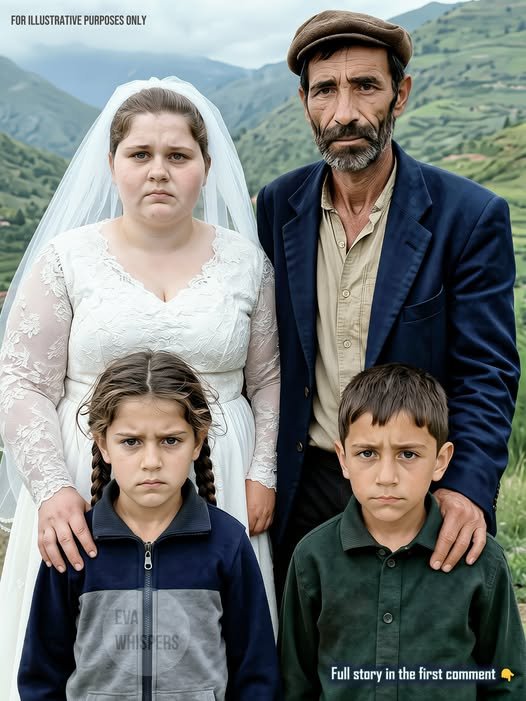
At eighteen, Ellie had never truly felt like her life belonged to her.
She lived in a small town where people knew each other’s business before breakfast and judged it before lunch. Every whispered comment, every sideways glance, every cruel smile seemed to follow her wherever she went. Ellie was shy, gentle, and painfully unsure of herself. She had grown up believing she was too quiet, too soft, too easy to overlook.
And her father never let her forget it.
He was a hard man, the kind who believed affection made people weak and obedience made them useful. To him, Ellie was not a daughter with dreams. She was a problem to be solved.
One cold morning, he called her into the kitchen and announced her future as if he were discussing the sale of livestock.
“You’re getting married,” he said.
Ellie stared at him, certain she had misunderstood.
“To who?” she whispered.
“Caleb,” her father replied. “The mountain man. He needs a wife. You need a purpose.”
The room seemed to tilt beneath her feet.
Ellie had heard of Caleb. Everyone had. He lived far up in the mountains, away from town, with two young children and a grief no one dared speak of too loudly. He was older than her, rough from years of hard living, and recently widowed.
Ellie’s eyes filled with tears.
“Why me?” she cried.
Her father’s face did not soften.
“Because he needs someone, and you have nothing better waiting for you.”
Those words broke something inside her.
The wedding happened so quickly that Ellie barely remembered it afterward.
She stood in a plain dress with shaking hands while the townspeople murmured from the church pews. Some looked at her with pity. Others looked at her with amusement. None of them looked at her like she was a young woman being sent into a life she had not chosen.
Caleb stood beside her, tall, quiet, and weathered by mountain wind and sorrow. He hardly spoke, but there was something in his eyes—something tired, guarded, and almost kind.
Ellie was too frightened to notice.
His children stood close to him. Mia was eight, with watchful eyes and a stiff little chin. Ben was five and hid behind his father’s coat, peeking out at Ellie as if she were a stranger who had come to take something from him.
And in a way, Ellie understood.
To them, she was not family. She was not comfort. She was simply the woman who had arrived after their mother was gone.
The mountain cabin was nothing like the home Ellie had imagined for herself as a girl. It was small, drafty, and far from everything familiar. The air was sharp. The silence was deep. The pine trees stood like dark giants around the house, and at night the wind pressed against the walls as if trying to get inside.
Ellie felt more alone there than she had ever felt in town.
Mia and Ben avoided her. Caleb left early most mornings to hunt, chop wood, or repair fences. Ellie was left with unfamiliar chores and two grieving children who did not want her help.
She burned bread. She spilled water. Her arms ached from carrying wood. Her fingers cracked from washing clothes in cold water.

At night, when everyone was asleep, Ellie cried quietly into her pillow.
She wondered if this was what the rest of her life would be—a lonely cabin, a husband who felt like a stranger, and children who saw her as an intruder.
But Ellie had a heart that did not know how to give up on people.
So she tried.
She baked cookies one afternoon, even though the first batch came out too dark around the edges. She placed them gently on the table and smiled at Mia and Ben.
Mia stared at the plate.
“You’re not our mother,” she said coldly.
Ben took one step backward and hid behind a chair.
Ellie’s smile trembled, but she did not argue. She knew pain when she saw it. She knew what it felt like to be lonely, to be scared, to want someone and resent anyone who tried to stand in their place.
So instead of forcing herself into their hearts, she waited at the door.
She left wildflowers on Mia’s windowsill. She carved little shapes from sticks and left them for Ben near the hearth. She hummed softly while cooking, not because anyone joined in, but because the silence had become too heavy.
At first, the children ignored everything.
Then one morning, Ellie noticed the wildflowers had been placed in a cup of water.
A few days later, Ben carried one of the carved sticks in his pocket.
They still did not call her family, but they were beginning to notice her kindness.
Caleb remained difficult to understand. He spoke only when necessary, and grief seemed to sit on his shoulders like an old coat he no longer knew how to remove. Yet Ellie began to see pieces of him that others probably missed.
She saw how carefully he tucked blankets around Ben at night.
She saw how he saved the softest piece of bread for Mia.
She saw how he sometimes stood outside after dinner, staring into the trees, his face full of memories.
One afternoon, Ellie struggled to carry a heavy bundle of firewood into the cabin. Her arms shook, and she nearly dropped it at the door.
Caleb appeared beside her.
Without a word, he lifted the bundle from her arms.
Ellie stepped back, embarrassed. “I was trying to help.”
“I know,” he said quietly.
She expected criticism. Instead, he added, “But you don’t have to carry everything alone.”
It was the first gentle thing he had said to her.
And for the first time since the wedding, Ellie felt a small spark of hope.
Life in the mountains did not become easy overnight. The days were still long. The chores were still exhausting. Ellie still made mistakes. But slowly, she began to learn.
She learned how to keep the fire alive through the night.
She learned which berries were safe and which ones to avoid.
She learned how to knead bread, mend torn sleeves, and listen to the mountain wind for signs of coming snow.
Most of all, she learned the language of the children’s grief.
Mia’s anger was really fear.
Ben’s silence was really longing.
And Caleb’s distance was really sorrow.
Then, one evening, Mia became sick.
It began with a small cough and turned into a fever by midnight. Caleb’s face tightened with worry, but the storm outside made it impossible to ride into town for help.
Ellie did not panic.
She sat beside Mia’s bed with a bowl of cool water and a stack of clean cloths. All night, she wiped the child’s forehead, changed her damp blanket, whispered soft words, and kept the fire burning.
Caleb stood in the doorway, watching silently.
Near dawn, Mia’s fever finally eased.
Ellie was so tired she could barely keep her eyes open, but when Mia reached for her hand, she forgot every ache in her body.
“Thank you,” Mia whispered.
Ellie pressed the little girl’s hand between both of hers.
“You don’t have to thank me,” she said softly. “I’m here.”

From that day on, something changed.
Mia began helping Ellie in the kitchen. Ben started following her from room to room, asking questions in his small, careful voice. One night, he brought her a book and climbed onto the bench beside her.
“Can you read this?” he asked.
Ellie’s heart swelled.
“Yes,” she said. “Of course I can.”
Soon, bedtime stories became a nightly ritual. Caleb would sit by the fire, pretending to mend tools while actually listening. Mia would lean against Ellie’s shoulder. Ben would fall asleep before the last page.
For the first time, the cabin did not feel like a prison.
It felt like a place that might one day become home.
As the seasons shifted, Ellie began to change too—not because anyone demanded it, and not because the town had judged her, but because the mountain life awakened a strength she never knew she had.
She walked the trails to clear her mind. She breathed in the sharp pine air. She watched the sunrise spill gold over the ridges. The mountains that once frightened her began to comfort her.
Step by step, Ellie became steadier.
Her hands grew more capable.
Her voice grew less timid.
Her heart grew braver.
One night, while the children slept, Caleb told her about Sarah, his late wife. He spoke slowly, as if every word had to pass through pain before reaching the air.
“She died bringing Ben into the world,” he said, staring at the fire. “After that, I didn’t know how to be anything except useful. I could feed them. Keep them warm. Protect them. But I didn’t know how to make this house feel alive again.”
Ellie listened with tears in her eyes.
Then, for the first time, she told him about her own life. About her father’s coldness. About growing up feeling unwanted. About the shame she carried because of other people’s words.
Caleb looked at her for a long moment.
Then he said, “People can be cruel when they don’t understand what they’re looking at.”
Ellie gave a small, sad smile. “And what do you see?”
His answer was quiet.
“I see someone who keeps choosing kindness, even when life has not been kind to her.”
Those words stayed with her.
Winter came hard that year.
Snow buried the trails. The wind screamed around the cabin. Food grew scarce, and every meal had to be stretched carefully. Ellie made sure Mia and Ben ate first, pretending she wasn’t hungry when portions ran small.
Caleb noticed.
He always noticed more than he said.
One morning, he took her outside and began teaching her the skills she would need to survive in the mountains. How to read tracks. How to move quietly. How to respect the wilderness without fearing it.
Ellie was nervous at first. Her hands shook. Her breath came too fast.
Caleb stood beside her and said, “You are stronger than you think.”
She wanted to believe him.
So she tried.
And with time, she did.
The children grew closer to her with every passing week. Mia began sharing stories about her mother, not with bitterness, but with trust. Ben started calling her “Mama Ellie” by accident one afternoon, then froze as if he had done something wrong.
Ellie knelt in front of him, her eyes shining.
“You can call me whatever feels right in your heart,” she said.
Ben threw his arms around her neck.
After that, he never stopped.
The first time Mia called her “Mom,” Ellie had to turn away and wipe her eyes before anyone saw her cry.
Caleb saw anyway.
That night, he found Ellie outside beneath a sky full of stars.
“You’ve changed this place,” he said.
Ellie looked toward the cabin, where warm light glowed through the windows and the children’s laughter drifted through the cracks.
“No,” she whispered. “This place changed me too.”
Caleb stood beside her in silence. Then his hand found hers.
He did not say much.
He never needed to.
The warmth of his fingers around hers said enough.
Then one day, Ellie’s father came to the mountain.
He arrived without warning, dressed in his usual stern expression and carrying the same cold authority that had once made Ellie shrink.
He looked around the cabin with disapproval.
“So this is what became of you,” he said.
For a moment, Ellie felt like the frightened girl she used to be.
Then Mia slipped her small hand into Ellie’s. Ben stood close to her side. Caleb watched from near the door, quiet but steady.
And Ellie remembered who she had become.
She lifted her chin.
“This is my home,” she said.
Her father’s eyes narrowed. “Don’t forget who made this arrangement.”
Ellie’s voice did not shake.
“You may have sent me here,” she replied, “but you don’t own the life I built.”
Her father stared at her, stunned.
Ellie continued, softer now, but stronger than ever.
“I am not here because you chose it anymore. I am here because I choose them.”
For the first time in her life, her father had nothing to say.
He left before sunset.

When the door closed behind him, Caleb gave Ellie a quiet nod—not of pity, but of respect.
And somehow, that meant everything.
Months later, the annual village festival arrived.
Ellie did not want to go at first. She remembered the whispers, the laughter, the way people had watched her wedding as if it were entertainment.
But Caleb said, “Come with us. Not for them. For us.”
So she went.
She walked into town holding Ben’s hand while Mia skipped ahead with ribbons in her hair. Caleb walked beside Ellie, proud and unashamed, as if he wanted every person there to see exactly who she was to him.
The whispers came, but they were different now.
People noticed the children clinging to her with love. They noticed the calm confidence in her face. They noticed Caleb’s hand resting gently at her back.
Ellie no longer felt small beneath their stares.
Near the center of the festival, Caleb stopped.
Then, in front of the whole town, he knelt before her.
Ellie’s breath caught.
In his hand was a simple ring, plain but beautiful.
“I know our beginning was not fair to you,” Caleb said, his voice rough with emotion. “You were brought into my life by someone else’s decision. But every day since then, you have chosen us with your whole heart.”
Tears filled Ellie’s eyes.
Caleb looked up at her.
“You gave my children laughter again. You gave this house warmth again. You gave me hope when I thought I had lost it forever. So I’m asking you now—not because you have to stay, but because I pray you want to.”
He held out the ring.
“Ellie, will you choose this family with me?”
Mia started crying before Ellie could answer. Ben wrapped his arms around her waist.
Ellie looked at the man before her, then at the children who had become her heart.
“Yes,” she whispered. “I choose you.”
The crowd burst into applause, but Ellie barely heard it.
For once, her life was not being decided for her.
For once, the choice was hers.
And she chose love.
Years passed, and the mountain cabin grew warmer with every season. Flowers bloomed by the doorway. Children’s drawings decorated the walls. The sound of laughter filled rooms that had once known only silence.
Ellie became known in town not as the girl people had pitied, but as the woman people admired. Some called her “the mountain mother,” because she always seemed to know how to comfort a crying child, stretch a meal, calm a frightened heart, or remind someone that they were stronger than they believed.
She never forgot where she came from, but she no longer lived under its shadow.
Years later, when her father fell ill, he sent word asking to see her.
Ellie went.
He looked smaller than she remembered. The hardness in his face had faded, leaving behind an old man with regrets he could no longer hide.
“I was cruel to you,” he admitted.
Ellie sat quietly beside his bed.
“Yes,” she said.
“I thought I was giving you a future.”
“You were trying to get rid of a burden,” she replied gently.
Tears filled his eyes.
“I’m sorry.”
Ellie looked at him for a long time.
The apology did not erase the pain. It did not return the years he had stolen or soften the words that had wounded her. But Ellie had learned something in the mountains: forgiveness was not always about excusing someone.
Sometimes it was about freeing yourself.
So she took a breath and said, “I forgive you.”
Not because he deserved it.
Because she deserved peace.
When she returned to the cabin, Caleb was waiting on the porch.
He did not ask too many questions. He simply opened his arms, and Ellie stepped into them.
That evening, Mia—now taller, wiser, and almost grown—sat beside Ellie by the fire.
“Mom,” she said softly, “were you scared when you first came here?”
Ellie smiled sadly.
“Terrified.”
Mia leaned her head against her shoulder.
“But you stayed.”
Ellie looked around the room—the home she had built, the children she had loved, the man who had become her partner in every storm.
“Yes,” she said. “But not because I was forced to. I stayed because love found me here. And because I found myself too.”
Mia squeezed her hand.
“You’re the strongest person I know.”
Ellie’s eyes filled with tears, but this time they were not tears of fear or loneliness.
They were tears of gratitude.
Later that night, Ellie stood outside with Caleb as the sun disappeared behind the mountains. The sky glowed orange and rose, and the wind carried the scent of pine through the valley.
Caleb wrapped an arm around her shoulders.
“Do you ever regret it?” he asked quietly.
Ellie knew what he meant.
The beginning. The pain. The choice that had not been hers.
She looked toward the cabin, where Mia and Ben were laughing inside, and smiled.
“I regret the way it began,” she said. “But not where it led me.”
Caleb kissed her forehead.
Ellie rested her head against his chest and whispered, “You are my home.”
And as the mountains stood strong around them, Ellie finally understood.
She had not been rescued by love.
She had grown into it.
She had taken a life that began with fear and turned it into something beautiful.
And the girl who once believed she had no choice became a woman who chose herself, her family, and the future with a heart full of courage.