
Part 1
At breakfast, my mother changed my life with the same calm voice she used to ask for sugar.
“Your sister’s twins are moving into your room,” she said, stirring cream into her coffee like she hadn’t just kicked the air out of my lungs. “They need more space now. They’re growing.”
My fork froze halfway to my mouth.
Across the table, my older sister Sabrina didn’t even look up from her phone. But I saw it—the tiny lift at the corner of her mouth. That quiet little smile of victory.
Her twins, Milo and June, were in the living room, pulling apart the basket of clean laundry I had folded before sunrise. Sabrina had moved back into our parents’ house three months earlier after her divorce, bringing two toddlers, six suitcases, and the silent expectation that the rest of us would rebuild our lives around hers.
I looked at my mother.
“My room?” I asked.
Mom sighed, as if I had already made things difficult.
“Don’t start, Leah. You’re twenty-seven years old. You work from a laptop. You can sleep in the basement until you find your own place.”
“The basement floods,” I said quietly.
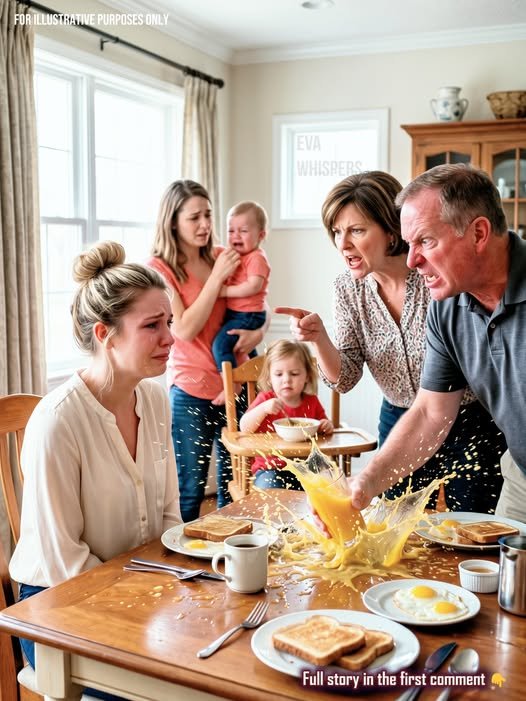
Before my mother could answer, my father slammed his glass down. Orange juice jumped over the rim and splashed across the tablecloth.
“Agree, or get out of this house,” he snapped.
Everything went still.
The clatter from the living room seemed to fade. Even Sabrina stopped scrolling.
I stared at my father, waiting for him to take it back. Waiting for a flash of shame. Waiting for some proof that the man who once carried me on his shoulders still lived somewhere behind those angry eyes.
But Russell Carter did not soften.
He leaned back in his chair, face flushed, jaw hard, completely convinced that his temper was the final law of the house.
Mom whispered, “Russell,” but she didn’t defend me.
Sabrina finally lifted her eyes. “Leah, please don’t make this into a whole thing. My kids can’t keep sharing one little room forever.”
“It wasn’t a little room when I was paying half the utilities,” I said.
Dad’s expression hardened.
“Nobody asked you to do that.”
And that was the moment something inside me went silent.
Because they had asked.
Not with honest words. Not directly.
They had asked when Dad’s hours were cut and the mortgage was suddenly “a little tight.”
They had asked when Mom’s credit card bills piled up.
They had asked when Sabrina needed diapers, formula, groceries, gas money, car repairs, and help with her lawyer.
They asked through guilt.
Through long sighs.
Through the word family.
But now that I was inconvenient, all those years of help had magically disappeared from memory.
I looked down at the orange juice drying on my hand. Then I wiped it away with a napkin.
“Okay,” I said.
Mom blinked. “Okay?”
I pushed back my chair.
“I’ll be gone by Friday.”
Sabrina’s shoulders dropped, relieved. She had won.
Dad picked up his fork again as if the conversation was finished.
“Good,” he muttered. “Maybe the real world will finally teach you some gratitude.”
One week later, I stood on the porch of the yellow house next door with a brass key resting in my palm.
The realtor smiled and handed me the paperwork.
“Congratulations, Ms. Carter. It’s officially yours.”
Across the lawn, my mother stepped outside carrying a laundry basket.
The second she saw me unlock the front door, the basket slipped from her hands.
Clothes spilled onto the grass.
I turned the key, pushed open the door, and looked back at her.
“Good morning, Mom.”
The yellow house had belonged to Mrs. Alder, our neighbor for nineteen years. After her stroke, her daughter wanted a fast private sale.
I had known about it for six weeks.
And I had known better than to tell my family.
They thought I had nowhere to go because I never showed off. They thought my quietness meant weakness. They thought that because I worked in the basement, I was stuck there.
They didn’t know I had built a scheduling app during sleepless nights, while everyone else was in bed.
They didn’t know I had sold it.
They didn’t know I had enough money to buy the house, fix what needed fixing, and cover my expenses for two years without asking anyone for a dollar.
They didn’t know I had stayed not because I needed them, but because I had confused loyalty with letting everyone else drain me dry.
By the second morning, Dad had stopped pretending he wasn’t watching from the window.
By the third, Mom knocked on my new front door with a stack of bills in her hand.
“Leah,” she began softly, “the water bill is higher this month. With the twins here, things are just… tight.”
I stood in my doorway, warm coffee in my hand, looking at the woman who had watched me be pushed out of my own room.
“You told me nobody asked me to help.”
Her lips pressed together.
“Don’t be cruel.”
“I’m not being cruel,” I said. “I’m simply unavailable.”
Behind her, chaos exploded from the house next door.
Sabrina shouted because Milo had dumped cereal into an air vent. Dad yelled back from somewhere inside. June started crying. A dog barked from down the street. Then, as if the house itself wanted to prove a point, the smoke alarm went off.
For the first time in years, none of it was mine to fix.

Part 2
For a long time, I had been the invisible engine inside that house.
I cooked when Mom was tired.
I cleaned when Sabrina forgot.
I sent money when Dad panicked.
I watched the twins when Sabrina needed to “run errands” that somehow lasted five hours.
I remembered appointments, paid overdue bills, folded laundry, handled repairs, bought groceries, calmed arguments, and swallowed my own exhaustion because everyone else always seemed to need something more.
I had not been living with my family.
I had been maintaining them.
And now the machine had finally unplugged itself.
Within a month, the truth began showing.
The lawn next door grew uneven and patchy. Trash bags started sitting beside the bins because no one remembered pickup day. Dad missed a mortgage payment because he had quietly depended on my automatic transfers. Sabrina’s ex stopped sending extra money. Mom looked more tired every morning, her face thinner, her voice smaller.
And every day, when I walked to my car, I lifted my hand and waved.
“Good morning,” I said.
Not sweetly.
Not bitterly.
Just clearly.
Clearly enough for them to understand that I was still close, but no longer available to be used.
By fall, the old house looked different.
Not destroyed.
Not beyond saving.
Just exposed.
Without me absorbing every consequence, everyone inside had to meet the life they had helped create.
Dad took weekend shifts at a hardware store. He came home too tired to lecture anyone about gratitude.
Mom learned exactly how much I had been doing only after laundry piled up, dishes overflowed, and the twins ran out of clean pajamas.
Sabrina discovered that parenting felt very different when the sister next door refused to become free childcare on command.
At first, they blamed me.
Sabrina called me selfish.
Dad called me arrogant.
Mom said I had become cold.
I let every accusation land on my porch and disappear.
For years, I had mistaken being needed for being loved. I had thought that if I gave enough, helped enough, sacrificed enough, one day they would finally see me.
But they had seen me.
They had simply seen me as useful.
That truth hurt more than I expected. Some nights, I sat alone at my new kitchen table, listening to the quiet hum of the refrigerator, and cried—not because I wanted to go back, but because I was grieving the family I had kept trying to earn.
Still, every morning, I woke up in a room no one could take from me.
A room with sunlight on the floor.
A room where nobody barged in asking for money.
A room where peace was not treated like selfishness.
Slowly, the quiet stopped feeling lonely.
It started feeling like safety.
The breaking point came on a cold November morning.
I was watering the mums by my front steps when Dad crossed the lawn.
He moved slowly, hands tucked into the pockets of his jacket. He looked older than he had at breakfast months earlier. The pride was still there, but it had cracks now. Real ones.
“Leah,” he said.
I kept my hand on the watering can.
“Good morning, Dad.”
He flinched.
Maybe because he finally understood that those words were no longer just a greeting.

Part 3
They were my boundary.
My line in the grass.
My reminder that I could stand near them without being swallowed by them again.
Dad cleared his throat.
“I was wrong,” he said.
I said nothing.
For once, I did not rush to make his discomfort easier.
He swallowed hard.
“About the room. About the money. About how I spoke to you. About all of it.”
Mom had stepped onto their porch behind him, holding June on her hip. Sabrina stood in the doorway, pale and quiet, her arms folded across her chest.
Dad looked at my little yellow house, then back at me.
“I acted like giving you a roof meant I owned your obedience,” he said. “But you were helping us survive, Leah. And I treated you like… like spare furniture we could move around whenever we wanted.”
It was not a perfect apology.
But it was the first one that did not ask me to comfort him afterward.
Mom started crying.
“I miss you in the house,” she said.
“I know,” I answered.
Her face lifted with hope.
Then I added, “But I don’t miss who I became there.”
The words hurt her. I could see it.
But this time, I did not soften the truth just to protect someone else from the weight of it.
Sabrina stepped onto the porch, hugging herself against the cold.
“The twins ask why Aunt Leah doesn’t come over anymore.”
My heart tightened. Milo and June were innocent in all of this. They were loud, messy, sticky-fingered little people who loved without strategy.
“I’ll take them to the park on Saturdays,” I said. “Two hours. Not because you expect it. Not because you need it. Because I love them.”
Sabrina’s eyes filled.
“And us?” she asked.
I looked at my sister. The same sister who had smiled while I was being pushed into a damp basement. The same sister who had accepted my help for years and still treated my life as smaller than hers.
“I love you,” I said. “But I’m done being the floor everyone stands on.”
No one spoke for a long moment.
The wind moved through the lavender I had planted beside the walkway. Somewhere behind them, one of the twins laughed, bright and unaware.
After that morning, things changed.
Not perfectly.
Not magically.
Not the way stories sometimes pretend people change overnight.
But slowly, honestly, painfully.
Dad began paying me back in small monthly transfers. Sometimes it was only a little. But every payment came with no speech, no guilt, no excuse.
Mom started asking before assuming. At first, her voice shook when she did it, like respect was a language she was still learning.
Sabrina got a part-time job at a daycare. For the first time, she understood the value of childcare because someone was paying her to provide it.
And I kept my house.
I painted the front door blue.
I planted lavender along the walkway.
I bought a dining table big enough for six, even though most nights it belonged only to me.
On Saturdays, Milo and June came over with sticky hands, crooked ponytails, toy cars, stuffed animals, and laughter that filled every corner.
We went to the park. We made pancakes. We drew pictures. We built forts from blankets in my living room.
And when the two hours ended, I walked them home.
Sometimes Mom invited me to dinner.
Sometimes I went.
Sometimes I smiled and said, “Not tonight,” then went back to my quiet kitchen and ate soup alone without guilt sitting beside me.
That was the part no one tells you about choosing yourself.
At first, peace feels like betrayal.
Then one day, it simply feels like breathing.
My family did not fall apart because I left.
It fell apart because I had been holding it together for years while everyone pretended my hands were not tired.
And when they finally learned to stand without leaning on me, something better than revenge happened.
I stopped waiting for them to give me space.
I stopped begging to be valued.
I stopped shrinking myself to fit inside a home that only loved me when I was useful.
Then I turned a key in my own front door.
And for the first time in my life, I understood the difference between having a room…
and building a home.