
I was seven years old the night my mother disappeared. I still remember the sound of rain hitting the tin roof, the smell of wet soil drifting through my bedroom window, and my father’s boots stomping across the porch long after midnight.
When I ran downstairs, clutching my blanket to my chest, he was standing by the kitchen sink with his hands braced against the counter. His face was pale. His shirt was soaked. And when I asked where Mama was, he didn’t answer right away.
He only looked out the window toward the neighboring farm.
Across the property line, behind the rusted barbed-wire fence, the Whitaker farmhouse glowed faintly in the storm.
Finally, my father knelt in front of me, grabbed my shoulders, and said in a voice I would never forget, “Hannah, listen to me. That family will bury us if we let them.”
That was the night I learned to hate the Whitakers.
And Tom Whitaker, their only son, became my enemy before either of us was old enough to understand why.
The Fence Between Us
For twenty years, Tom and I lived less than half a mile apart, but we might as well have lived on opposite sides of the world.
At school, he sat two rows behind me and pulled my braids when we were children. I shoved mud into his backpack once in fifth grade and told the teacher he had started it.
At county fairs, our families set up booths on opposite ends of the field. If the Carters sold apple pies, the Whitakers sold peach cobbler. If we entered pumpkins in the harvest contest, they entered squash twice as big.
People in town used to joke that the Carter-Whitaker feud was older than the courthouse clock.
No one laughed around my father.
He never explained exactly what happened the night Mama disappeared. He only told me that she had gone near the Whitaker property and never came back the same way. When I pressed him, his jaw tightened.
“Some questions only reopen wounds,” he would say.
So I stopped asking.
Tom must have been told his own version, because he hated me just as fiercely.
By the time we were grown, our fights had become quieter but sharper. He would fix a broken fence post on his side and accuse our cattle of leaning on it. I would report his irrigation ditch for leaking water onto our pasture. He called me stubborn. I called him arrogant.
The truth was, we were both raised on the same poison.
We just drank it from different cups.
The Spring Everything Fell Apart
That spring, the rain didn’t come.
The creek thinned to a silver ribbon. The pasture turned brittle beneath our boots. My father’s shoulders seemed to bend lower each morning as he opened envelopes from the bank.
I found him one evening at the kitchen table with his head in his hands.
Beside him was a letter stamped in red.
Final Notice.
The Carter farm, the land my grandparents had worked, the land where my mother planted sunflowers along the fence, was slipping away from us.
I was twenty-seven years old, and for the first time in my life, I saw my father cry.
Two days later, he told me we had been called to a meeting at the old county office. When we arrived, Tom Whitaker was there with his parents.
The air in that room felt thick enough to choke on.
A lawyer named Mr. Bellamy placed a yellowed folder on the table. Inside were documents tied to an old land trust created decades earlier, before I was born.
“There is a way to save both farms,” he said carefully. “But the terms are unusual.”
My father wouldn’t look at me.
Tom’s father stared at the floor.
Mr. Bellamy explained that the Carter and Whitaker farms had once been meant to operate together. If the direct heirs of both families legally united the properties before the end of June, the trust would release enough funds to pay the debts and protect the land from being sold to developers.
Then Tom’s mother whispered, “There has to be a marriage.”
I laughed because I thought she was joking.
No one else laughed.
Tom looked as stunned as I felt.
“You expect me to marry him?” I said, pointing across the table.
Tom’s eyes narrowed. “Don’t sound so horrified. I’m not exactly celebrating either.”
But the deadline was close. The bank was circling. Developers were already offering cash. And our parents, the same people who had spent twenty years teaching us to despise each other, suddenly insisted this was the only way.
A marriage.
A signature.
A sacrifice.
To save everything.

The Wedding No One Dreamed Of
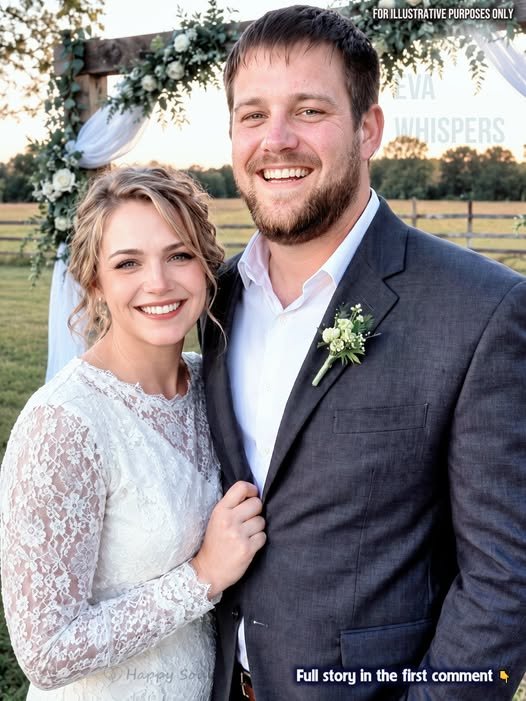
Two weeks later, I stood in my bedroom wearing my grandmother’s white lace dress.
It smelled faintly of cedar and lavender from the trunk where it had been stored. The sleeves were too delicate for the rough hands I had earned working fence lines and hauling feed. Still, when I looked in the mirror, I saw more than myself.
I saw my grandmother.
I saw my mother.
I saw every woman who had ever tried to keep that farm alive.
Downstairs, guests gathered under white lights strung across the patio. Someone had brought wildflowers. Someone else had brought a cake. The town had turned out because nothing entertained people more than enemies forced into peace.
Tom waited near the oak tree in a dark suit that made him look annoyingly handsome.
I hated that I noticed.
His expression was hard, but his eyes were restless.
When I reached him, he leaned close and muttered, “For the record, this is still the worst idea anyone has ever had.”
I whispered back, “For once, we agree.”
We said our vows like two people signing a treaty after a war.
The guests clapped. Our parents smiled too widely. My father kissed my forehead with trembling lips. Tom’s mother hugged me longer than expected and whispered, “I’m sorry.”
At the time, I thought she meant for the marriage.
Later, I realized she meant for everything.
“We Need to Go Now”
That night, the reception was still roaring when Tom found me near the edge of the patio.
Music played. People danced. My father was laughing with Tom’s parents as if twenty years of bitterness had melted in a single evening.
Tom’s face told a different story.
“Don’t look at them,” he said quietly.
I frowned. “What?”
“We need to go to the old barn right now.”
I followed his gaze across the dark pasture toward the abandoned barn near the property line. It had stood there my whole life, leaning slightly to one side, its roof patched with rusted sheets of metal.
“My father always said that barn was unsafe,” I said.
“My father lied.” Tom’s voice was low. “And I think yours did too.”
My stomach tightened.
“What are you talking about?”
He glanced back at the patio. “I want to show you something our parents have been hiding from us for twenty years.”
The world seemed to tilt beneath me.
I should have demanded answers right there. Instead, I lifted the hem of my wedding dress and followed him into the pasture.
The June wind dragged against the silk. Grass brushed my ankles. Behind us, laughter and music faded with every step.
When we reached the barn, Tom pulled an iron key from his pocket.
“Where did you get that?” I asked.
“From my father’s desk. I found it last week.” He shoved it into the rusted padlock. “I almost told you before the wedding, but I needed to know what was inside first.”
The lock groaned open.
Tom pulled the heavy wooden door wide.
The Secret in the Barn
The smell hit me first.
Dust. Hay. Old wood. Time.
Tom reached for a switch near the door. A single lamp hanging from the ceiling flickered, buzzed, and filled the barn with pale yellow light.
At first, I saw only shadows.
Then my eyes adjusted.
And my legs nearly gave out.
The barn wasn’t empty.
Along one wall stood shelves covered in boxes, framed photographs, old blankets, and sealed glass jars filled with seeds. A long table sat in the center, covered with maps, ledgers, and papers carefully wrapped in plastic.
But it was the photographs that stole the breath from my lungs.
My mother was in them.
Not one photograph.
Dozens.
There she was, younger than I remembered, laughing beside Tom’s mother. They stood arm in arm in front of the barn, both wearing muddy boots and sun hats.
In another photo, my mother held baby me on her hip.
Beside her, Tom’s mother held baby Tom.
The two of us were reaching toward each other with tiny hands.
I stepped closer, trembling.
“That’s impossible,” I whispered.
Tom stood beside me, his face pale. “Keep looking.”
There was a faded sign leaning against the wall.
Alder Creek Family Cooperative.
Below it were the Carter and Whitaker names painted together.
Together.
Not divided.
Not enemies.
Together.
On the table lay a leather-bound journal. My fingers shook as I opened it.
The first page was written in my mother’s handwriting.
For Hannah and Thomas, if the truth is ever buried too deep.
I stopped breathing.
Tom gently turned the page.
There were plans. Crop rotations. Water-sharing agreements. Seed records. A business proposal for both farms to operate as one cooperative. My mother and Tom’s mother had signed every page.
Then I saw a stack of letters tied with blue ribbon.
Each envelope had my name on it.
Hannah Grace Carter.
The first was dated three months after Mama disappeared.
My knees weakened, and Tom pulled out a chair before I fell.
Letters From a Mother I Thought I Lost
I opened the first letter with shaking hands.
My dearest Hannah,
If this reaches you, please know first that I did not leave because I stopped loving you. I have loved you every minute of every day.
A sound broke from my throat.
Tom looked away, giving me the dignity of not watching me fall apart.
The letter explained what no one had ever told me.
My mother and Tom’s mother, Evelyn, had been best friends since childhood. They had grown up dreaming of joining the farms, not fighting over them. They had discovered that both families were drowning in debt long before my father ever admitted it.
Together, they created a plan to save the land.
A cooperative.
A trust.
A future where the fence would come down.
But our fathers refused.
Not because the plan was bad.
Because accepting it meant admitting their wives had found the solution they had been too proud to see.
The arguments grew worse. Developers came sniffing around the land. One company offered quick money if both families sold at once.
My mother refused.
On the night she disappeared, she was not running away from me.
She was driving to the county office with the original trust papers because she feared the documents would be destroyed.
A storm flooded the road. Her truck broke down miles from town. A woman from a neighboring county found her and helped her leave safely the next morning.
But when Mama tried to come home, my father told her the farm was better without her. He said if she returned, the feud would destroy everyone. He told her I was too young to understand and that one day he would explain.
He never did.
She wrote anyway.
Year after year.
Birthday letters. Christmas letters. Apologies. Stories about the sunflowers she missed. Questions about whether I still sang while feeding the chickens.
My father had hidden them all.
Some had been opened. Some had never been touched.
I pressed one letter to my chest and sobbed so hard I could barely breathe.
All those years, I had believed my mother had vanished into silence.
But she had been reaching for me the whole time.

Tom’s Truth
Tom picked up another envelope.
His name was written across it.
He opened it slowly.
As he read, his face changed. The anger he had carried like armor began to crack.
“My mother knew,” he whispered.
I looked up.
He swallowed hard. “She helped your mother hide the papers here. She promised to tell us when we were old enough. But my father threatened to leave her with nothing if she brought it up again.”
His hand tightened around the letter.
“She let me hate you.”
I didn’t know what to say, because my father had done the same to me.
For a long moment, we sat in that barn as the truth settled around us like dust.
We had not inherited a feud.
We had inherited a lie.
Tom turned toward me. “Hannah, I didn’t marry you to trap you.”
“I know,” I said, though my voice shook.
“I thought we were saving the farms.”
“So did I.”
He looked at the papers on the table. “But this says the marriage was never the only way. A legal partnership would have worked. The trust required the heirs to unite the land. Not their lives.”
The words hit me like a slap.
Our parents had rushed us into marriage because it was easier than confessing.
Easier than saying, We were wrong.
Easier than admitting two women had tried to save everyone twenty years ago.
The Confrontation
We carried the letters and documents back across the pasture.
The reception was still going, but the joy felt strange now, almost cruel.
When my father saw my face, his smile disappeared.
Tom’s father stood at once. Evelyn covered her mouth.
I placed the letters on the table in front of them.
“Tell me it isn’t true,” I said.
My father stared at my mother’s handwriting.
For once, he had no warning, no excuse, no anger large enough to hide behind.
“Hannah,” he whispered.
“Did she write to me?”
His eyes filled with tears.
“Did she?” I demanded.
“Yes.”
The word was barely audible, but it shattered something inside me.
Tom turned to his father. “And you knew too?”
His father’s face hardened out of habit, but it didn’t last. His shoulders dropped.
“We thought we were protecting our families,” he said.
“No,” Tom replied. “You were protecting your pride.”
Silence spread across the patio.
My father began to cry.
Not loudly. Not dramatically. Just an old, broken kind of crying that seemed to come from a place he had locked away for years.
“I loved your mother,” he said to me. “But I was angry. I was ashamed. She saw a way forward, and I only saw how small it made me feel. When she left to file those papers, I told myself she had chosen the land over us.”
“She chose all of us,” I said.
He nodded, tears slipping down his cheeks. “I know that now.”
Evelyn stepped forward, trembling.
“I wanted to tell you both,” she said. “Every year, I told myself I would. Then another year passed, and the lie became heavier.”
Tom looked at his mother with pain in his eyes. “You let me hate her.”
Evelyn nodded. “And I will regret that for the rest of my life.”
The Choice We Made
The wedding ended without music.
Guests left quietly after realizing something much deeper than a family celebration had unfolded. By midnight, only Tom and I remained in the barn, sitting at the old table under the single yellow lamp.
Between us lay the trust documents.
The solution had been there all along.
Not in hatred.
Not in sacrifice.
Not even in marriage.
But in honesty.
Tom looked at me carefully. “We can annul this. First thing Monday.”
I appreciated that he said it.
I appreciated even more that he meant it.
I looked around the barn at the photographs of our mothers, at the seed jars, at the cooperative sign, at the proof of a friendship stronger than the bitterness that buried it.
“I don’t know what we are,” I said honestly.
Tom gave a small, tired smile. “That makes two of us.”
“But I know what we’re not,” I continued. “We’re not our fathers. We’re not their feud. And we’re not going to let them decide the rest of our lives.”
So we made a different vow that night.
Not a romantic one.
Not yet.
A truthful one.
We would save the farms together. We would reopen the cooperative. We would take down the barbed-wire fence. And we would find my mother.
Bringing Her Home
The newest letter in the box was only six months old.
Inside was a return address in Oregon and one sentence that nearly broke me.
If Hannah ever wants me, I will come.
I called the number with shaking hands the next morning.
When a woman answered, I couldn’t speak.
Then she whispered, “Hannah?”
I had not heard my mother’s voice in twenty years, but something inside me recognized it immediately.
I cried like the seven-year-old girl who had waited by the window during a storm.
She arrived three days later.
Her hair was streaked with silver. Her face carried years I had not been there to witness. But when she stepped out of the car and opened her arms, I didn’t care about the time we had lost.
I ran to her.
For a long time, we simply held each other in the driveway while my father stood several feet away, weeping quietly.
Forgiveness did not happen all at once.
It came slowly.
In conversations. In apologies. In painful questions answered honestly. In my mother walking through the farmhouse and touching the walls like she was greeting ghosts.
Tom watched from the porch, his hands in his pockets.
When my mother saw him, she smiled through tears.
“Thomas Whitaker,” she said softly. “You used to steal Hannah’s animal crackers.”
Tom blinked. “I did?”
“You did,” she said. “And she used to bite your sleeve when you wouldn’t share.”
For the first time in my life, Tom and I laughed together without bitterness.
The Fence Came Down
A month later, Tom and I stood on opposite sides of the rusted barbed-wire fence with wire cutters.
Our parents watched from the shade.
No one spoke much.
There are some moments too sacred for speeches.
Tom cut the first strand.
I cut the second.
By sunset, the fence that had divided our lives lay coiled in the grass.
The next week, we reopened the barn as the office of Alder Creek Family Cooperative. My mother and Evelyn worked side by side again, older now, softer in some ways, stronger in others.
My father and Tom’s father had to earn their places back, and we did not make it easy for them. But they showed up. They listened. They apologized more than once.
And Tom?
Tom became the surprise I never saw coming.
He was still stubborn. Still blunt. Still impossible before coffee.
But he was also patient. Honest. And far kinder than the boy I had been taught to hate.
We did not fall in love overnight.
Real love rarely works that way.
Instead, we learned each other slowly.
One repaired fence post at a time.
One shared breakfast at a time.
One truth at a time.
What the Barn Taught Me
People in town still talk about our wedding.
They call it the strangest marriage Alder Creek ever saw.
Maybe they’re right.
I married my childhood enemy to save our family farm.
But in the end, Tom was never my enemy.
He was a boy standing on the other side of a fence, being told the same lie I was.
That night in the barn, we found more than papers, photographs, and letters.
We found the truth.
We found our mothers’ courage.
We found the future our families had almost lost.
And most of all, we learned that hatred can be inherited…
But it does not have to be kept.
Sometimes the thing that saves a family is not pride, revenge, or even sacrifice.
Sometimes it is one locked door.
One hidden truth.
And two people brave enough to open it.