
Part One: The Only Place Left to Go
Three weeks after my divorce became final, I boarded a flight from Denver to Baltimore with my entire life packed into two suitcases.
Everything else I owned was either sitting in cardboard boxes inside a storage unit or locked inside the townhouse my former husband had decided no longer belonged to me.
Balanced against my chest was my fifteen-month-old daughter, Mia. Her small fingers were curled around the ear of a worn stuffed rabbit named Bunny, the one possession she refused to release even while sleeping.
I had a diaper bag hanging from one shoulder, a collapsed stroller dragging behind me, and a boarding pass clenched between my teeth.
By the time I reached row fourteen, my arms were trembling.
I was thirty-two years old, newly divorced, nearly broke, and without a permanent home.
My former husband, Nathan Pierce, had emptied most of our shared savings account two days before filing for divorce. A week later, he changed the locks on our townhouse while Mia and I were visiting my mother.
When I confronted him, he claimed the house was legally his because his father had helped with the down payment.
Then, as though removing us had not been enough, he began posting photographs online of expensive dinners, weekend trips, and a smiling woman I recognized from his office.
His new life appeared polished and effortless.
Mine fit into two suitcases.
My cousin Rachel had offered Mia and me the guest room in her house near Annapolis. She promised we could stay as long as necessary while I searched for work in medical billing.
People called it a fresh start.
To me, it felt more like reaching the nearest safe shore after barely surviving a storm.
As I struggled to lift the diaper bag into the overhead compartment, a woman seated across the aisle looked at Mia and sighed loudly.
“Oh, wonderful. A baby.”
Mia had not cried. She had not kicked anyone’s seat. She had barely opened her eyes.
Still, I instinctively prepared to apologize.
For years, apologizing had been my first response to discomfort—even when I had done nothing wrong.
Before I could speak, the man seated beside the window turned toward the woman.
“The child has the same right to be on this flight as everyone else,” he said calmly. “I’m sure the adults will manage.”
His voice was not harsh, but it carried a quiet authority that ended the conversation immediately.
The woman looked away and began scrolling through her phone.
I lowered myself into the aisle seat with Mia on my lap.
“Thank you,” I whispered.
The man nodded.
He appeared to be in his early forties. His dark hair was touched with silver at the temples, and he wore a navy sweater beneath a simple gray coat. He had broad shoulders, tired blue eyes, and the composed posture of someone accustomed to being observed.
“I’m Claire,” I said.
“Adrian Cole.”
When Mia dropped Bunny, Adrian retrieved it before I could bend down.
A few minutes later, he helped secure the stroller without being asked. When Mia began growing restless, he folded an airline napkin into a crooked little bird.
At least, I assumed it was supposed to be a bird.
Mia stared at it solemnly.
“I don’t think she’s impressed,” he said.
“She has very demanding artistic standards.”
The corner of his mouth lifted.
It was the first time I had laughed in weeks without immediately feeling guilty afterward.

Part Two: The Stranger in Seat 14A
Once the plane reached cruising altitude, I began noticing something unusual.
People were watching Adrian.
A young man two rows ahead held his phone at an awkward angle, pretending to photograph the clouds while keeping the camera pointed toward us.
Two passengers near the front whispered to each other, repeatedly glancing back.
Even one of the flight attendants seemed unusually formal when she addressed him.
“Is everything comfortable, sir?”
“Yes, thank you.”
She gave him a knowing nod before continuing down the aisle.
Adrian’s relaxed expression gradually disappeared. His shoulders tightened, and his jaw became rigid.
He noticed every camera.
After several minutes, he leaned slightly toward me, careful not to crowd my space.
“May I ask you for an unusual favor?”
I glanced at him.
“How unusual?”
His eyes shifted toward the young man holding the phone.
“Would you be willing to pretend you fell asleep on my shoulder?”
I stared at him.
“You want me to do what?”
He looked genuinely embarrassed.
“If people believe I’m traveling privately with my family, they may stop filming. You can absolutely refuse. I realize how strange this sounds.”
Mia was already drifting to sleep against my chest, her cheek warm against my collarbone.
I looked around the cabin.
Three people quickly lowered their phones when they realized I had noticed them.
I understood what it felt like to become someone else’s entertainment. During my divorce, Nathan had shared carefully selected pieces of our private life with friends and relatives until I no longer recognized myself in the story he told.
He portrayed himself as the patient husband and me as an unstable wife who had suddenly destroyed a happy home.
Perhaps that was why Adrian’s request did not frighten me as much as it should have.
I understood the desire to disappear.
“All right,” I whispered. “But Mia swings that rabbit like a weapon when she wakes up.”
“I accept full responsibility for the risk.”
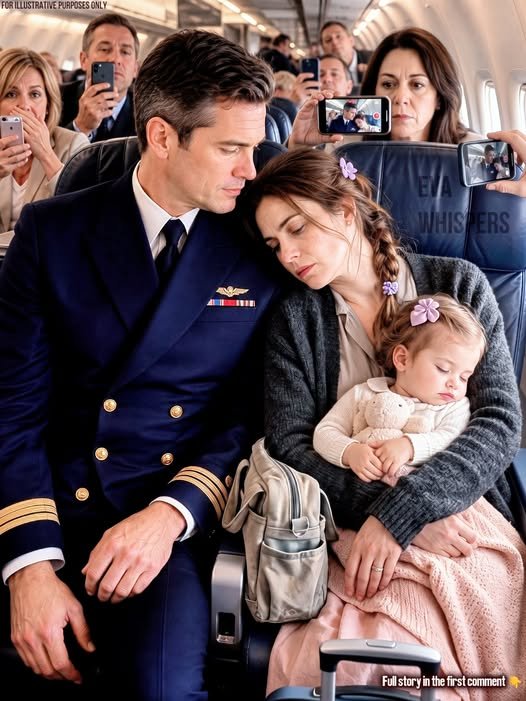
I carefully rested my head against his shoulder.
Adrian became perfectly still. He placed both hands on the tray table and maintained a respectful distance, making it clear that the gesture was nothing more than a shield against unwanted attention.
Across the aisle, someone whispered, “He must be traveling with his wife and daughter.”
Another person murmured something in agreement.
One by one, the phones lowered.
I closed my eyes, intending only to pretend.
But Adrian’s shoulder was steady, and the hum of the aircraft softened around me. Mia slept safely in my arms.
For the first time in months, I was not defending myself.
No one was demanding an explanation.
No one was accusing me of being unreasonable, emotional, or difficult.
I was simply a tired mother holding her child.
A few minutes later, I actually fell asleep.
When the captain announced our descent into Baltimore, I lifted my head.
“I’m sorry,” I said. “I think I stopped pretending.”
Adrian gave me a faint smile.
“You looked like you needed the rest.”
His words were simple, but they struck something tender inside me.
Nathan had often complained that my exhaustion made his life inconvenient. He never asked what I needed.
A stranger had noticed in less than an hour.
Part Three: The Photograph
After landing, Adrian carried one of my suitcases down from the overhead compartment and unfolded Mia’s stroller at the gate.
While he was securing Bunny beneath the canopy, his phone vibrated.
He read the message.
The warmth vanished from his face.
“What happened?” I asked.
He hesitated before turning the screen toward me.
Someone had already posted a photograph from the plane.
It showed me asleep against Adrian’s shoulder with Mia resting between us. Because of the angle, we looked like a quiet little family returning from a trip.
“Who are you?” I asked.
“My full title is Commander Adrian Cole. I serve in the United States Coast Guard.”
I looked at him again, suddenly understanding the whispers and cameras.
“Why would people recognize you?”
“I testified before a congressional committee earlier this week. The hearing concerned failures in programs designed to support Coast Guard families. The coverage attracted more public attention than I anticipated.”
Two professionally dressed men approached from the terminal crowd.
Before joining them, Adrian reached into his coat and handed me a card bearing his name and an official office number.
“If anyone contacts you—or if someone posts an image clearly showing Mia—call this number. You never agreed to become part of this.”
He looked directly at me.
“I’m sorry, Claire.”
Then he was escorted away.
I stood beside the stroller, watching him disappear into the crowd.
The flight was over, but I had the unsettling feeling that something had just begun.
Rachel met us outside the terminal.
Her house stood on a quiet street not far from the Chesapeake Bay. Blue shutters framed the windows, bicycles lay scattered across the front lawn, and a wooden wind chime clicked softly above the porch.
Her children had taped a handmade sign to the guest-room door.
WELCOME CLAIRE AND MIA.
Several letters leaned sideways. The heart beneath Mia’s name was drawn in green marker.
I nearly cried.
It was the first time in months that someone had prepared a place for us instead of finding a way to remove us.
That evening, after Mia fell asleep, I checked my phone.
I had nineteen notifications.
The photograph from the flight had spread across social media. One caption claimed Commander Adrian Cole had been seen traveling with his wife and young daughter following his testimony.
Then I found Nathan’s post.
He had shared the photograph with his own caption.
“So this is what responsible motherhood looks like now. Barely divorced and already involving our daughter with a powerful stranger. My attorney will be addressing this.”
My hands began to shake.
Rachel read the post over my shoulder.
“Call the commander.”
“I met him once.”
“You helped him. Now he needs to correct what happened.”
She placed Adrian’s card in my hand.
A staff member answered immediately. Less than a minute later, Adrian came onto the line.
“Claire, I’m sorry,” he said. “My office is already contacting the account that posted the image.”
“Nathan is using it against me in our custody dispute.”
Adrian became silent while I read Nathan’s accusation aloud.
When I finished, his voice was calm.
“I’ll prepare a formal statement tonight. The flight crew can confirm the circumstances, and your attorney may contact my legal office directly.”
“You would do that for someone you barely know?”
“I asked you to help me,” he replied. “My request placed you in this position. Correcting the record is my responsibility.”
I pressed my lips together, fighting tears.
Nathan had always treated kindness like a transaction. If he did something for me, he expected gratitude, obedience, and repayment.
Adrian spoke of responsibility as though it required no reward.
Before ending the call, he told me something troubling.
The photograph had not first appeared from a random passenger’s social media account. Someone had emailed it directly to a media page before we even left the airport.
The sender had included Adrian’s full name, his title, and the false claim that I was his wife.
Someone had known exactly who he was.
And they had wanted the image to spread.

Part Four: A Message from the Past
By midnight, Adrian’s signed statement had reached my attorney, Monica Grant.
It explained that I was an unrelated passenger traveling with my daughter and that Adrian had requested my assistance because other passengers were recording him.
The statement should have ended the matter.
It did not.
The following morning, Monica called.
“Nathan has requested temporary restrictions on your ability to travel with Mia.”
My stomach dropped.
“Can he force us back to Colorado?”
“Not immediately. The judge rejected his emergency request, but there will be a hearing on Friday. Save everything—messages, financial records, photographs, anything showing what happened before you left.”
I spent the day assembling evidence.
Bank statements showed the money Nathan had removed.
Messages showed his threats to delay child support unless I agreed to his custody conditions.
Photographs showed my clothing and Mia’s toys sitting outside the townhouse after he changed the locks.
Each document reopened something I had worked hard to survive.
That afternoon, an investigative podcast producer named Nora Bell called.
She said she had received the airplane photograph along with a private message that had not been posted publicly.
“What did it say?” I asked.
Nora hesitated.
“It said, ‘Ask the mother holding the child what happened to Evelyn.’”
I had never heard the name.
Nora explained that Evelyn Cole had been Adrian’s older sister. Years earlier, she had worked with families connected to an organization called HarborLight Family Services.
HarborLight was a private contractor paid to provide counseling, emergency housing, child care, and medical assistance to military families.
Evelyn reportedly discovered missing money and falsified service records.
She tried to report what she found.
Her concerns were dismissed.
Several months later, she died in a highway collision before she could appear at a formal inquiry.
When I called Adrian, he confirmed the basic facts.
“My sister believed HarborLight was billing the government for services families never received,” he said. “I never believed she was imagining it.”
“Why would anyone connect her to me?”
“I don’t know.”
That night, while searching for Mia’s medical records, I found an envelope tucked inside the lining of my suitcase.
I assumed it contained one of the documents I had packed in Denver.
Instead, an old photograph slid onto the bed.
A younger Adrian stood at a family picnic beside a smiling dark-haired woman who had to be Evelyn. A small boy stood in front of them.
Beside Evelyn was another woman, visibly pregnant.
For a moment, I could not breathe.
She looked almost exactly like me.
The shape of her face.
The curve of her eyebrows.
Even the small dimple beside her mouth.
Rachel entered the room and froze when she saw the photograph.
“Claire,” she whispered, “is that supposed to be you?”
I turned it over.
Four names had been written in faded ink:
Evelyn. Adrian. Owen. Elena.
A small folded note fell from the envelope.
It contained only one sentence.
She was not the only mother who escaped.
Part Five: The Woman Who Shared My Face
Adrian answered on the second ring.
“I found a photograph in my suitcase,” I said. “You’re standing beside Evelyn, a little boy, and a pregnant woman named Elena.”
He said nothing.
“She looks like me, Adrian.”
His silence confirmed that he recognized her.
“Who was she?”
“Her name was Elena Cole,” he said at last. “She was married to my older brother, Matthew.”
“Where is she now?”
“She disappeared three years ago while she was seven months pregnant.”
I sat on the edge of the bed and watched Mia sleeping in the travel crib.
Adrian explained that Elena had been an accountant and Evelyn’s closest friend. The two women had worked together to uncover HarborLight’s false records.
After Evelyn’s death, documents disappeared from Elena’s apartment.
One evening, Elena called Adrian in tears. She said she had trusted the wrong person and believed someone was watching her.
Before hanging up, she told him to find “the other mother.”
Three hours later, police found Elena’s abandoned car at a highway rest area.
Her purse was inside.
Her phone was gone.
Days later, the family received an email claiming Elena had left voluntarily and wanted no further contact.
The final line asked someone to apologize to Evelyn.
But Evelyn had already been dead for months.
Whoever wrote the message did not understand the family well enough to make the lie convincing.
“Did you recognize the resemblance when you saw me on the plane?” I asked.
“Yes.”
The answer hurt more than I expected.
“You knew before you asked me to help you?”
“At first, I thought grief was confusing me. You looked so much like Elena that I couldn’t think clearly. Then people began filming, and everything happened quickly.”
“You trusted me because I reminded you of her.”
“Partly,” he admitted. “That was unfair to you.”
I waited for him to defend himself.
Nathan would have argued that I was misunderstanding him. He would have found a way to make my discomfort seem irrational.
Adrian did none of that.
When I told him he could not come to Rachel’s house, he accepted the boundary immediately.
We agreed to meet the next afternoon in a crowded café with Monica present.
There, Adrian revealed that investigators had traced the anonymous upload of our airplane photograph to an airport business lounge.
The same lounge network had been used to send Elena’s false farewell email three years earlier.
His congressional testimony had reopened questions someone wanted buried.
The photograph was not random.
Neither was the envelope in my suitcase.
Monica established firm rules. Adrian’s office would communicate with us only through her unless there was an emergency.
While they discussed the investigation, a memory returned to me.
After Mia’s birth, I had been weak from complications. Nathan handled almost all the hospital paperwork.
One night, I woke and heard him arguing with a nurse in the hallway.
The nurse insisted they had received the wrong infant file.
Nathan later told me it was only a billing mistake.
I had been exhausted, frightened, and grateful that he was handling everything.
I never questioned him.
Monica requested certified copies of Mia’s hospital records that same day.

Part Six: The Signature I Had Never Seen
Two days before the custody hearing, Monica called.
“The hospital issued an amended discharge form after Mia’s birth,” she said. “The original record included an internal reference number connected to a family-services contractor.”
“Which contractor?”
“HarborLight.”
The room seemed to tilt.
I searched every folder on my laptop and every document I had brought from Colorado.
Eventually, I found a file labeled:
NEWBORN FAMILY ASSISTANCE INTAKE.
HarborLight’s logo appeared at the top.
The final page contained Nathan’s signature beneath a section authorizing the coordination of Mia’s records with an affiliated support network.
I had never seen the document.
I had never given permission.
My phone rang from an unknown number.
Remembering Monica’s warning, I let it go to voicemail.
A woman’s trembling voice filled the room.
“Claire, if you found the photograph, do not trust the amended birth record. And do not trust Nathan. Mia was never supposed to remain hidden this long.”
The message ended.
A text arrived seconds later.
It contained a photograph of an infant identification bracelet.
The name printed on it was:
BABY GIRL COLE.
The birth date matched Mia’s.
Beneath the image was another message.
Ask Adrian why his missing niece has your daughter’s eyes.
I stood frozen while Mia sat on the rug, stacking wooden blocks.
Rachel moved beside me.
“Don’t believe anything yet,” she said firmly.
But suddenly, Nathan’s reaction to the airplane photograph made sense.
Perhaps he had not been jealous.
Perhaps he had recognized Adrian.
For one terrible moment, I wondered whether the child I had carried, delivered, fed, comforted, and loved could somehow be connected to Elena.
Then I looked at Mia.
She laughed as her tower collapsed.
Whatever was hidden inside those records, she was my daughter. No photograph, message, or secret file could change the life we had shared.
Monica delivered the bracelet image, voicemail, and hospital documents to the court.
The custody hearing was postponed.
Nathan’s effort to force us back to Colorado failed.
Investigators began examining HarborLight’s records and Nathan’s employment history.
He had once worked as a regional records coordinator for one of HarborLight’s subcontractors.
He had signed documents he never expected me to read.
Part Seven: The Truth Behind the Bracelet
The bracelet did not prove that Mia was Elena’s child.
I refused to allow strangers online to turn my daughter into a mystery for public entertainment.
Certified testing eventually confirmed what my heart had always known.
Mia was biologically mine.
The anonymous message had mixed facts with carefully designed lies. Someone had used the matching birth dates, altered records, and Elena’s disappearance to frighten us.
The confusion distracted attention from the financial evidence hidden inside HarborLight’s files.
Investigators discovered that identification numbers had been transferred among infant-assistance cases to conceal improper payments.
Families were listed as receiving housing, medical coordination, or child-care services they had never received.
Nathan had approved and processed some of those records.
He had also concealed HarborLight’s intake form from me because he knew the reference number could connect him to the altered files.
His public attack after the airplane photograph had been an act of panic.
He recognized Adrian immediately.
He knew Adrian’s testimony could reopen the investigation.
And he feared that my sudden connection to the commander—even an accidental one—might expose what he had helped conceal.
The final truth was more complicated than the anonymous messages suggested.
Elena had survived.
She had given birth safely under a protected identity and remained hidden because she believed returning publicly would endanger both her daughter and the evidence she had preserved.
For years, she communicated only through attorneys and trusted investigators.
Months after the airplane photograph went viral, Elena was finally able to contact Adrian.
She was alive.
So was her daughter.
The resemblance between Elena and me was nothing more than an extraordinary coincidence.
Yet that coincidence had brought two unfinished stories together.
A photograph intended to embarrass Adrian and destroy my custody case had instead exposed the connection Nathan desperately wanted hidden.
Part Eight: The Shoulder I Needed
Nathan eventually lost the power he had tried to hold over me.
The court reviewed his financial manipulation, his effort to exclude me from the townhouse, the unauthorized medical documents, and his involvement with HarborLight’s records.
I received primary custody of Mia.
More importantly, I stopped believing that defending myself made me difficult.
I found a new position with a medical billing company near Annapolis and rented a small apartment a few streets away from Rachel.
The place was modest. The kitchen was narrow, the bedroom windows rattled during storms, and the living-room carpet had a faded mark that no amount of cleaning could remove.
But the key belonged to me.
No one could change the locks without my permission.
No one could remove my belongings and call it reasonable.
Adrian did not become the husband strangers had imagined when they saw the airplane photograph.
Our lives were not a romance created by a viral image.
He became something quieter and perhaps more meaningful—a trusted family friend.
He visited occasionally, always calling first. Mia adored his terrible napkin animals and continued attacking him with Bunny whenever he pretended to fall asleep.
Through his sister’s case, Adrian helped establish stronger protections for families reporting problems within support programs.
Through my own experience, I learned that survival was not merely reaching a safer place.
It was learning to trust my judgment again.
It was allowing myself to rest without fearing what someone might take while my eyes were closed.
The last time I saw the airplane photograph, Mia was three years old.
She pointed at the screen and immediately recognized Bunny.
“Mommy, why were you sleeping on Uncle Adrian?”
I looked at the image.
The frightened woman in that photograph seemed familiar, but she no longer felt like me.
She had boarded the plane believing she had lost everything.
She did not yet know that her life was about to open instead of close.
“Adrian needed people to stop bothering him,” I explained.
“So you took a nap?”
“I was only pretending at first.”
Mia considered this seriously.
“Then why did you really fall asleep?”
I brushed a strand of hair away from her face.
“Because I was very tired.”
She leaned against me.
“And he kept you safe?”
I smiled.
“For a little while.”
The truth was that Adrian had needed my help that day.
But I had needed something too.
I needed proof that kindness did not always come with conditions.
I needed to remember that not every stranger was waiting to use my weakness against me.
And I needed one quiet hour in which I could stop holding myself together.
“Sometimes,” I told Mia, “someone you don’t know needs a little kindness.”
She waited for the rest.
“And sometimes, while you’re helping that person, you discover they gave you exactly what you needed too.”