
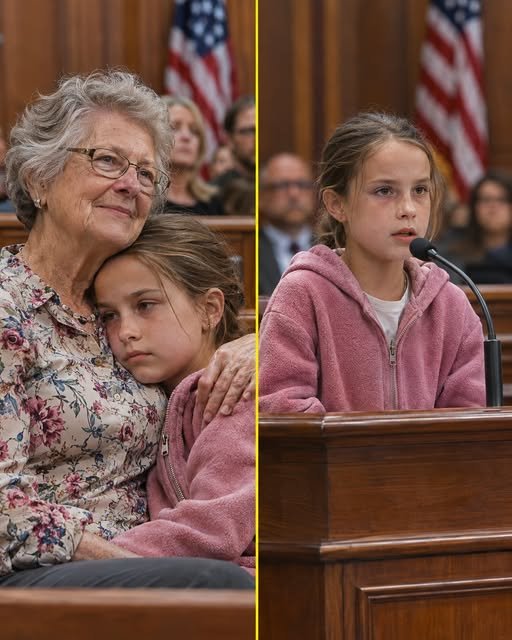
For eleven years, I thought the hardest part of raising my granddaughter would be explaining why her father never came. Then he appeared with a beautiful house, an attorney, and a story that made me the villain. I went to court afraid our ordinary life would not be enough. Hazel went carrying a backpack—and something neither of us should have had to defend.
Part 1 — The Man Who Returned With a Bigger House
“Grandma, if the judge makes me go, will I still be allowed to call you before bed?”
My granddaughter asked that question the night before our first court hearing.
Hazel was standing in my bedroom doorway, clutching the stuffed rabbit she had slept with since she was a toddler. One of its ears hung slightly lower than the other. I had sewn that ear back on three times, and she still refused to replace it.
I was sitting on the edge of my bed, picking lint from the navy cardigan I had chosen for court. I had been doing that for nearly twenty minutes because it was easier than reading the hearing notice again.
“Come here, sweetheart,” I said.
She crossed the room and sat beside me, arranging her rabbit in her lap. At eleven, she had begun doing thoughtful little things without being asked: carrying the groceries when my hands ached, setting out my glasses before breakfast, pretending not to notice when I needed to sit down halfway through sweeping the porch.
I loved the young person she was becoming. But I hated that she was learning to worry about me.
“I’m going to do everything I can to keep your home your home,” I told her.
Hazel looked up. “That isn’t the same as saying he can’t take me.”
“No,” I admitted. “It isn’t.”
Her eyes filled, but she did not cry. She simply tucked herself against my side as she had done when she was small. I held her and thought about how unfair it was that a child who had already lost her mother could be frightened of losing the only home she remembered.
A month earlier, Hazel’s father had been little more than a name on official papers. Then he had appeared at our front door as if eleven years were an inconvenient detail we could move past.
It was a Saturday morning. I had pancake batter on my hands, and Hazel was setting plates on the kitchen table. When the doorbell rang, I assumed it was Ruth, my niece, dropping off the library books she had borrowed.
Instead, a man in a tailored jacket stood on my porch. A polished car waited at the curb. His hair was neatly cut, and his expression held the practiced confidence of someone accustomed to being welcomed.
It took me a moment to recognize him.
“Margaret,” he said. “It’s Brandon.”
Eleven years earlier, he had stood in that same doorway with a diaper bag at his feet and a four-month-old baby in his arms.
Now he smiled as though we had simply lost touch.
“I’ve come to talk about Hazel.”
I kept one hand on the door. “After eleven years?”
His smile tightened. “I know I’ve been away. But things are different now. I’m married. I have a good job. Caroline and I have a house with plenty of room.”
“Room for what?” I asked, although I already knew.
“For my daughter. I want her to live with us.”
I stared at him. Then I looked past his shoulder at the car, trying to understand how a man could arrive after more than a decade and speak as if a child were furniture he had finally made space for.
He glanced into our living room. The arm of our sofa was patched. A basket of clean laundry waited beside it. I had meant to repaint the walls that summer but had decided the money was better spent on Hazel’s school supplies.
“I can give her a proper home, Margaret,” he said.
“She has a proper home.”
Before either of us could say more, Hazel appeared behind me holding two plates.
“Grandma? The pancakes are—”
She stopped when she saw the stranger.
Brandon’s face brightened. “Hazel. Look at you.”
He stepped forward with his arms open, but Hazel stiffened. She balanced the plates against her chest, unsure what he expected of her.
“I’m your dad,” he said.
She looked at me. I nodded, because whatever else happened, I would not lie to her.
Brandon began talking about his swimming pool, the school near his house, and the bedroom he and Caroline had already chosen for Hazel. He said she could decorate it any way she wanted. Then he glanced around our little house again.
“You wouldn’t have to live somewhere so cramped anymore.”
Hazel carefully put the plates down.
“But this is where I live with Grandma.”
“We’ll work that out,” he answered.
I moved beside her. “You can arrange a conversation with me. You cannot walk in here and announce that she’s moving.”
His friendly expression disappeared.
“I’m her father,” he said. “You seem to have forgotten that.”
“No, Brandon. I remember exactly who you are.”
After he left, I discovered the pancakes had burned. Hazel picked at one without taking a bite.
“Did you know he was coming?” she asked.
“No.”
“Did he ever ask to come before?”
I put down my fork. “No, sweetheart.”
She gave a small nod. She asked no more questions, but I could see her putting those answers somewhere deep inside herself.
Three weeks later, a process server arrived with a petition asking the court to end my guardianship and place Hazel in Brandon’s care.
The papers described his stable marriage, his income, his spacious home, and his determination to become an involved father. They also mentioned my age—seventy-five—more than once.
I could not argue with that number. Some mornings, my knees reminded me of it before I even got out of bed. But on those pages, eleven years of meals, school pickups, nightmares, birthdays, fevers, and bedtime stories had been reduced to an arrangement that was apparently no longer necessary.
Hazel found me sitting at the kitchen table with the petition spread out in front of me.
“He’s making you send me away?”
“He’s asking a judge to decide.”
“Then tell the judge no.”
I wanted more than anything to say that one word would be enough.
Instead, I called the legal-aid number printed on the courthouse information sheet. The next day, an attorney named Dana Brooks returned my call.
“Do you have the original guardianship order?” she asked.
“Yes.”
“School records? Medical records? Anything showing your care of Hazel over the years?”
“I have calendars and files. I save nearly everything.”
“Do you have anything documenting her father’s absence?”
I looked across the kitchen at Hazel’s drawing taped to the refrigerator. How was I supposed to prove eleven years of empty chairs?
“He wrote a letter after he left,” I said slowly. “I kept it.”
“Please find it if you can. Keep the original safe and bring it to me.”
That evening, I opened the cabinet containing my daughter Emily’s belongings. There were photographs, birthday cards, her hospital bracelet, and a folded baby blanket I had never been able to give away.
But the envelope was missing from the folder where I remembered putting it.
I searched until my back hurt. Then I sat on the floor beside the open cabinet and stared at Emily’s photograph.
For eleven years, I had tried to protect Hazel from the circumstances that brought her to my home. Now I was afraid those same circumstances might take her away from it.
And somewhere among our family’s memories was a letter I had once hoped she would never need to read.
Part 2 — The Eleven Years He Called a Misunderstanding
My daughter Emily died after a sudden illness when Hazel was only four months old.
I still remember the silence in the hospital after the doctor told us there was nothing more they could do. I remember staring at a paper cup of untouched water and feeling certain that if I waited long enough, someone would return and correct a terrible mistake.
At Emily’s funeral, people spoke to me in careful, broken sentences. I heard almost none of them. I was too busy supporting Hazel’s head and making sure the blanket did not cover her face.
Brandon was twenty-four. He and Emily had been young parents, but they had chosen each other, and for a while I believed we would manage our grief together.
During that first week, he barely spoke. I told myself he was in shock. When he forgot to warm a bottle, I made one. When he said he could not sleep, I told him to rest while I watched Hazel.
Then, a week after the funeral, he came to my house with the diaper bag.
“I can’t do this,” he said.
I thought he meant that day. “Leave her with me for the afternoon. Get some sleep. Eat something.”
“No, Margaret.” His voice was flat. “I mean this life.”
He looked at the baby carrier and then away.
“I’m too young. I have things I still want to do.”
I can remember the sound of the refrigerator humming behind him. It is strange what the mind preserves when everything else is breaking.
“And she has a whole life she needs someone to help her begin,” I told him.
He did not answer. He left Hazel’s spare clothes beside my chair, stepped outside, and drove away.
For days I expected him to return. I kept his number by the telephone. I listened for cars slowing outside. I left a little space beside the changing table for the things I assumed he would bring back.
Instead, a letter arrived. In it, Brandon repeated that he was not ready to be a father and asked me not to contact him unless it was absolutely necessary.
I kept the letter, not because I wanted to use it against him, but because there were evenings when I could barely believe what he had done. Written words seemed harder to explain away than memories.
With help from a family-law clinic, I applied for guardianship. Brandon was notified and signed the necessary consent. The court gave me the authority to care for Hazel and make decisions about her schooling and medical treatment. It did not erase the fact that he was her father.
For years, that distinction seemed to matter only on paper. He did not appear at school events or send birthday cards. He did not call when she was sick or ask whether she had learned to walk.
I learned all those things in his absence.
I learned that Hazel would not sleep unless the hallway light was on. I learned that she hated mashed peas but loved apples cut into thin slices. When she was three, she called every butterfly an “Emily” after seeing her mother’s picture beside a drawing of one. When she was five, she asked why other children had someone to make Father’s Day cards for.
“You can make one for anybody who loves you,” I told her.
She made hers for Ruth, then changed her mind and gave it to me. It had three purple hearts and a crooked sentence: Thank you for coming every time.
I kept it in a drawer beside my bed.
We did not have much money. I cleaned houses part-time when Hazel was little, arranging my hours around a neighbor who could help with childcare. Later, Social Security and what I had saved covered most of our needs. Our house was small, but it was paid for. If the porch railing needed repair, we saved until we could afford it. If Hazel outgrew her winter coat, I bought another before I bought anything for myself.
There were difficult days. I will not pretend love made them easy. I was tired often, frightened sometimes, and acutely aware that I was getting older while Hazel was growing up.
But there were good days too, thousands of them. Saturday pancakes. Library afternoons. Rainstorms spent playing cards. A science-fair display that fell apart the night before it was due. Each year, there were candles on a cake and my hand ready to catch the plate when she leaned too close to blow them out.
It was a life. Not a grand one, but a complete one.
When Dana and I met in her office, she reminded me that the law did not treat my eleven years of care as invisible.
“Brandon’s parental rights were not terminated,” she explained. “We have to take that seriously. But he cannot simply arrive and remove Hazel because he has more money now. The court will look at the guardianship, the facts, and the legal requirements for changing it.”
“So what do we do?”
“We show what is true. Carefully. With evidence.”
She spread the records across her desk. Together we put the years in order: the original guardianship file, Hazel’s school enrollment, medical appointments, emergency contacts, and the things Brandon had never asked about.
Then Dana asked the question I had been dreading.
“What happens if you become ill?”
I straightened. “I’m perfectly capable of looking after her.”
“I can see that. I’m asking whether you have a plan, not whether you love her.”
My niece Ruth lived fifteen minutes away. She already picked Hazel up from school when I had appointments and was the first person I called if I needed help. With Dana’s guidance, we began putting those arrangements into writing.
“Planning isn’t admitting defeat,” Dana said. “It’s part of keeping Hazel safe.”
While I was gathering records, Brandon was sending Hazel photographs of his house.
One showed a swimming pool. Another showed a wide staircase. A third showed a bedroom with a white canopy bed.
Across the back, he had written: All of this could be yours. You deserve more.
Hazel studied the pictures at the kitchen table.
“It’s pretty,” she said.
“It is.”
“Would you have a room there?”
I paused. “He hasn’t mentioned one for me.”
She quietly turned the pictures facedown.
At Dana’s suggestion, we allowed scheduled phone calls while the case was pending. I sat within earshot in case Hazel needed me but tried not to interrupt.
“We could paint your room pink,” Brandon told her during one call.
“My favorite color is green.”
“Then green. Whatever you want.”
Hazel traced a mark in the tabletop with her finger.
“Do you know my teacher’s name?”
He was silent for a moment.
“That’s something I can learn,” he said.
It was the first answer that gave me a flicker of hope. Then he added, “Everything will be easier when you stop letting Grandma make you worry.”
Hazel handed me the phone without another word.
I wanted to end the calls. Dana urged me to keep any contact structured and to let the family counselor help Hazel express what she wanted. I agreed. I would not teach my granddaughter that the only way to be safe was to shut every door forever.
A week before the hearing, Brandon brought his wife, Caroline, to an arranged visit at our house.
Caroline crouched to Hazel’s height and asked what she liked to read. She listened to the answer. She did not mention the swimming pool. I found myself relaxing slightly.
Then Caroline said, “I’m so glad we’re finally doing this. Brandon told me how hard he tried to find a way back to you.”
Hazel looked at me.
Brandon quickly cut in. “We’re focusing on the future.”
Later, Caroline stepped outside to answer a call. Brandon remained in the kitchen, speaking quietly into his own phone. I was in the pantry reaching for the coffee tin when I heard him.
“No, she doesn’t want to come,” he said. “Caroline doesn’t know that.”
I stopped moving.
“I told her Margaret kept us apart. If she finds out I walked away, everything changes.”
I stepped out of the pantry. Brandon ended the call at once.
“What did you tell your wife about me?” I asked.
“Don’t start, Margaret.”
He offered no other explanation.
Only after they had gone did I notice Hazel standing by the hallway cabinet, her face unusually still.
“Were you near the kitchen when your dad was on the phone?” I asked gently.
She nodded. “I heard some of it.”
I knelt as far as my knees allowed. “You don’t have to figure out what grown-ups meant. That’s for us to handle.”
She glanced at her mother’s photograph on the cabinet.
“Grandma,” she whispered, “did he ever write down why he left?”
I thought of the missing envelope.
And for the first time, I realized Hazel was no longer only afraid of what might happen next. She was trying to understand what had happened to her in the first place.
Part 3 — The Envelope Inside the Backpack
I told Hazel the truth: Brandon had written a letter when she was a baby, and I had kept it. But I could not find it.
“Was it about me?” she asked.
I sat beside her on the sofa. “It was about a decision your father made. That isn’t the same thing as being about who you are.”
She twisted the rabbit’s repaired ear between her fingers.
“But I was the baby he didn’t want to take care of.”
There was no gentle way to deny a fact she had already understood.
“You were a baby who needed love and care,” I said. “He was the adult responsible for giving it. If he couldn’t do that, it was never because something was wrong with you.”
She leaned into me. I wrapped my arm around her and wished I could take that knowledge out of her heart without taking away the truth.
The next morning, I told Dana what I had overheard on Brandon’s phone call. She took notes and asked exactly where I had stood, which words I remembered, and what I did not know.
“Please don’t try to fill in the missing parts,” she said. “The truth will be stronger if we keep it precise.”
When I mentioned Hazel might have heard some of it, Dana’s expression grew serious.
“Margaret, don’t ask Hazel to collect proof for you. Don’t rehearse what she might say. The adults have to carry this case.”
“I know.”
But I was not certain I had been living as though I knew. Hazel saw me sorting papers late into the night. She heard me take calls from my attorney. She watched me count the days until court on the calendar.
How could she not believe she needed to help?
Two evenings before the hearing, I found her on the living-room floor with our old photograph album open around her. She had been adding pictures that had accumulated in a drawer: her first day of fifth grade, a birthday picnic with Ruth, the crooked science-fair display we had fixed using tape and a cereal box.
“You look tired in this one,” she said, pointing to the science-fair photograph.
“You informed me at eight o’clock that night that we needed cardboard.”
She smiled. “We won, though.”
“We got a ribbon for effort.”
“That’s still winning.”
She turned another page. There was a picture of her first bicycle, with my hand gripping the back of the seat.
“Did Mom know how to ride a bike?” she asked.
“Your mother could ride a bike. Steering was another matter. Once, she waved at a neighbor and rode straight into a hedge.”
Hazel laughed, her shoulders loosening. For a few precious minutes, we were simply a grandmother and granddaughter looking at pictures, not two people waiting for strangers to decide where one of us belonged.
Then she closed the album halfway.
“Would Mom have wanted me to move?”
I took my time answering.
“Your mother would have wanted you safe and loved,” I said. “And she would have wanted the adults to think about you, not about who wins an argument.”
Hazel looked down at the pictures. “I wish I could ask her.”
“So do I, sweetheart.”
On the morning of the hearing, she put on her favorite green sweater and slung her school backpack over one shoulder. I assumed it contained the usual things she carried everywhere: a library book, pencils, a snack she would forget to eat, and her rabbit, tucked carefully into the front pocket.
I did not know she had packed anything else.
Dana had arranged for Ruth to stay with Hazel at the courthouse unless the judge wanted to hear from her. Hazel would not be required to sit through every dispute between adults.
At the courthouse, Brandon stood beside his attorney. Caroline was with him, but she no longer smiled with the easy certainty she had shown at our first meeting.
When the hearing began, Brandon’s lawyer described his stable employment, his marriage, and the home he could provide. He acknowledged the years apart but insisted his client had grown up and now wanted to take responsibility.
Dana did not argue that his house was smaller than mine. It plainly was not. She presented the guardianship order and our record of Hazel’s life: who took her to school, who signed her medical forms, who knew which counselor had helped her after a difficult year, and who had been there when ordinary childhood things went wrong.
Then I was called to speak.
Brandon’s attorney asked whether I worried about my age.
“Yes,” I said.
He looked up, apparently surprised.
“I worry enough to prepare,” I continued. “Ruth helps us. I can manage my daily activities, and my doctor has given me no reason to believe otherwise. We’ve put emergency arrangements in place.”
“But you can’t promise you’ll remain healthy.”
“No,” I answered. “I don’t think anyone here can.”
The judge asked about Hazel’s school, her medical care, and our daily routine. For the first time since the petition arrived, I felt steadier. We were talking about the child I knew rather than the picture Brandon had painted of our home.
During a break, Ruth brought Hazel down the corridor. She walked straight to Dana and tugged gently at her sleeve.
“I have something,” she whispered.
Dana crouched beside her. “What is it?”
Hazel unzipped her backpack. First she pulled out the photograph album. Then she reached between its pages and removed a folded envelope, old enough that the edges had turned yellow.
I knew the handwriting on the front before she lifted it toward me.
Brandon’s.
My stomach dropped.
“Hazel, where did you find that?”
“In my baby book. I was looking for the picture of Mom holding me.” Her voice shook. “It was tucked behind the last page.”
Years before, I must have placed the letter there with the things I was afraid of losing, then forgotten exactly where I had hidden it.
Hazel stared at the floor.
“I read it, Grandma. I’m sorry.”
I reached for her, but Dana spoke first.
“You’re not in trouble, Hazel. You haven’t done anything wrong. I need to look at it before anyone decides what to do with it.”
Hazel handed her the envelope. She looked terribly young, standing there in her green sweater with the rabbit’s ear sticking out of her backpack.
I had spent weeks searching for proof of Brandon’s choices. My granddaughter had found it while looking for a picture of the mother she missed.
When court resumed, Dana told the judge an original letter had unexpectedly been located. She gave Brandon’s lawyer an opportunity to examine it and asked for time to address the new evidence properly.
The judge did not announce a verdict. She asked how it had been found and whether Brandon recognized the writing.
He stared at the envelope.
“It looks like mine,” he said at last.
Caroline turned toward him. Her expression changed.
The judge continued the evidentiary hearing for two weeks so both sides could review the letter and complete the remaining steps. The guardianship would stay in place until the matter was decided.
In the corridor afterward, Hazel looked from Brandon to the envelope resting in Dana’s folder.
I thought of all the explanations her father had offered for his absence, and all the explanations I had made for him when she was little.
Now his own words had returned.
But the fact that the letter might help our case did not change the cruelest part of the day: my granddaughter had read a grown man’s rejection and somehow believed she needed to apologize for finding it.
Part 4 — What the Letter Could Not Undo
When we returned home, I made two cups of tea. Neither of us drank them.
Hazel sat at the table with the rabbit in her lap, staring at a scratch in the wood. She had sat at that table learning to count, drawing birthday cards, and telling me all the things she was too shy to say at school.
Now she looked as though she were waiting to be scolded.
“I thought if I brought proof, you wouldn’t have to be scared,” she said.
I moved my chair beside hers.
“Hazel, listen to me. You are not responsible for protecting me.”
“But you protect me.”
“That’s my job. Your job is to be eleven. To go to school, argue with me about bedtime, and tell me when something hurts.”
She rubbed the rabbit’s ear with her thumb.
“The letter hurt.”
I pulled her close. There was no speech clever enough to make its words disappear. I could only hold her and make sure she never had to sit alone with what she had read.
Over the next two weeks, Dana handled the letter carefully. Copies were exchanged. Brandon’s attorney confirmed that he would not dispute that Brandon had written it.
Dana explained that the letter was not a magic piece of paper capable of canceling someone’s rights. It was evidence: of the choice Brandon had made, of the reasons the guardianship began, and of whether the account he was giving the court could be trusted.
We also provided Hazel’s school and medical records, our written support plan, and information from the counselor who had met with her. Dana prepared me for questions without telling me what answers to give.
A few days before the next hearing, Caroline called.
I asked Dana whether speaking to her was wise. With Dana’s guidance, I kept the conversation brief.
“Brandon told me you moved,” Caroline said. “He said you wouldn’t answer his calls.”
“We’ve lived in this house since before Hazel was born. My telephone number hasn’t changed.”
There was a silence long enough that I wondered whether she had hung up.
“I know that now,” she said.
I did not know what to say.
“I repeated things without asking whether they were true,” she added. “I’m sorry.”
She made no promises. She did not tell me what she would do about her marriage. The apology did not repair the harm, but it was the first time someone on Brandon’s side had acknowledged that a story could hurt people even when it sounded convenient.
At the continued hearing, Brandon admitted writing the letter.
His lawyer spoke about how young he had been when Emily died, about grief and fear, and about the different man he believed himself to be now.
I did not doubt that losing Emily had hurt Brandon. It had nearly destroyed me. I could understand a frightened young father needing help. What I could not understand was allowing one frightened week to become eleven silent years.
Under questioning, Brandon acknowledged receiving the guardianship papers and signing the consent. He knew where Hazel lived. He knew how to reach me. He had not sought court assistance to arrange visits or identified a single attempt to contact Hazel that I had prevented.
Then Dana asked about what he had told Caroline.
Brandon lowered his eyes.
“I was ashamed,” he said.
“Did Margaret keep you from seeing your daughter?”
He hesitated. I watched his jaw tighten.
“No.”
One small word. I had lived eleven years without realizing how badly I needed to hear him say it.
The judge asked why he had requested an immediate change of residence instead of first trying to build a relationship with Hazel.
“I thought when she saw what Caroline and I could offer—”
His sentence trailed off.
“What did you do to learn about the child she is today?” the judge asked.
He mentioned the photographs he had sent, the phone calls, and the visits arranged after the petition. He acknowledged missing one counseling appointment because of work.
It was not that he had nothing to offer. It was that he seemed to have prepared a new life for a child he had not yet taken the time to know.
After the adults finished speaking, the judge asked whether Hazel still wished to tell the court about her own experience. Dana and the counselor had discussed her participation with her beforehand. She knew she could decline or stop.
She chose to speak.
Hazel climbed into the witness chair. Her shoes rested against the foot rail, and the microphone looked too large in front of her. I folded my hands tightly so she would not see them tremble.
The judge made sure she understood that she should say only what she knew to be true. Then she asked what Hazel wanted the court to understand.
“I heard Dad say Caroline thought Grandma kept us apart,” Hazel began. “I wanted you to know Grandma didn’t do that.”
The judge thanked her and turned to a gentler question.
“Tell me about your home, Hazel.”
Hazel looked toward Dana. “Can I show you something?”
With permission, she opened our photograph album on her knees.
There was no rehearsed speech inside it. She showed the judge our ordinary photographs. A school concert where I sat in the wrong row and almost missed her song. A crooked birthday cake we had covered in extra frosting. The bicycle she had learned to ride while I ran behind her, certain my lungs would give out before she reached the corner.
Then she pointed to a picture of the two of us sitting on the kitchen floor during a power outage.
“Grandma knows when I say I’m not hungry but I’m really worried,” Hazel said. “Sometimes we make toast anyway, and she sits with me until I feel better.”
My eyes filled. I lowered my gaze to my hands.
“Dad has a beautiful house,” she continued. “I know that. But I don’t know him yet.”
The judge asked if anyone had told her what to say.
“No,” Hazel answered. “Grandma said this isn’t my job to fix.”
“That was an important thing for her to tell you,” the judge said.
Hazel took a breath. Her eyes moved briefly toward Brandon and then back to the album.
“He says he can give me a better life. But Grandma already gave me my life.”
The courtroom became very still.
“I don’t mean I never want to know him,” she added. “I just don’t want to lose everything so he can start over.”
That was the part I would remember long after the hearing. She had found a way to say something I had been struggling to explain for weeks: she could be curious about her father without wanting her home erased.
When she returned to my side, she did not ask if we had won. She asked if she could have some water.
The judge said she would issue a written decision after reviewing the evidence. Until then, the guardianship remained in place.
Outside the courtroom, Brandon approached us. Dana stayed close.
“I want to talk about another way,” he said quietly.
For the first time, he did not announce what would happen next. He waited for an answer.
I looked at Hazel. She had stepped slightly behind my shoulder, not hiding, simply staying where she felt safe.
“Not here,” I said. “And not without a plan.”
Brandon looked as though he might argue. Instead, he nodded once.
It was a small change. I was not ready to call it more than that.
Part 5 — The Home We Did Not Have to Earn
For ten days after the hearing, I tried to live normally.
I washed sheets, made appointments, reminded Hazel to put her lunch container in the sink, and checked the mailbox more often than I wanted to admit. Every time the telephone rang, I felt my chest tighten.
I had learned during those weeks that fear could make a person wait for life to begin again.
Then Dana called.
“Margaret,” she said, “I have the judge’s decision.”
I sat down at the kitchen table.
The court had denied Brandon’s petition to end the guardianship. The written decision addressed his voluntary absence, the reasons I had originally become Hazel’s guardian, the lack of an established relationship between him and Hazel, and the evidence of the stable life she had built in my care.
It did not turn on a single letter or on Hazel being asked to choose between two adults. Her wishes mattered, but she had not been made responsible for the outcome.
The judge had also considered my age alongside my actual health and the support we had arranged. A larger house and greater income did not, by themselves, establish that moving Hazel was warranted.
Dana paused before saying the words I had been longing to hear.
“She stays with you, Margaret.”
Outside the window, a car passed. Someone’s dog barked. The refrigerator motor came on. Nothing in the world seemed to understand that my entire life had just been handed back to me.
I lowered my head and cried.
Hazel came into the kitchen carrying a library book.
“Grandma?”
I held out my hand.
“The decision came,” I said. “You’re staying home.”
The book slipped from her fingers. She climbed into my lap so quickly that I had to grip the table to keep us steady.
“For real?”
“For real, sweetheart.”
She buried her face against my neck. I felt her shoulders shake, and for a moment I was holding the baby Brandon had left on my doorstep, the little girl who had learned to walk between our sofa and coffee table, and the eleven-year-old who had been brave in a courtroom when she should never have needed to be.
We stayed that way until the kettle began to whistle.
The decision did not mean Brandon could never have a relationship with Hazel. Dana explained the framework for gradual, supported contact and the steps required if either side wanted changes in the future. There would be no more unexpected announcements at our front door.
I wanted Hazel to feel safe. I also wanted her to know she was allowed to be curious about her father, angry with him, hopeful, disappointed, or all of those things at once.
What I would not allow was for her to be rushed into feeling something for the comfort of adults.
There were practical matters to settle, too. Dana referred me for advice about financial support. Ruth and I finalized our emergency plan and made an appointment to discuss longer-term arrangements. I finally called someone to repair the porch railing instead of insisting I could handle it myself.
For years, I had believed that asking for help might give someone a reason to question whether I was capable of raising Hazel. The case had forced me to admit something I should have known all along: a dependable family is not one person pretending she will never need anyone else.
Caroline sent a short note.
I repeated a story that hurt you without checking whether it was true. I’m sorry. I won’t contact Hazel unless you and the people helping her think it’s appropriate.
I appreciated that she asked for nothing in return. I had no way of knowing what would happen inside her marriage, and it was not my place to decide it.
Brandon’s first supported visit after the decision lasted less than an hour. Hazel chose to bring a card game. When he suggested going shopping afterward, the counselor reminded him that the visit had an agreed ending.
He looked disappointed, but he stayed, played the last hand, and said goodbye when it was time.
Later, as I helped Hazel put away her sweater, she told me, “He asked about my science project.”
“Did he listen?”
“Mostly.”
I nodded. “That’s something.”
It was not forgiveness. It was not proof that he had changed. It was one conversation, one small opportunity to do better than before.
We let it be enough for that day.
The following Saturday, I made pancakes.
Hazel perched on the kitchen counter, ignoring the rule I had repeated since she was six. Her feet swung above the floor while I measured flour into our chipped mixing bowl.
“Chocolate chips?” she asked.
“I thought you might be tired of those by now.”
She gave me a look of such deep disbelief that I laughed.
While the first pancake cooked, she fetched the photograph album. We had placed Brandon’s letter in a separate folder with the legal papers. It belonged to the history of what happened to her, but it did not belong among the pictures of her birthdays.
“Can we put in a new one?” she asked.
“A new what?”
“A picture. Of this morning.”
I looked around. There was flour on my sleeve, a dish towel slipping from the oven handle, and a pancake growing a shade too dark in the skillet. My glasses were sliding down my nose.
“Are you sure you want to remember this kitchen?” I asked, teasing her.
She looked genuinely puzzled.
“Of course. It’s our kitchen.”
I set my phone against the sugar canister and turned on the timer. In the photograph, Hazel is laughing because I nearly miss the chair. The pancake behind us is probably burning. Neither of us looks particularly elegant.
Nobody who saw it would know what that kitchen had held in the previous weeks: court papers, sleepless nights, unfinished cups of tea, or questions I had been afraid to answer.
They would see two people having breakfast.
Hazel studied the screen, then rested her head against my shoulder.
“That one,” she said. “That looks like us.”
For years, I had worried about the things I could not give my granddaughter. I had counted every repair I postponed, every trip we could not afford, every way our home looked smaller than somebody else’s.
But she had never needed me to build a perfect life. She had needed me to be there for the one we had.
The next week, I printed the photograph. Hazel tucked it into the album beside an empty space she said we would fill later.
Then she closed the cover and left it on the coffee table.
Not hidden away. Not packed for another house.
Just waiting for the next ordinary day.