
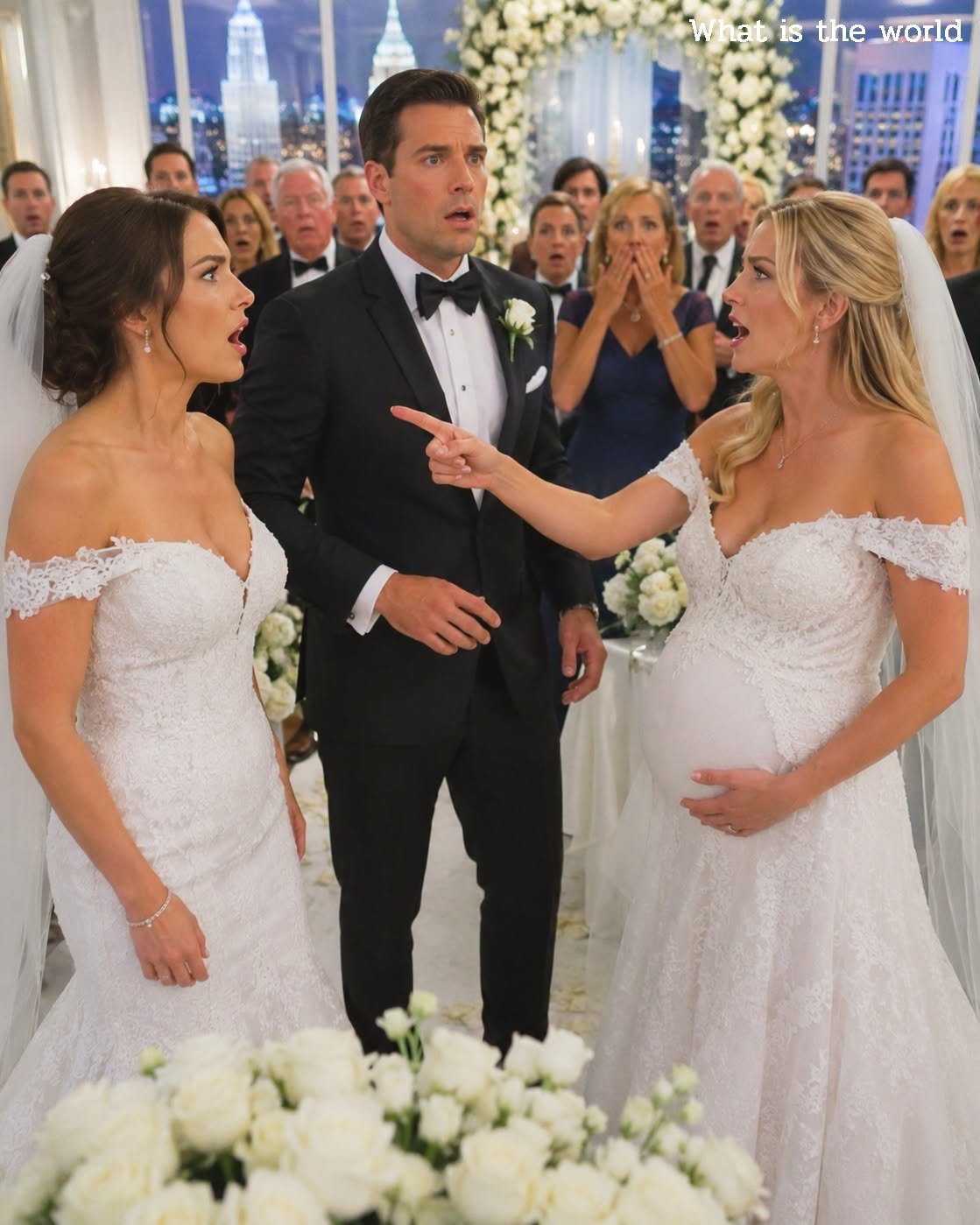
“Let me have him—I’m pregnant,” my sister announced as she walked down the aisle at my wedding in a dress nearly identical to mine, expecting me to fall apart, but instead I looked toward the billionaire who had agreed to officiate the ceremony, smiled, and said, “Since today’s plans have changed, how about you marry me instead?”—and suddenly nobody in the room knew where to look.
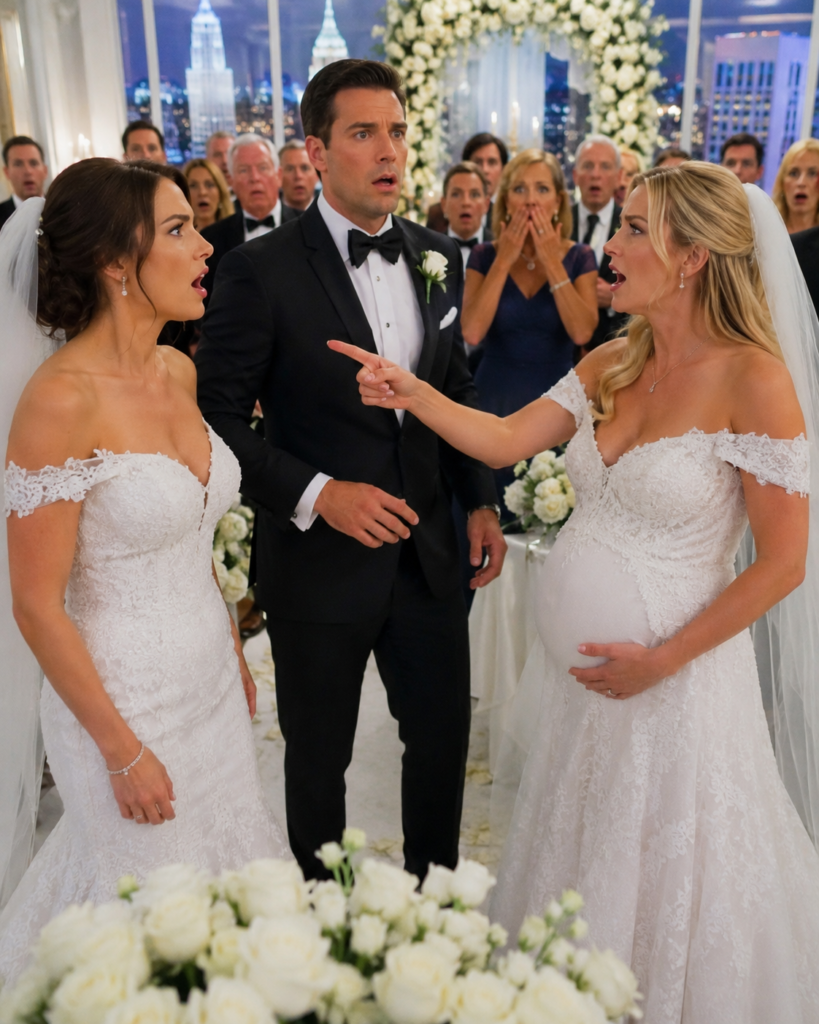
Three years of shared vacations, birthdays, Sunday grocery runs, arguments over thermostat settings, late-night takeout, plans about children we did not yet have.
And the best sentence he could produce was two words.
I’m sorry.
Danielle moved closer.
Her hands rested dramatically across her stomach.
“Ryan didn’t know how to tell you.”
That was the first lie I recognized.
I would discover later that there had been many more.
“He loves me,” she continued. “He has for a long time.”
Someone in the third pew whispered, “Oh my God.”
My mother covered her mouth.
My father stared straight ahead.
The organist quietly removed her hands from the keys.
Danielle kept walking.
There had always been something about my sister that changed when people were watching. At family dinners she could be careless, bored, childish. Put twelve people around her and suddenly every pause had timing. Every expression had purpose.
Today she had two hundred.
She looked almost energized.
“This isn’t how I wanted you to find out,” she said.
I stared at the matching gown.
“Really?”
The first uncertain expression crossed her face.
I nodded toward her dress.
“Because your outfit suggests otherwise.”
A few people shifted in their seats.
Someone near the back made a sound suspiciously close to a laugh.
Danielle’s expression tightened.
“Don’t make this ugly, Vicki.”
That almost made me smile.
She had arrived at my wedding wearing a copy of my gown, with my fiancé beside her, and somehow I was being warned not to make things ugly.
Then three memories arrived at once.
Three weeks earlier, Danielle had asked for the name of my bridal boutique on Madison Avenue. She said she loved their work and wanted inspiration for whenever her own turn came.
Two weeks earlier, Ryan had canceled dinner with me twice, then a Saturday morning appointment with our mortgage broker.
One week earlier, Danielle had hugged me in our mother’s kitchen in Queens and told me nobody could possibly outshine me on my wedding day.
I had believed every word.
Not because she was convincing.
Because she was my sister.
“How long?” I asked.
Danielle blinked.
Ryan looked at me.
“How long has this been going on?”
“Victoria,” Ryan began.
I held up one hand.
“Not you.”
He stopped.
That surprised him.
It surprised me too.
For most of our relationship, Ryan had been the person who smoothed things over. He had a talent for making uncomfortable conversations feel unnecessary.
Maybe later.
Maybe you misunderstood.
Maybe this isn’t the right time.
Somehow later had always benefited him.
Not anymore.
I looked at Danielle.
“How long?”
Her confidence weakened.
“Does that really matter now?”
“Yes.”
Silence.
“Eight months,” she finally said.
My mother made a small sound.
Eight months.
I thought about my birthday dinner.
My promotion.
The weekend Danielle stayed at our apartment because her building’s boiler had supposedly stopped working.
The Hudson Valley trip Ryan abruptly left because of a “client emergency.”
The Saturday morning Danielle insisted she had food poisoning and skipped brunch.
Eight months meant they had spent Thanksgiving with me while knowing.
Christmas.
New Year’s Eve.
My birthday.
Our engagement party.
Eight months meant my sister had helped me choose table linens while hiding this from me.
I slowly removed my engagement ring.
Ryan noticed.
For the first time, he moved toward me.
“Victoria, please. Can we go somewhere private?”
I almost laughed.
“Private?”
His face changed.
“Now you want privacy?”
The whispering grew louder.
Ryan glanced toward the guests.
That was when I understood one of the most important things I would ever learn about him.
He was not most frightened by losing me.
He was frightened by being seen.
Danielle was the opposite.
She wanted the audience.
Ryan wanted an exit.
And the two of them had somehow convinced themselves they were building a life together.
I held out the ring.
“Take it.”
He stared at my palm.
“I don’t want it.”
“I didn’t ask what you wanted.”
His jaw tightened.
I set the ring carefully on the edge of the first pew.
Then I turned back toward the altar.
That was when I saw Sebastian Sterling.
He had been standing three feet behind me the entire time.
Sebastian was sixty-one, silver-haired, tall, and so calm that he seemed separated from the chaos by invisible glass.
He had served for years on the New York bench before retiring and later chaired the Sterling Civic Foundation, one of the largest privately funded housing and education charities in the state.
More importantly, he was an old friend of my boss and had agreed months earlier to officiate my ceremony.
I knew him for another reason too.
Six months earlier, we had spent nearly two hours talking at a charity gala at the Metropolitan Museum of Art.
He had asked me to dinner afterward.
I had said no.
“I’m engaged,” I had told him.
His response had stayed with me.
“That is an excellent reason to say no.”
No pressure.
No clever attempt to persuade me.
No wounded pride.
He had simply walked me to the coat check, wished me good night, and never crossed the line again.
But before leaving, he had said one more thing.
“If your circumstances ever change, Victoria, I hope you’ll allow me to ask again.”
Now our eyes met across the altar.
He did not look triumphant.
He did not look pleased that Ryan had failed me.
He looked concerned.
That mattered more than I understood at the time.
“Do you need a moment?” he asked quietly.
Everyone could hear him, but his attention remained on me.
I looked toward Ryan.
Then Danielle.
Then my parents.
Then the rows of guests watching me with a mixture of shock, pity, curiosity, and something worse—the expectation that I would fall apart for them.
“No,” I said.
Danielle frowned.
“No?”
I turned toward her.
“Thank you.”
She actually took a step backward.
“For what?”
“For telling me before I signed anything else with him.”
Her face hardened.
“You think you can pretend this doesn’t hurt?”
“I didn’t say that.”
My voice cracked slightly.
That was good.
It reminded me I was still human.
“It hurts more than you can imagine. But pain and humiliation aren’t the same thing.”
Danielle stared at me.
“You wanted me humiliated.”
“No, I—”
“You bought my dress.”
Silence.
“You brought people here ready to record my reaction.”
One of her friends lowered her phone.
“You waited until I was standing at the altar.”
Danielle’s cheeks turned red.
“So don’t rewrite this now. You didn’t come here because you loved me enough to tell me the truth. You came because you wanted an audience.”
Her eyes filled.
For years, Danielle’s tears had been the emergency brake in our family.
If she cried, conversations stopped.
If she became overwhelmed, people softened.
If she felt criticized, somehow the original issue disappeared.
My mother stood.
“Victoria, maybe everybody should take a little time.”
There it was.
Not Victoria, are you all right?
Not Danielle, how could you do this?
Everybody should take a little time.
Neutral language for a situation that was not neutral.
I looked at my mother.
“Did you know?”
“No.”
“Dad?”
My father finally met my eyes.
“No.”
I believed them.
That should have comforted me.
Instead, another question appeared.
“If you had known, would you have told me?”
My mother’s silence lasted one second too long.
One second.
That was all I needed.
“Victoria,” she said carefully, “your sister has always been impulsive. Sometimes getting involved makes things worse.”
I nodded.
Of course.
Danielle was impulsive.
I was responsible.
Therefore, if Danielle created a problem, my job was to absorb the impact quietly.
I had been doing it since childhood.
Danielle forgot Dad’s birthday? I reminded her.
Danielle spent too much? I loaned her money.
Danielle quit a job after six weeks? I helped rewrite her résumé.
Danielle argued with Mom? I called both of them separately until peace returned.
Being dependable had slowly turned into being available for everyone else’s consequences.
Something changed inside me that morning.
Not loudly.
More like a lock turning.
Sebastian spoke quietly beside me.
“You don’t owe anyone a performance.”
I looked at him.
He continued.
“You also don’t owe anyone a decision while you’re standing in shock.”
That sentence changed the entire direction of the day.
Because the Sebastian from Danielle’s fantasy would have seized the opportunity.
He would have stepped forward, announced that he had always wanted me, and turned my disaster into his victory.
Instead, he gave me something Ryan rarely had.
Room.
Danielle suddenly laughed.
It was sharp and nervous.
“Of course.”
Everyone looked at her.
She pointed toward Sebastian.
“This is what this is about, isn’t it?”
I frowned.
“What?”
“You and him.”
Ryan’s head came up.
Danielle kept going.
“You met him months ago. You’ve been waiting for this too.”
For the first time that morning, I saw genuine anger in Sebastian’s face.
He did not raise his voice.
“Ms. Sullivan.”
The formality alone silenced her.
“Victoria declined a dinner invitation from me six months ago because she was engaged to Ryan. I respected that answer. I have had no romantic relationship with her.”
Danielle looked around.
Nobody rescued her.
Then Sebastian added, “The difference between respecting a commitment and secretly undermining one should not require explanation.”
A murmur moved through the pews.
Danielle’s theatrical confidence finally cracked.
Ryan stepped forward.
“This doesn’t need to become a public trial.”
I turned toward him.
“You’re right.”
Relief entered his expression.
I continued.
“So leave.”
He stared at me.
“What?”
“You and Danielle wanted today to become about the two of you.”
I gestured toward the doors.
“Congratulations. You can have the sidewalk.”
A woman near the back laughed openly this time.
Ryan flushed.
“Victoria.”
“Go.”
Danielle crossed her arms.
“You can’t throw us out.”
I looked around the church.
“My name is on the contract.”
That was technically only half true. My parents had contributed to the venue, but the reservation agreement was mine.
Still, it worked.
The church coordinator, Mrs. Reynolds, appeared from a side aisle as though she had been waiting for permission.
“Ms. Sullivan,” she said gently, “would you like us to clear the sanctuary?”
“No.”
Everyone looked at me.
I surprised myself again.
“No. These people got dressed. They traveled here. Some flew across the country. The flowers are paid for. The musicians are here.”
I looked at the white roses surrounding the altar.
“They came for a wedding, but apparently we’re not having one.”
Then I looked at my best friend Laura in the second row.
“So we’ll have lunch.”
Laura stood immediately.
“Absolutely.”
A few people laughed.
The tension shifted.
It did not vanish.
But suddenly the day belonged to me again.
Ryan stared at me as if this possibility had never occurred to him.
He had expected devastation.
Danielle had expected spectacle.
Neither had planned for logistics.
That thought almost made me laugh.
Mrs. Reynolds approached Ryan and Danielle.
“I’ll show you out.”
Danielle’s face went blank.
“You’re seriously staying?”
“Yes.”
“In your wedding dress?”
I looked down at myself.
“Especially in the wedding dress.”
Then something remarkable happened.
People began clapping.
Not everyone.
Maybe twenty people at first.
Then forty.
Then most of the room.
It was not applause for a wedding.
It was applause for refusing to surrender my own day.
Danielle stood in the aisle wearing her imitation gown while the room applauded the woman she had expected to embarrass.
That was the first moment she truly understood the plan had failed.
She turned and left.
Ryan followed.
But before reaching the doors, he looked back at me.
I would remember his expression for years.
He looked confused.
Almost offended.
As if I had violated an agreement he assumed we had—that he could hurt me, and I would still make him the most important person in the room.
I didn’t.
The doors closed behind him.
I exhaled.
My knees immediately weakened.
Sebastian caught my elbow.
“Now,” he said quietly, “you’re allowed to shake.”
And I did.
Not for the cameras.
Not for my family.
Not for Ryan.
I sat in the first pew and cried for exactly seven minutes with my face in Laura’s shoulder while the church slowly emptied toward the reception room.
Sebastian stayed several feet away.
He did not touch me.
He did not try to turn the moment romantic.
He simply made sure nobody interrupted.
When I finally stood again, I looked at him.
“You were right.”
“About what?”
“At the gala.”
He studied my face.
“You told me if my circumstances changed, you’d ask again.”
One corner of his mouth moved.
“I did.”
“Well?”
He did not take the bait.
“Victoria, you found out ten minutes ago that your fiancé has been lying to you.”
“So?”
“So I would be an irresponsible man if I used that moment to ask you for anything.”
That stopped me.
He stepped closer.
“I am still interested in you.”
My pulse changed.
“Very interested.”
Several guests were close enough to hear.
Sebastian did not care.
“But I do not want to become the decision you make because Ryan disappointed you.”
He looked directly into my eyes.
“If I ask you again, I want your answer to be about me.”
The room went silent for a second time.
This silence felt entirely different.
I swallowed.
“When will you ask?”
“When you can answer without looking over your shoulder.”
Then he offered his arm.
“Would you like lunch?”
I laughed.
A real laugh.
The first one of the day.
“Yes.”
The reception had originally been planned at a private event room overlooking Central Park.
We went anyway.
The staff had already arranged everything: champagne-colored linens, white roses, a jazz trio, place cards, a six-tier cake with tiny sugar flowers I had spent an embarrassing amount of time choosing.
The cake topper still showed a bride and groom.
Laura removed the groom.
She placed the bride alone in the center.
Everyone cheered.
For the next hour, the strangest celebration of my life unfolded.
My college roommate told a story about the time I drove six hours through a snowstorm to help her move.
My boss raised a glass and said I had once saved a multimillion-dollar project simply by being the only person willing to ask an uncomfortable question.
My aunt whispered that she had never liked Ryan.
I told her that information would have been more useful six months earlier.
We laughed until I cried again.
For a while, I believed the worst was over.
Then my mother asked to speak with me privately.
She found me on the terrace.
Manhattan stretched below us, bright and indifferent.
My mother closed the glass door.
“Your sister is devastated.”
I looked at her.
For several seconds I thought I had misheard.
“Danielle is devastated?”
“She made a terrible decision.”
“Several.”
“She’s still your sister.”
There was that sentence.
The oldest rope in our family.
Still your sister.
Still your mother.
Still your father.
Still family.
Words people used when they wanted forgiveness without the inconvenient part where anyone changed.
“Mom, I was supposed to get married today.”
“I know.”
“My fiancé had been lying to me for eight months.”
“I know.”
“My sister arranged to tell me in front of everyone while dressed like me.”
My mother looked down.
“I know.”
“And you came out here to tell me she’s devastated.”
Her eyes filled.
“When you say it like that—”
“How else should I say it?”
She had no answer.
I softened my voice.
“I love you.”
She looked at me.
“But I’m not fixing Danielle’s feelings today.”
“I didn’t ask you to fix them.”
“You came very close.”
She wiped beneath one eye.
“She called me from the car. Ryan barely spoke to her. She says she thinks he may leave.”
I almost laughed.
“So she disrupted my wedding for a man who may leave her before lunch?”
“Victoria.”
“No. Listen to that sentence.”
My mother closed her eyes.
I suddenly saw how tired she looked.
Not evil.
Not calculating.
Just a woman who had spent twenty-five years managing Danielle by reducing the impact of her decisions.
Maybe that was why my sister had never learned to carry consequences herself.
“I’m going back inside,” I said.
“What should I tell her?”
“Nothing from me.”
“Not even that you need time?”
“She already knows that.”
I opened the door.
Mom touched my arm.
“Are you ever going to forgive her?”
I thought about it.
“I have no idea.”
That was the most truthful answer I could give.
“Forgiveness isn’t a reservation she gets to make on my calendar.”
Then I returned to the party.
Sebastian was standing near the piano talking to Laura.
He excused himself when he saw me.
“You all right?”
“No.”
He nodded.
Again, no attempt to fix it.
I appreciated that.
“I have a question,” I said.
“Ask.”
“Did you know?”
His expression changed slightly.
“About Ryan?”
“Yes.”
“I knew there was a problem.”
My stomach tightened.
“How?”
“Laura called me.”
I turned toward my best friend.
Laura looked guilty.
“When?”
“Four days ago,” Sebastian said.
My anger arrived instantly.
“You knew for four days?”
“I knew Ryan had been seen with Danielle twice. I did not know the nature of the relationship, and I did not know what Danielle intended to do today.”
“You didn’t tell me.”
“No.”
“Why?”
“Because Laura was not certain.”
Laura joined us.
“I saw them leaving a restaurant in SoHo,” she said. “They were holding hands. I followed them for half a block because I thought I was losing my mind.”
“Why call Sebastian?”
“Because I knew Ryan would deny it, and I knew your parents would tell you not to ruin the wedding over a misunderstanding.”
That hurt because it was probably true.
Laura continued.
“I also knew Sebastian cared about you. I asked him whether I should tell you immediately.”
“And?”
“He said yes.”
I looked at Sebastian.
He nodded.
“I told Laura you had the right to know before the ceremony.”
Laura’s eyes dropped.
“I lost my nerve.”
I stared at my best friend.
She whispered, “I’m sorry.”
For the first time that day, I became angry enough to walk away.
I went to the restroom, locked myself inside one of the stalls, and stood there trying to breathe.
Everyone knew something.
Maybe not everything.
But something.
Laura knew.
Sebastian suspected.
Danielle knew.
Ryan knew.
And I had been the woman arranging peonies.
There is a particular humiliation in learning that your life had information circulating around it while you remained outside the conversation.
I hated it.
Five minutes later there was a knock.
“Victoria?”
Laura.
I opened the door.
She looked miserable.
“You should have told me.”
“Yes.”
“Immediately.”
“Yes.”
“I don’t care if you were uncertain.”
“I know.”
“You let me walk into that church.”
Tears gathered in her eyes.
“I was afraid I would tell you, Ryan would explain it away, Danielle would call me jealous, and you would marry him angry at me.”
“So you chose for me.”
Laura closed her eyes.
“Yes.”
That answer mattered.
No defense.
No justification disguised as apology.
She accepted it.
“I’m sorry,” she said. “I was wrong.”
I stood there for a long moment.
Then I hugged her.
Not because everything was suddenly fine.
Because accountability made repair possible.
That afternoon taught me something my family had somehow never learned.
People can hurt you and still deserve another conversation.
But only if they are willing to name what they did.
Danielle had not.
Ryan had not.
Laura had.
That difference became important later.
At three thirty, while guests were beginning to leave, Ryan texted me.
Can we talk privately tonight?
I stared at the screen.
Then another message came.
What Danielle did today was not the plan.
I almost admired the sentence.
Not the plan.
Apparently, there had been an acceptable version of betraying me.
I typed:
There is nothing to discuss tonight.
His reply came immediately.
Please. There are things you don’t know.
I turned the phone facedown.
Sebastian saw me.
“Ryan?”
“Yes.”
“Do you want advice?”
“No.”
“Good.”
I looked at him.
He smiled.
“You didn’t look like someone requesting advice.”
I laughed.
That evening, I went home alone.
Not with Sebastian.
Not with Laura.
Alone.
That decision ended up changing everything.
My apartment looked exactly as I had left it that morning.
Ryan’s running shoes were beside the door.
His coffee mug sat in the dishwasher.
His jacket hung behind mine.
A framed photo from our trip to Cape Cod stood on the bookshelf.
I spent an hour moving his belongings into the guest room.
Not throwing them.
Not damaging anything.
Just separating.
His.
Mine.
His.
Mine.
Four years of love reduced to categories.
Around ten, somebody knocked.
I checked the camera.
Ryan.
I almost ignored him.
Then I opened the door but left the chain attached.
He looked exhausted.
“Can I come in?”
“No.”
“Victoria.”
“What do you need?”
He looked down the hallway.
“Can we not do this out here?”
“You chose an audience this morning. You’ll survive a hallway.”
He flinched.
“I didn’t choose what Danielle did.”
“You chose eight months.”
He pressed his lips together.
“I made mistakes.”
“That word is doing extraordinary work.”
“I never wanted to leave you.”
I actually stared at him.
Ryan seemed to think this helped.
“It got complicated.”
“No. Explain.”
He exhaled.
“Danielle kept telling me she understood me. Things between us had gotten serious. Everything was wedding, apartment, savings, planning. With her, it was easy.”
I nodded slowly.
“So I was your life, and she was your escape.”
“That’s not what I meant.”
“It’s exactly what you meant.”
He leaned closer to the door.
“When she told me she was pregnant, everything changed.”
There it was.
I had almost forgotten.
“Did you see any proof?”
Ryan frowned.
“What?”
“Of the pregnancy.”
“She showed me a picture of a test.”
“A picture?”
“Yes.”
“Not a doctor’s appointment?”
“No.”
“Ultrasound?”
“It’s early.”
“How far?”
He hesitated.
That hesitation was tiny.
But after eight months of missing signs, I was finally paying attention.
“You don’t know.”
“She said around six weeks.”
I thought about Danielle’s theatrical hand placement that morning.
Something felt wrong.
Not because I had evidence.
Because Danielle had designed the announcement for maximum effect.
“Why did she wait until the wedding?”
Ryan looked away.
“I told her I needed time.”
“To do what?”
“Figure things out.”
“You were standing at the altar.”
“I know.”
“You had reached the end of the available figuring-out period.”
His face reddened.
“She wasn’t supposed to come.”
I stared at him.
“What?”
Ryan closed his eyes.
“She told me yesterday she wouldn’t do anything. Then this morning she called and said she was already on her way.”
That changed the picture again.
Danielle had not arrived with Ryan as part of a shared plan.
She had ambushed him too.
Ryan had betrayed me.
But he had not planned the public scene.
That did not make him innocent.
It made the situation messier.
More human.
More disappointing.
“Did you intend to marry me today?”
He said nothing.
“Ryan.”
“Yes.”
The answer landed harder than Danielle’s entrance.
“You were going to marry me while continuing this?”
“I was going to end it with her.”
“When?”
“After the honeymoon.”
I laughed once.
Not because anything was funny.
Because the alternative was screaming.
“You were going to take me to Italy, come home, and then become honest?”
“I know how it sounds.”
“No. I don’t think you do.”
He touched the door gently.
“I loved you.”
“Past tense?”
His eyes filled.
“I still do.”
That was worse.
Because I believed him.
Ryan probably did love me.
Just not with the discipline required to make love safe.
That distinction took me months to understand.
“I packed your things into the guest room.”
His face changed.
“Victoria—”
“You can collect them tomorrow while I’m at work. Laura will be here.”
“Is this because of Sebastian?”
There it was.
The convenient explanation.
I shook my head.
“No.”
“You’re already choosing him.”
“I’m choosing not to choose you.”
He had no answer.
I closed the door.
The next morning, my phone contained forty-three messages.
Family.
Friends.
People who had attended.
People who had apparently received videos.
Danielle’s church entrance had already spread through private group chats.
I turned my phone off and went to work.
For the first time in years, work felt simple.
Numbers behaved.
Contracts said what they meant.
Spreadsheets did not wear matching wedding dresses.
At lunch, reception called.
“Mr. Sterling is here to see you.”
I looked through the glass wall of my office.
Sebastian stood near the elevators carrying two paper coffee cups.
No limousine.
No entourage.
No lawyers.
Just coffee.
I let him in.
“You’re either very brave or very badly informed,” I said.
“About?”
“My mood.”
“I brought espresso.”
“That improves your odds.”
He handed me the cup.
We sat.
For several minutes neither of us mentioned the wedding.
Then he said, “I’m going to ask now.”
My heart tightened.
“Ask what?”
“The question I promised I would ask when your circumstances changed.”
I stared at him.
He continued.
“Dinner. Friday. Seven thirty. A restaurant. Public place. No rings. No dramatic declarations.”
I laughed.
“You rehearsed that.”
“Extensively.”
“Why?”
“Because you terrify me slightly.”
That might have been the moment I first started falling for him.
Not because he was powerful.
Because a man who had spent most of his life commanding rooms was willing to admit that my answer mattered to him.
I said yes.
Friday dinner became Sunday brunch.
Sunday brunch became a walk through Riverside Park.
Then weeks passed.
Sebastian never asked me to move faster.
He did something stranger.
He asked questions.
What did I actually want from my career?
Why had I almost bought a house in Westchester when I preferred Manhattan?
Why did I apologize before disagreeing with people?
Why did I always call my parents back immediately but let my own friends wait?
Some questions annoyed me.
That usually meant they were useful.
Meanwhile, the story with Danielle continued without me.
Two weeks after the wedding, Laura called.
“I have something you should hear.”
“What?”
“Danielle and Chloe are no longer friends.”
Chloe had been one of the women recording at the church.
Apparently, watching the aftermath had shaken her.
She contacted Laura and admitted something Danielle had told her the night before the wedding.
The pregnancy was not confirmed.
Danielle had taken one home test that looked faintly positive, then another that was negative.
Instead of waiting for a medical appointment, she chose the version that gave her leverage over Ryan.
Even worse, she had told Chloe, “If it turns out I’m wrong, it won’t matter once he chooses me.”
I sat silently.
“So she may actually have believed she was pregnant at first?”
“Yes.”
“But she knew she wasn’t sure.”
“Yes.”
That distinction mattered.
I did not want to turn Danielle into a cartoon villain.
People rarely are.
She had built an entire public confrontation around something she desperately wanted to be true.
And when reality failed to cooperate, she had kept moving.
A week later, Danielle had a medical appointment.
She was not pregnant.
Ryan ended their relationship the same day.
Not because he suddenly grew moral principles.
Because the story he had used to justify leaving one life for another had collapsed.
Danielle called me that night.
I did not answer.
She called again.
Then Mom.
Then Dad.
Finally, Danielle sent a voice message.
I waited until morning to listen.
Her voice sounded smaller than I had ever heard it.
“I know you hate me. I know I deserve that. But Ryan left. He says I trapped him. Mom and Dad barely speak to me. People from work saw the videos. I don’t know what to do.”
I listened to it twice.
Then I deleted it.
Not because I enjoyed her pain.
I didn’t.
I simply understood something new.
Her emergency did not automatically become my assignment.
Three months after the wedding, my mother invited me to Sunday dinner.
I almost declined.
Then Sebastian said something that irritated me.
“If you keep avoiding your family because of Danielle, she is still controlling where you go.”
So I went.
Alone.
My parents’ house smelled like roast chicken and rosemary.
For ten minutes, everything felt normal.
Then Danielle came downstairs.
She looked different.
No makeup.
Hair tied back.
An oversized Columbia sweatshirt.
She stopped when she saw me.
“I didn’t know you were coming.”
“I didn’t know you were living here again.”
Mom became very interested in the salad.
Danielle sat across from me.
Dinner was painfully polite.
Weather.
Work.
A cousin’s new baby.
The Yankees.
Then Danielle put down her fork.
“I owe you an apology.”
My father inhaled quietly.
I waited.
She looked directly at me.
“I wanted to hurt you.”
Nobody moved.
Danielle continued.
“Not physically. I wanted you embarrassed. I wanted everyone to see Ryan choosing me instead of you.”
That was the first time she had admitted it without softening the language.
“I told myself it was because I loved him. But that wasn’t all of it.”
Her eyes filled.
“I was jealous of you.”
I said nothing.
“You always had everything together. Dad trusted you. Mom called you when something went wrong. You got the better jobs. You saved money. You had Ryan. And every time I looked at you, I felt like the messy version of the same family.”
“Danielle—”
“No. Let me finish.”
So I did.
“When Ryan started paying attention to me, it felt like I had finally gotten something you couldn’t.”
Her voice broke.
“That sounds horrible.”
“It does.”
She nodded.
“I know.”
No excuses.
Again, that mattered.
“I copied your dress because I wanted people comparing us.”
My mother closed her eyes.
“I asked my friends to record because I wanted proof that for once I was the person everyone noticed.”
She wiped her cheek.
“And when the first test looked positive, I used it. The next test was negative. I knew I should wait. I didn’t.”
I sat back.
“Why tell me this now?”
“Because therapy is expensive, and apparently the therapist wants actual answers.”
I almost smiled.
Danielle did too.
Only for a second.
Then she became serious.
“I don’t expect you to forgive me.”
“Good.”
She nodded.
“I just needed to stop pretending I was also a victim of what happened.”
That sentence did more than three months of apologies from the rest of my family.
I still did not forgive her that night.
But I stayed for dessert.
That was enough.
Ryan’s life also continued.
His consulting firm did not collapse.
Sebastian did not interfere with his contracts.
I made that a condition early in our relationship.
“I don’t want you punishing people professionally because they hurt me personally,” I told him.
Sebastian had looked offended.
“I wasn’t planning to.”
“I’m serious.”
“So am I.”
That answer made me trust him more.
Ryan did eventually leave Miller Consulting, but for reasons entirely of his own making.
His performance had been slipping for nearly a year.
Too many missed meetings.
Too many unexplained absences.
Too much energy spent managing private lies.
He accepted a position with a smaller firm in Philadelphia and moved away.
Six months after the wedding that never happened, he sent me one final email.
It was the first apology from him that did not contain the word but.
He wrote that he had spent months blaming Danielle because it was easier than admitting he had made a series of choices.
He wrote that he had mistaken stability for boredom because stability required him to become an adult.
He wrote that I had offered him a future and he had treated it like something guaranteed.
At the end he said:
You did not lose me that morning. I lost you months earlier. You were simply the last person to be informed.
I cried after reading that.
Then I archived it.
Some endings do not need enemies.
Sometimes accountability is enough.
Eight months after the church, Sebastian took me back to the Metropolitan Museum of Art.
Same gala.
Same room.
Same orchestra.
Almost exactly one year after we first met.
He waited until we were standing near the staircase where I had rejected his first invitation.
Then he reached into his jacket.
I looked at him.
“Sebastian.”
“I have waited.”
“You have.”
“I have demonstrated unusual restraint.”
I laughed.
“Heroic restraint.”
“Historic.”
He opened a small velvet box.
The ring was elegant.
Not enormous.
Not designed to impress strangers.
Exactly my taste.
That detail affected me more than the diamond.
He knew me now.
Really knew me.
“Victoria,” he said, “I am not asking because somebody else failed you.”
My eyes filled.
“I am asking because I have spent eight months watching you rebuild your own life without needing anyone to rescue you.”
He took my hand.
“And I would very much like to build the next part beside you.”
I looked at the man in front of me.
At sixty-one, Sebastian had lived enough life to understand that affection and possession were not the same thing.
He never told me he would give me an empire.
He never promised nobody would hurt me again.
He promised something better.
Partnership.
I said yes.
We married four months later.
Small ceremony.
Forty-two guests.
No matching dresses.
No cameras held up in the aisle.
No elaborate surprises.
Danielle came.
That decision took me weeks.
We were not the sisters we had once been.
Maybe we never would be again.
But she had spent nearly a year doing the uncomfortable work of becoming someone I could speak to without feeling that old knot in my chest.
She had changed jobs.
Moved into her own apartment.
Stayed in therapy.
Stopped asking Mom to negotiate on her behalf.
Most importantly, she had stopped demanding that I make her feel forgiven.
At the reception, she approached me alone.
“You look beautiful.”
I smiled.
“Thank you.”
Then she handed me an envelope.
Inside was a photograph.
Not from my first wedding.
From when we were children.
I was ten.
Danielle was six.
We were sitting on our parents’ front steps in matching summer dresses, both laughing at something outside the frame.
On the back she had written:
I don’t expect us to go backward. I hope someday we can build something new.
I folded the card carefully.
“We already are,” I told her.
She cried.
This time, I hugged her.
Years later, when people heard some version of the story, they always focused on the church.
The matching wedding dress.
The secret relationship.
The interrupted ceremony.
The wealthy older man standing near the altar.
They wanted the story to be about a spectacular reversal.
They wanted Danielle to lose everything.
Ryan to be ruined.
Sebastian to sweep me into a limousine and transform me overnight from humiliated bride into untouchable queen.
Real life was better than that.
Nobody became untouchable.
Nobody became royalty.
Nobody needed to be ruined for me to heal.
Ryan moved on.
Danielle grew up.
My parents slowly learned that keeping peace was not the same as being fair.
Sebastian and I built a marriage that had very little resemblance to the dramatic day that brought us together.
And me?
I changed the most.
I stopped confusing endurance with strength.
I stopped apologizing before saying no.
I stopped believing being the dependable daughter required becoming the family’s shock absorber.
I stopped measuring love by how much inconvenience I was willing to absorb.
Most of all, I stopped thinking winning meant watching somebody else lose.
Years after that first wedding day, Sebastian and I were having dinner on the terrace of our home in Connecticut when he asked me a question.
“Do you ever think about what would have happened if Danielle had stayed quiet?”
“Yes.”
“And?”
I looked across the lawn where the first autumn leaves were beginning to collect beneath the maple trees.
“I probably would have married Ryan.”
Sebastian waited.
“I might have discovered everything six months later. Or five years later.”
“Do you resent her less because of that?”
I thought about it.
“No.”
He smiled slightly.
“Fair.”
“But I understand something I didn’t understand then.”
“What?”
“People can do something terrible to you and accidentally reveal something you desperately needed to know.”
Sebastian reached across the table and took my hand.
“That sounds almost philosophical.”
“Marriage to an old judge has damaged me.”
“Retired judge.”
“Even worse.”
He laughed.
I looked down at my wedding ring.
Not the ring Ryan had given me.
Not some enormous symbol of status.
A simple ring I had chosen with Sebastian one rainy Saturday on Madison Avenue.
That morning at the church, I thought my life had been taken away from me.
My wedding.
My future.
My sister.
The man I loved.
The family story I believed I belonged to.
But nothing had actually been taken.
The future I lost had never been real.
Ryan was already someone different from the person I thought I was marrying.
Danielle was already carrying years of resentment I had never seen.
My family was already relying on patterns that kept one daughter comfortable by asking the other to be endlessly reasonable.
The church did not create those truths.
It revealed them.
And once they were visible, I finally had choices.
That was the part nobody captured on their phones.
There was no dramatic music when I learned to set boundaries.
No audience when I sat alone in my apartment separating Ryan’s shirts from mine.
No applause when I told my mother I loved her but would not solve Danielle’s problems.
No champagne when I admitted to Laura that her silence had hurt me.
No crowd when Danielle finally stopped defending herself and simply said, I wanted to hurt you.
Those were the moments that changed my life.
The wedding interruption was only the loudest one.
For a long time, I thought Danielle’s greatest mistake had been trying to take Ryan from me.
Eventually I realized that was not true.
Her greatest mistake was believing Ryan was something that could be won.
A man is not a trophy.
Neither is a marriage.
Neither is a sister’s envy proof of your value.
Ryan was a person making choices.
So was Danielle.
So was I.
The day became mine again only when I stopped letting their choices decide what mine had to be.
I did not marry Sebastian that afternoon just to make Danielle regret what she had done.
I did something much harder.
I went home alone.
I sat with the humiliation.
I asked uncomfortable questions.
I let people disappoint me without immediately replacing them.
And months later, when Sebastian asked me to build a life with him, I knew my answer belonged entirely to me.
That was the victory.
Not the money.
Not the house.
Not the last name.
Not the photographs of Danielle walking out of the church while I remained standing.
My victory was becoming impossible to manipulate through guilt.
It was understanding that love without respect becomes obligation.
That forgiveness without accountability becomes permission.
That family loyalty does not require permanent access to your peace.
And that sometimes the most powerful response to public humiliation is refusing to become the version of yourself somebody else prepared for the audience.
Danielle came to the church expecting me to collapse.
Ryan expected me to negotiate.
My parents expected me to keep the family together.
For once, I did none of those things.
I simply chose what came next.
And years later, that remains the part of the story I treasure most.
Not that my sister tried to take my wedding.
Not that my fiancé chose dishonesty.
Not even that another man happened to be standing beside me when everything became clear.
The best part is that on the worst morning of my life, surrounded by two hundred people waiting to see what I would do, I finally stopped asking everyone else what Victoria Sullivan was supposed to be.
And I decided for myself.