
Part 2:
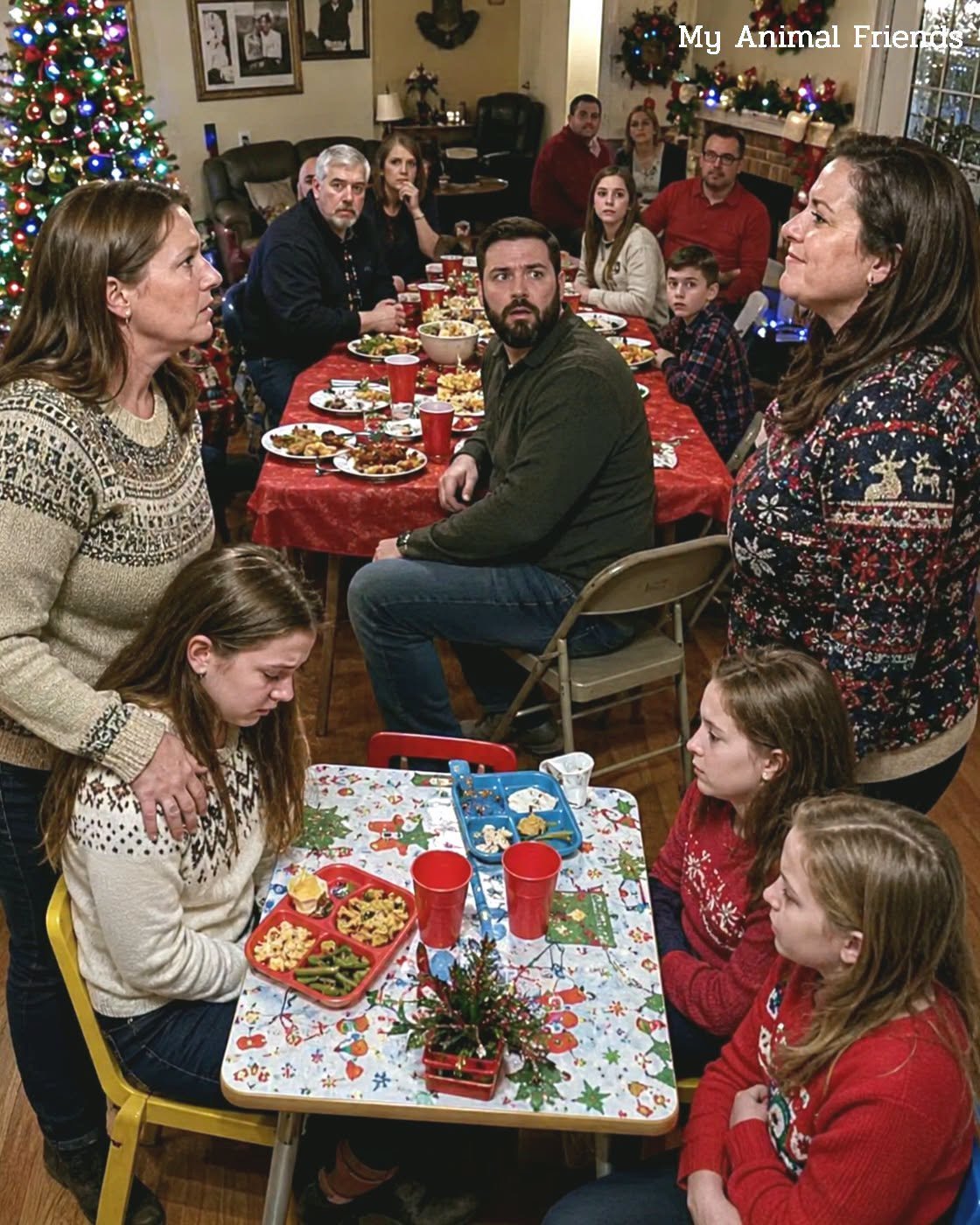
“What now?” My voice was steady, colder than I’d ever heard it. He pushed his chair back without another word.
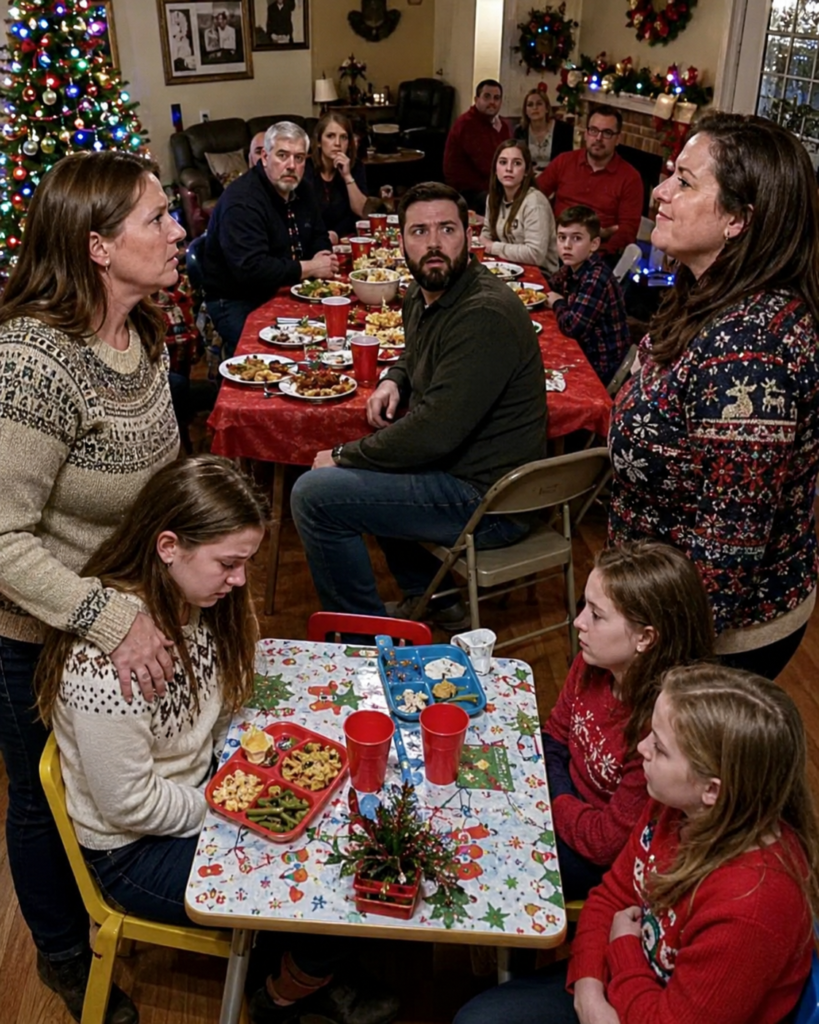
Someone, maybe mom, maybe one of the cousins, asked, “What’s going on?”
I turned, still calm, still quiet. “This is the last time you’ll see us.”
Their faces froze, mouths halfopen, hands hovering in midair. No one laughed.
Then I took Olivia’s hand. She didn’t resist. She just let me pull her up from the table, her small fingers trembling in mine. We walked out of that house without another word. Past the kitchen, past the dining room where the adults sat frozen, past the Christmas tree with its blinking lights, out into the night air, sharp and cold behind us.
The house still hummed with the echo of their laughter, the kind that cuts.
I opened the car door for Olivia, buckled her in. She stared out the window, lips pressed tight, saying nothing. Adam slid into the driver’s seat, glancing at me, but he didn’t ask. Not yet.
The engine started. We pulled away from the curb. Only then did I let myself breathe.
They thought mocking my daughter was just a game. Very soon, Monica would learn how wrong they were. Soon, she will receive a letter and nothing will be the same again.
If you’ve ever wondered what it feels like to grow up as the family’s black sheep, let me save you the suspense. It’s like being invited to a party where everyone else is in on a joke you don’t understand, and the punchline is always you.
I had one sister, Monica, and one brother, Daniel. Between the two of them, they were enough to fill our parents with pride for a lifetime.
Monica was the social one, the golden girl.
Daniel was athletic, charming, the kind of kid every parents about at dinner parties. And me, I was the nerd. Not the fun kind of nerd, either. Not the quirky nose movie trivia nerd, the serious kind. Nose in a book, tinkering with computers before most people knew how to set the clock on a VCR.
My siblings never let me forget it.
When I got glasses, they called me owl and hooted every time I spoke. At dinner, they once pulled my chair out of the room as a prank. Everyone laughed while I stood there, tray in hand, not sure whether to sit on the floor or just disappear.
If I tried to join a conversation, Daniel would sigh and announce, “Shh, the encyclopedia is talking.”
The worst part wasn’t even them. It was mom and dad.
They didn’t join in, but they didn’t stop it either. Sometimes dad chuckled like he couldn’t help himself. Mom would pat my shoulder and say, “Don’t be so sensitive.”
That line became the soundtrack of my childhood.
Don’t be so sensitive when they hid my homework. Don’t be so sensitive when they mocked the way I dressed. Don’t be so sensitive when they joked I must be adopted because how else could I be so different?
I laughed along sometimes because what else could I do?
But inside I knew I didn’t belong. Not really.
And when you grow up knowing you don’t belong, you learn to make yourself useful. That’s how I became the helper, the one who did the dishes, carried the trays, kept the peace.
If I couldn’t be loved, maybe I could at least be tolerated.
Of course, the irony is that all the things they mocked me for, the books, the glasses, the computer obsession, turned into the very things that saved me.
I built a career out of it. Senior software engineer. Good money, good benefits. Adam, my husband, is in tech, too. Two nerds building a nerdy little life together.
Our family works. Theirs, not so much.
And that’s how I ended up paying for a house that wasn’t mine.
5 years ago, when Olivia was six, Monica came to me in tears. Her husband was finding himself, which translated meant he was bouncing between classes and part-time jobs without ever landing on an actual income. Monica was working part-time, too, claiming she couldn’t juggle a career and motherhood.
She’d tried a few side businesses, handmade candles, an Etsy shop, a fitness coaching thing, but they all ended in debt.
She told me she just wanted stability for Madison, a safe home, somewhere her daughter could feel settled.
It started with her asking if I could help with a deposit. “Just a little boost,” she said.
Then the truth came out. Her credit was wrecked from unpaid cards and loans. No bank would give her a mortgage.
So, I did what I thought was the kind thing, the family thing. I bought the house in my name and let her live in it.
It was supposed to be temporary, 6 months, maybe a year, until she and her husband got their finances sorted.
That was 5 years ago.
They pay for the electricity and water. That’s it. I’ve covered every mortgage payment.
And somewhere along the way, the house stopped being mine in their eyes. It became their home, their entitlement.
My name might be on the deed, but in their minds, I was just the nerd with the money.
“Must be nice,” Monica once said when I mentioned a work project. “Just sitting at a computer all day. You wouldn’t even know what to do with that money if you weren’t helping us.”
I laughed it off. That’s what I do.
But later that night, I stared at the ceiling and thought, “Maybe she’s right. Maybe I’ve been paying for acceptance this whole time.”
Of course, I never said that out loud. It was easier to tell myself I was just helping. That’s what family does, right?
And for a while, it worked. Or at least I let myself believe it did.
Adam never liked it. He’s too polite to say I was being used, but I could see it in his eyes. Every month when the mortgage payment came out, every holiday when we showed up with gifts while Monica barely said thank you, Adam would glance at me like he was waiting for me to snap.
I didn’t because deep down I thought maybe this is the price of belonging.
By then, Olivia was already part of our lives.
She and Madison were only months apart in age, growing up side by side. Olivia was quiet, thoughtful, happiest with a book in her hand or a Lego set spread across the floor. Brilliant, but shy, socially awkward, like Adam and me.
In other words, a perfect target for this family.
At first, I convinced myself it was fine. Kids tease, families play favorites. It wasn’t like what I went through.
Except it was.
At Thanksgiving, Olivia tried to tell a story about her science fair project. Monica cut her off mid-sentence. “Let Madison finish first.”
Everyone nodded like it was perfectly normal.
Another time, Olivia brought over a robotics kit she’d built. She explained how the sensors worked, her eyes lighting up. Mom smiled, patted her head, and then immediately turned to Madison. “Show us your cheer routine.”
The room erupted in claps and praise.
Olivia sat down quietly, twisting her hands together, pretending she didn’t care.
I saw it. I felt it. And I told myself it wasn’t serious. That I was imagining it. That history wasn’t repeating.
But after Christmas dinner, there was no denying it anymore.
Something in me shifted that night. I wouldn’t stand by, tray in hand, while Olivia became their new punchline.
Not anymore. It stops here.
The drive home was the quiet kind of silence. The kind that isn’t peaceful, just heavy.
Adam kept his eyes on the road. Olivia stared out the window, her breath fogging the glass. I sat in the front seat with my arms folded so tightly I could feel my fingernails pressing into my skin.
Adam tried once, halfway down the block. “What’s going on?” he asked, his voice careful, like he was testing the temperature of boiling water.
“Later,” I said, my throat was too tight to get into it.
He nodded, but I could feel his confusion bouncing around the car like static. No one spoke again.
By the time we pulled into the driveway, my jaw achd from clenching it.
Inside, Adam tossed his keys into the dish by the door and turned to me. “Okay,” he said. “What was that?”
I pulled off my coat and hung it up slowly because if I moved too fast, I’d probably snap it right in half.
“They were mocking Olivia.”
He frowned.
“Mocking out loud in front of everyone. It wasn’t teasing, Adam. It was organized humiliation.”
His eyebrows shot up. “I didn’t hear anything like that. I just thought they were playing some silly game.”
“Exactly.” My voice was flat, sharp. “They thought it was a game, too.”
Adam looked thrown.
He’s always been the peacekeeper, the one smoothing ruffled feathers at family gatherings while I carried trays. He couldn’t quite process that we’d just detonated Christmas over something he hadn’t even heard.
Before I could answer more, Olivia spoke for the first time since we left the house.
Her voice was small, the kind of voice that makes you lean in because it sounds like it might disappear.
“It was just a joke.”
I turned. She was standing by the couch, still in her coat, staring down at her shoes. Her words cut deeper than anything Monica had said all night.
“If I walked away every time people made jokes about me, I’d have no friends,” she added, almost whispering.
That was the moment my chest cracked because I recognized it. Word for word, thought for thought. It was me, 11 years old, swallowing every barb my family tossed my way and calling it normal.
Adam rubbed his forehead, still confused.
“Olivia, what kind of jokes?”
She hesitated, then her lip trembled. “They said Madison’s smarter than me, funnier, better, that I’m annoying.”
The word hung in the air like a knife.
She blinked hard and added quickly, “But it’s fine. It’s probably true. She is smarter than me.”
Her voice broke on that last word, and it nearly killed me.
I crouched in front of her, took her cold hands in mine. “None of that is true,” I said, steady but fierce. “They weren’t being honest. They were being mean. Jokes that hurt aren’t jokes.”
She shook her head, tears glistening but refusing to fall. “But if I can’t take it, maybe I am weak. Maybe they’re right.”
I wanted to scream.
Not at her, at them. At all of them who’d trained her to think cruelty was a test she had to pass.
Instead, I took a breath.
“No,” I said calm as I could manage. “You are not weak. You are kind. You are brilliant. And people who tear you down don’t deserve you ever.”
Her lips wobbled. The tears came then, rushing fast like she’d been holding them back for hours. She buried her face against me, her small body trembling.
Relief. That’s what it was: relief that someone was finally telling her the truth.
She didn’t have to take it.
I held her until her breathing slowed until the storm inside her passed.
Later, I tucked her into bed. She was quiet, thoughtful, still processing. But I saw something shift in her eyes. A seed planted.
When I came back to the kitchen, Adam was leaning against the counter, arms crossed, looking like he wasn’t sure whether to be angry or bewildered.
“You’ve always said yes to them,” he said. “Always helped, always kept the peace.”
“What happened to that?”
“That was the old me.”
I pulled out a chair and sat down hard. “I kept saying yes, hoping it would mean something. It never did.”
He hesitated.
“But the house, they’re done.” My voice was ice. “I want them out.”
He studied me. “Are you sure? That’s a big step.”
I met his eyes. “I’ve never been more sure of anything.”
For a moment, he looked like he might argue. Then he sighed, shoulders dropping.
“Okay.”
That was all I needed.
I pulled my laptop onto the table. The glow of the screen lit up the kitchen as I drafted the letter. It was short, formal, cold.
Monica and her family had 30 days to vacate the house.
Adam read over my shoulder, lips pressed thin. He didn’t say a word.
When it was done, we sealed it in an envelope. Adam slid it into the outgoing mail pile by the door. I stared at it for a long moment.
That envelope was more than paper and ink. It was the first boundary I had drawn in my entire life. It was the line between the old me, the girl who swallowed jokes until she believed them, and the woman who would never let her daughter live that same fate.
The house was quiet. Too quiet.
No one had called since Christmas. No apologies, no explanations. Maybe they thought I wasn’t serious. Maybe they thought, like always, that I’d fold.
They were wrong.
Very soon, Monica would open that letter. And when she did, nothing in this family would ever be the same again.
3 days later, the call came.
Monica.
I knew what was coming before I picked up. She didn’t disappoint.
“You’ve lost your mind,” she spat down the line. “30 days. You think you can just kick us out like we’re strangers over a joke? You’re pathetic, Hannah. You’ve always been too sensitive.”
There it was again. That old refrain.
Too sensitive.
I let her blow off steam, then said, steady as stone, “It’s not a joke. You have 30 days. I’m selling the house.”
“You can’t sell it,” she shrieked. “We live here.”
“My name’s on the deed. Not yours,” she swore.
Called me selfish, told me I was destroying the family. Then she hung up.
I stared at the phone a moment, half expecting it to ring again straight away. It didn’t.
Not yet.
But later that evening, it did.
Mom.
Her voice was soft, honeyed, like she was tucking me into bed again.
“Hannah, sweetheart, I think we should all take a breath. Don’t do anything rash. Think of Madison. She needs stability. You’ve always been the generous one. Don’t throw that away over one silly night.”
I almost laughed.
Generous. That was a new one.
“It’s not about one night,” I said, my voice flat. “It’s about Olivia and the years of being treated like we don’t count. The letter stands.”
“Hannah, listen.” Mom pressed, syrup thick in her tone. “You’ve helped so much already. Can’t we just move past this? You don’t want to break the family apart.”
I leaned back in my chair. “Family broke itself a long time ago. I just finally noticed.”
The pause stretched.
Then the sweetness cracked like sugar shattering under heat.
“You’ll regret this.” She hissed and cut the line.
So much for honey.
The days crawled by. I knew their tactic. Do nothing, drag their feet, wait for me to fold like I always did, but I didn’t.
I called a realtor, listed the house. He warned me Monica might slam doors in buyer’s faces, might refuse to let people through.
“She can make this miserable,” he said gently, as though I didn’t already know.
“Then she’ll be served,” I said. “Either way, the house is mine, and she’s out.”
I wasn’t bluffing. Not anymore.
The threats kept coming. Lawyers, court, promises they’d never leave. But they knew I had every legal right, and dragging it out would only bleed them dry.
Day 30 came cold and gray.
When I turned onto the street, the moving truck was already there. Monica’s husband wrestled a box down the steps. Monica was barking orders, her face red, her arms folded whenever she wasn’t waving them at him.
My parents hovered nearby, directing traffic like generals.
When they spotted me stepping out of my car, the glares they shot could have burned holes through me.
I crossed the street slowly, the slam of the truck door ringing like a bell.
The driveway was littered with boxes. Monica’s husband muttered curses under his breath as he staggered past me with another load. Mom and dad stacked things by the door, whispering sharp and angry.
That’s when we locked eyes.
Me on the walkway, them on the steps.
Mom dropped a box and stormed toward me.
Dad right behind her.
Monica followed, arms folded tight, venom in her eyes.
“How could you do this to your sister?” Mom demanded. “To us? Over nothing but words.”
Monica jabbed a finger at me. “You were always jealous, always different. You never belonged here.”
The words landed like a weight in my chest.
Heavy. Familiar.
“So that’s it?” I asked quietly. “All these years. I didn’t belong.”
Mom’s face hardened.
No more honey. No more coaxing. Just truth. Bitter and raw.
“You were never like us. You never fit in. And yes, maybe you did try to buy your way into this family. But that was your choice.”
The world went still.
It was what I had suspected my whole life, but never wanted to believe.
And now here it was, said aloud, finally, and undeniable.
I straightened, steady as steel. “No, that was me trying to believe I mattered to you. And now I know the truth. You never wanted me and I’m finally done wanting you.”
Silence.
Behind them, the moving truck roared to life. Monica’s husband shouted her name.
I stepped back, put my hand on the door frame.
“Goodbye,” I said.
And then I closed the door.
About a year later, Olivia came home from school, her backpack bouncing against her shoulder.
She dropped it by the door and said almost casually, “Remember that friend who always made little jokes about me.”
I nodded, bracing myself.
“I don’t sit with her anymore,” she said. “I realized she wasn’t really a friend.”
Before I could answer, she grinned. “I hang out with someone new now. She likes the same books I do. She doesn’t laugh at me. She laughs with me.”
I don’t cry easily, but in that moment, I almost did.
For the first time, Olivia had learned something that took me decades.
You don’t keep people who tear you down. You choose the ones who lift you up.
And then, of course, came the gossip.
Through relatives, I heard what happened to Monica.
After the eviction, they slunk back to mom and dad’s. It lasted two months before the walls cracked. Too many people under one roof, constant fights, tension so thick you could slice it.
Eventually, they left for a cramped rental in a rough part of town.
Gone were the days of side hustles and finding yourself.
Monica clocked in for a full-time job she hated. Her husband traded his creative path for manual labor, coming home [snorts] each night exhausted, bitter, defeated.
They were tired. They were broke. And they were still arguing.
And mom and dad, they were the ones bailing Monica out now, handing her money, covering her bills.
The same parents who once told me I was too sensitive.
The irony wasn’t lost on me.
They chose Monica over me a long time ago. And now she was the weight sinking them both.
I watched Olivia one afternoon curled on the couch with her new friend, giggling over a book they both loved.
The sound filled the house with something I hadn’t felt in years.
Peace.
They thought mocking me was harmless. They thought mocking Olivia was funny.
But in the end, it cost them everything.
And it taught me something I should have known all along.
I never needed their acceptance to begin with.
So, what do you think? Did I go too far or not far enough? Let me know in the comments and subscribe