
People often say time heals every wound. I used to believe them. Now I know that time does not always heal. Sometimes it simply teaches you how to carry the pain without dropping it in front of other people.
The Child Who Changed My Life
My life first changed when I was sixty-one.
It was late afternoon when a police officer knocked on my door. I remember noticing the dust on his shoes before I noticed the expression on his face.
My daughter and her husband had been killed in a head-on collision.
Their three-year-old daughter, Maya, had survived only because they had left her with me that morning.
While the officer spoke, Maya stood in the hallway behind me, holding a stuffed rabbit beneath one arm. One of its ears was already worn thin from being carried everywhere.
She looked from the officer to me, confused by the silence.
“Grandma, when is Mommy coming back?”
There are moments when a person’s heart breaks so completely that the body should not be able to keep standing.
But mine did.
I knelt, pulled Maya into my arms, and held her while the officer quietly stepped away.
That night, I sat beside her bed until she fell asleep. She still did not understand what had happened. She only knew that everyone around her had suddenly started crying.
Within a month, I abandoned my quiet retirement plans.
The guest room became Maya’s bedroom. My bookshelves filled with toys. My peaceful mornings were replaced by cereal bowls, cartoons, missing shoes, and questions I did not always know how to answer.
I learned to sleep lightly again.
I learned the names of animated princesses and talking animals. I learned how to braid hair badly, how to pack school lunches, and how to smile even when grief pressed against my chest.
I expected to raise her alone.
My son Daniel was only twenty-one then. He had a job, friends, and a future that should not have included helping his mother raise a grieving child.
But he surprised me.
Daniel began visiting every weekend.
He repaired Maya’s toys, attended her school performances, and taught her to ride a bicycle in my driveway. He ran behind her for nearly an hour, one hand gripping the back of the seat, until she finally balanced on her own.
When Maya turned around and realized he had let go, she screamed with joy.
Daniel cheered louder than anyone.
At school, Maya once described him as her older brother.
“Except he’s very old,” she added.
Daniel laughed about that for months.
By the time Maya turned eleven, the three of us had become our own little family.
I believed nothing could separate us.
I was wrong.
The Morning They Left
Maya loved the water.
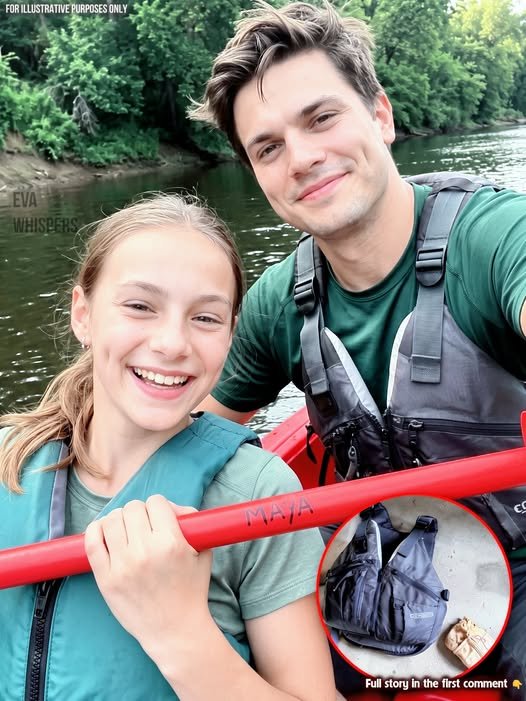
Daniel had taken her kayaking several times, always on calm sections of the river. He had bought her a bright red paddle and written her name along the handle with permanent marker.
By that summer, the letters had begun to fade.
One Saturday morning in June, Daniel arrived carrying two bags of groceries.
Before he could close the door, Maya rushed into the kitchen holding the paddle.
“You promised we could go today!”
“I said we could go if the weather stayed clear,” he replied.
“It did. I checked the forecast.”
Daniel looked at me with amusement.
“She checked the forecast, Mom. She’s eleven years old and already more responsible than I am.”
I handed him a cup of coffee.
“You spoil her.”
“Someone has to.”
Maya ran upstairs to find her water shoes.
As soon as she disappeared, Daniel’s phone vibrated on the kitchen counter.
He looked at the screen but did not answer.
A few seconds later, it vibrated again.
Then a third time.
This time, Daniel picked it up and stepped onto the back porch.
Through the window, I saw him pacing while he spoke. His shoulders were tense, and he kept glancing toward the house.
When he finally returned, the warmth had disappeared from his face.
“Is something wrong?” I asked.
“Just work.”
He avoided my eyes as he lifted Maya’s paddle from beside the wall.
For several seconds, he stared at her faded name.
“Daniel?”
He looked up and forced a smile.
“We’ll leave at eight. The river is only forty minutes away. We should be home before dinner.”
“You’ll keep her life vest on?”
“Every second.”
“You’ll stay in the calm section?”
“I’ve been there dozens of times, Mom.”
Maya came running downstairs with a backpack bouncing against her shoulders.
As they drove away, I stood on the porch and waved.
The red paddle stuck out from the back seat like a cheerful flag.
That image would remain in my mind for the next seven years.
Because Daniel returned without her.

The River
It was four in the afternoon when I heard Daniel’s truck pull into the driveway.
The door slammed with unusual force.
Then there was silence.
No excited footsteps.
No voice calling my name.
No screen door flying open.
I was folding towels in the living room. I placed them on the couch and went to the window.
Daniel stood beside the truck.
He was soaking wet.
His life vest was still fastened across his chest, and water dripped from his clothes onto the driveway. His entire body was trembling.
Maya was nowhere in sight.
I opened the front door.
“Daniel?”
He looked at me.
The expression on his face made my blood run cold.
“Where is Maya?”
His mouth opened, but at first, no sound came out.
Then his face collapsed.
“She went under.”
I gripped the doorframe.
“What?”
“She fell into the river. I tried to reach her. I kept diving, but I couldn’t find her.”
I stared past him, expecting Maya to appear from behind the truck.
She did not.
“What are you saying?”
“She stood up in the kayak. I told her to sit down, but she lost her balance. The current pulled her away.”
His words came between gasps.
“I tried, Mom. I swear I tried.”
My knees gave way, and I sank into the chair on the porch.
I remember telling him to call the police.
I remember hearing my own voice as if it belonged to someone far away.
Daniel sat on the porch floor and covered his face with both hands.
Within thirty minutes, the first officers arrived.
Then came rescue boats, divers, volunteers, and search teams from neighboring counties.
For two weeks, they searched the river and its banks.
They found Maya’s sun hat caught on a branch downstream.
They found one of her flip-flops near a muddy bend.
They never found Maya.
The detective assigned to the case was a patient man with tired eyes. He interviewed Daniel several times.
During the final interview, Daniel asked me to sit beside him.
The detective spoke gently.
“Tell me what happened from the beginning.”
“We were near the shallow bend,” Daniel said. “Maya wanted to move to the other side of the kayak. She stood up. I told her to sit down, but she slipped.”
“Did she have her life vest on?”
“Yes.”
“Did you see her after she entered the water?”
“For a few seconds. Then the current carried her behind the kayak. I jumped in, but I couldn’t find her.”
His story never changed.
Not one detail.
Afterward, I stopped the detective in the hallway.
“My son loved her,” I said. “He would never hurt her.”
The detective nodded.
“Accidents happen quickly on rivers.”
The case was eventually classified as a tragic accident.
And I believed every word Daniel had told me.
Why wouldn’t I?
He looked like a man who had drowned beside his niece but had somehow been forced to continue breathing.
Seven Years of Mourning
Daniel never went kayaking again.
He hung his orange life vest on a hook inside his garage and left it there.
Every time I visited, I saw it.
At first, I assumed he kept it as punishment—a reminder of the day he had failed to save Maya.
Three years after her disappearance, I finally asked him to remove it.
“It isn’t helping you,” I said.
Daniel stood beneath the vest, staring at it.
“I can’t take it down.”
“You cannot keep reliving that day.”
“I know.”
“Then why leave it there?”
His eyes filled with a sorrow I thought I understood.
“I just can’t, Mom.”
I did not push him.
Grief had made strangers of both of us, and I believed we were simply lost in different parts of the same wilderness.
Every year on Maya’s birthday, I placed a candle in the window.
I kept her room almost exactly as she had left it. Her books remained on the shelf. Her drawings stayed attached to the wall. Her stuffed rabbit rested inside a box in the attic because seeing it every day became too painful.
Daniel visited less often as the years passed.
When we were together, we avoided discussing the river.
But sometimes, I caught him watching me with an expression I could not understand.
I thought it was guilt.
I was right.
I simply did not understand what he felt guilty about.
Seven years passed.
Seven birthdays.
Seven Christmases.
Seven summers when I listened to children laughing outside and wondered what Maya would look like if she were still alive.
Then, on an ordinary Saturday morning, my entire understanding of those years shattered.

What Fell from the Life Vest
My garden had produced more vegetables than I could use, so I filled a basket with tomatoes, cucumbers, and zucchini and drove to Daniel’s house.
He was working that day, but I had a spare key.
I let myself in through the side door.
“Daniel?” I called, even though his truck was gone.
The house was silent.
His refrigerator was already full, so I decided to leave the basket on the workbench in the garage, where it was cooler.
The garage smelled of motor oil, old wood, and dust.
As I walked toward the bench, my shoulder brushed against the life vest hanging beside the door.
It swung gently on its hook.
I turned away, as I had done dozens of times before.
Then something dropped from inside it.
The object struck the concrete floor with a soft thud.
I lowered the basket onto the workbench.
A small package lay beneath the vest, wrapped in faded blue cloth.
For reasons I could not explain, my hands began trembling before I even touched it.
I sat down and carefully unfolded the fabric.
Inside was a small black phone, a photograph, and a bundle of postcards held together by a brittle rubber band.
I picked up the photograph first.
The moment I saw the girl in it, I stopped breathing.
It was Maya.
She was older—perhaps fourteen or fifteen—but there was no mistaking her.
She stood in front of a small yellow house with one hand resting on the head of a large brown dog.
She was smiling.
Alive.
Healthy.
Older.
The garage seemed to tilt around me.
I turned the photograph over, hoping for a date or explanation, but there was nothing written on the back.
Then I reached for the postcards.
The earliest handwriting was large and uneven, unmistakably written by a child. The more recent cards were written in the slanted, confident handwriting of a teenager.
Every card ended with a small red heart.
I read the first card.
Then another.
My vision blurred.
Daniel had known.
He had known she was alive.
The final postcard contained only a few words.
“Please tell Grandma soon. I’m ready.”
I read it again.
And again.
Seven years of lighting candles.
Seven years of wondering whether Maya had been frightened in her final moments.
Seven years of blaming a river for taking her from me.
All of it had been built upon a lie.
I sank to the garage floor.
A sound escaped me—half scream, half sob.
Then I reached for my phone and called 911.
The Truth in the Driveway
A police cruiser arrived first.
Daniel’s truck pulled into the driveway several minutes later.
Someone at the station must have called him because he looked frightened before he even stepped out.
Then he saw the police officer.
He saw the open garage.
Finally, he saw me standing beside the life vest with Maya’s photograph in my hand.
His knees nearly buckled.
“Mom…”
“Don’t.”
My voice was shaking, but I held up the photograph.
“Do not call me that until you explain this.”
Daniel covered his mouth with one hand.
“I can explain.”
“Explain how a child who supposedly drowned sent you postcards.”
Tears filled his eyes.
“She’s alive.”
The words struck me harder than any confession could have.
“Where is she?”
“She’s safe.”
“Where, Daniel?”
“With Colette.”
For a moment, I thought I had misheard him.
“Colette?”
She was the sister of Maya’s father—an aunt from the other side of the family whom no one had mentioned in years.
My daughter had strongly disliked her. After the accident, contact between us disappeared completely.
“I hadn’t heard that name in fifteen years,” I whispered.
Daniel nodded.
“Maya had questions about her father’s family. She asked me if there was anyone still alive.”
“And you told her about Colette?”
“Not at first. But she kept asking.”
The officer stood a few feet away, writing quietly.
Daniel’s shoulders shook.
“Colette contacted me that summer. Those calls you saw that morning were from her.”
I remembered the phone vibrating on my kitchen counter.
“You told me it was work.”
“I was trying to handle it.”
“Handle what?”
“Maya had been communicating with Colette for months. She used the computers at the library so neither of us would know.”
I felt sick.
“Why?”
“She wanted to learn about her father. She wanted photographs and stories. Colette made her feel as though we had kept part of her identity from her.”
I gripped the photograph more tightly.
“What happened at the river?”
Daniel stared at the ground.
“Maya told me she planned to leave with Colette.”
“You expect me to believe an eleven-year-old simply decided to disappear?”
“She thought she was going to stay with her for the summer. Colette told her that she could return whenever she wanted.”
“Then why didn’t she?”
Daniel began crying.
“Because once the search started, Colette panicked. Maya panicked too.”
His words came faster now.
“At the shallow bend, Maya jumped out of the kayak. The water was barely above her knees. She ran through the trees to an access road where Colette was waiting.”
“And you came home soaking wet.”
“I searched for her first. I didn’t know Colette had already taken her. I thought Maya might have fallen farther downstream.”
“Then you discovered the truth.”
He nodded.
“Later that evening, Colette contacted me. She said Maya was safe.”
“And instead of telling me, you allowed me to believe she was dead.”
“I panicked.”
“For seven years?”
Daniel pressed his hands against his face.
“I didn’t know how to undo what I had done. By then, police were searching the river. Everyone believed she had drowned. I was terrified that Colette would be arrested and Maya would blame me.”
“So you chose to destroy me instead.”
“I thought knowing she had chosen to leave would hurt you more.”
I stared at him.
“You thought grief was kinder than the truth?”
“I was wrong.”
“You watched me light candles for her.”
“I know.”
“You watched me keep her room untouched.”
“I know.”
“You stood beside me while I mourned a living child.”
Daniel lowered his head.
“I hated myself every day.”
I looked at the postcards.
“You sent her money.”
“Yes.”
“You spoke to her.”
“Mostly through postcards. Sometimes through the phone you found.”
“Did she ever ask about me?”
“All the time.”
“Then why didn’t she come home?”
“She was ashamed. As she got older, she understood what her disappearance had done. She believed you would never forgive her.”
I looked at the final postcard.
Please tell Grandma soon. I’m ready.
My anger did not disappear.
But beneath it, another feeling had begun to rise.
Hope.
Terrifying, fragile hope.
“Where is Maya now?”
Daniel looked up.
“Still with Colette. She’s eighteen.”
I turned to the officer.
“I need to see my granddaughter.”

The Long Road Home
The police reopened the case immediately.
Over the following days, statements were taken and records were reviewed. Daniel cooperated with every question.
Colette was contacted.
Most importantly, Maya’s identity and safety were confirmed.
She was alive.
I repeated those words silently every morning.
Maya is alive.
After seven years of thinking I would never hear her voice again, I barely knew what to do with that truth.
Part of me wanted to get into my car and drive straight to her.
Another part was afraid.
What would I say?
Would she still remember how I hummed while cooking?
Would she remember the stories I told her before bed?
Would she remember that I always cut her sandwiches diagonally because she insisted they tasted better that way?
Or had I become nothing more than an old photograph in someone else’s house?
Daniel came to see me once before Maya returned.
I did not let him inside.
He stood on the porch, looking exhausted.
“I’m sorry,” he said.
“I know you are.”
“I never meant for it to last this long.”
“But it did.”
He nodded.
“I don’t expect you to forgive me.”
“I do not know whether I ever can.”
He wiped his eyes.
“I understand.”
“No,” I said quietly. “You do not. You cannot understand what it means to bury a child without a grave. You cannot understand waking in the night and wondering whether she called for me.”
He lowered his head.
“You will face whatever consequences come from this,” I continued. “And I need distance from you.”
“I understand.”
“But right now, I need you to help bring Maya home.”
He nodded.
“I will.”
One week after I discovered the postcards, a car stopped outside my house.
That morning, I had climbed into the attic and opened the box containing Maya’s childhood belongings.
Her stuffed rabbit lay on top.
I carried it downstairs and placed it beside me on the couch.
When the car door closed outside, my entire body went still.
Footsteps approached the porch.
I opened the front door.
A young woman stood on the other side.
She was taller than I had imagined.
Her hair was longer. Her face had changed. She carried no suitcase, only a small backpack clutched against her chest.
For several seconds, neither of us spoke.
I searched her face for the eleven-year-old child I remembered.
I found her in the curve of her mouth.
In the shape of her eyes.
In the way she pressed her lips together when she was nervous.
But she was also a stranger.
Seven years had happened to her without me.
“Grandma,” she whispered.
Her voice broke on the word.
That single word destroyed every wall I had tried to build around my heart.
I opened my arms.
Maya stepped forward and collapsed against me.
She held me with such force that I could barely breathe.
“I’m sorry,” she sobbed. “I’m so sorry.”
I pressed my face against her hair.
“You’re alive.”
“I didn’t understand what I was doing.”
“You’re alive.”
“I thought I would only be gone for the summer. Then everyone started searching, and Aunt Colette said we could not go back yet. After that, I was afraid.”
I held her more tightly.
“You should have called me.”
“I know.”
“I would have come for you.”
“I know.”
Her body shook as she cried.
“I thought you hated me.”
“I was angry,” I said. “I was hurt. I am still hurt. But I never stopped loving you.”
She pulled back and looked at me.
“Can you forgive me?”
I touched her cheek.
“You were a child. The adults around you should have protected you from making a decision that large.”
Maya lowered her eyes.
“I missed you every day.”
“So did I.”
We went inside and sat together on the couch.
I handed her the stuffed rabbit.
For a moment, she simply stared at it.
Then she pressed it against her chest.
One worn ear brushed her cheek as she began to cry again.
This time, I cried with her.
What Remained
Maya did not move back into my house immediately.
Too much had happened for us to pretend that the missing years could be erased by one embrace.
Instead, we began slowly.
We ate breakfast together.
We looked through old photographs.
She told me about school, about the dog in the picture, and about the years she had spent wondering whether returning would cause more pain than staying away.
I told her about the candles.
I told her about the birthdays.
I told her the truth—not to punish her, but because rebuilding a family requires honesty.
Daniel cooperated with the investigation and accepted responsibility for the choices he had made.
I have not forgiven him completely.
Perhaps one day I will.
Perhaps forgiveness will come gradually, in small pieces rather than one grand moment.
Colette and I have also begun speaking.
Our conversations are difficult.
She believed she was giving Maya a connection to her father’s family. But she allowed an eleven-year-old child to disappear, and then helped keep her hidden.
Good intentions do not erase terrible choices.
Still, Maya loves her.
For Maya’s sake, I am trying to understand without excusing.
I lost seven years.
Nothing will return them.
I will never see Maya at twelve, thirteen, or sixteen. I missed school dances, illnesses, victories, disappointments, and ordinary afternoons that should have belonged to us.
That loss will always exist.
But so will the moment she stood on my porch and called me Grandma.
Most people who lose a child never receive another chance to hold them.
I did.
So I have decided not to spend whatever years remain counting only what was taken from me.
I will count breakfasts.
Birthdays.
Phone calls.
Laughter from the kitchen.
I will count every time Maya walks through my door.
The other evening, she helped me cook dinner.
While I washed vegetables, she noticed the old red paddle leaning in the corner of the garage. Daniel had returned it after the investigation began.
Her faded name was still visible along the handle.
Maya touched the letters with one finger.
“I don’t want to keep running from that day,” she said.
“Neither do I.”
She looked at me.
“Maybe we could go kayaking again someday. Somewhere calm.”
The thought frightened me.
But I understood what she was really asking.
She was not asking to return to the river.
She was asking whether we could create new memories without allowing the old ones to control us.
I placed my hand over hers.
“Someday,” I said.
Then we went back inside together.
This time, neither of us disappeared.