
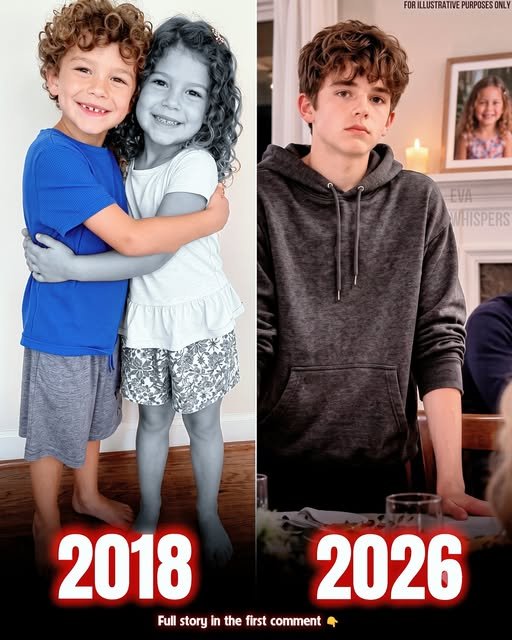
My son did not speak for eight years. His silence began on the afternoon we buried his twin sister. Then, on the anniversary of her death, during a quiet family dinner, Jeremy placed his fork on the table, lifted one trembling hand, and pointed directly at his father. “You always knew why I stopped talking.”
The sentence came out rough and uneven, as though the words had been locked somewhere deep inside him and had rusted with time.
For several seconds, no one moved.
My parents stared at Jeremy in disbelief. My mother’s hand rose slowly to her mouth. My father looked from my son to my estranged husband, waiting for someone to explain what had just happened.
Zane’s face lost all its color.
And in that terrible moment, I understood that my son’s silence had never been empty.
It had been guarding something.
Eight Years of Silence
Jeremy and his twin sister, Janice, had entered the world eleven minutes apart. From their first days together, they seemed connected in a way no one else could fully understand.
As babies, they cried when they were placed in separate cribs. As toddlers, they created their own games and unfinished sentences. By the time they were five, they could communicate with a glance across a crowded room.
They shared toys, secrets, snacks, and dreams.
They even slept more peacefully when their beds were in the same room.
Then Zane took them to the lake.
Only Jeremy returned.
Zane told me Janice had lost her footing near the water. He said the rocks were slippery and the current was stronger than it appeared. According to him, she had fallen before he could reach her.
He jumped into the water.
He searched until exhaustion nearly pulled him under too.
Rescue teams came. Divers searched for days. Volunteers walked along the banks and examined every bend in the river.
Janice was never found.
The authorities eventually described it as a tragic accident.
But no official conclusion could explain why Jeremy stopped speaking.
At the funeral, he stood beside me in a small black suit, his fingers locked around mine. He did not cry. He did not ask questions. He simply stared at the empty coffin surrounded by flowers.
Before that day, he had been a lively child who talked from the moment he opened his eyes in the morning.
After that day, he never said another word.
Not one.
At first, I believed Jeremy’s voice would return after the shock had passed.
Days became weeks.
Weeks became months.
I took him to child psychologists, grief counselors, speech specialists, and trauma therapists. Some believed he was unable to speak. Others believed he was choosing silence because speaking felt unsafe.
None of them could tell me what he feared.
We tried drawing exercises. Music therapy. Journaling. Games designed to help children express difficult memories.
Jeremy participated when asked, but he revealed almost nothing.
At night, I sat beside his bed and read stories aloud. Sometimes I paused deliberately, hoping he might finish a familiar sentence.
He never did.
On difficult evenings, I told him about Janice.
I reminded him how she once wore rain boots to bed because she believed a storm might flood the hallway. I told him about the time she called blueberry pie “birthday pie” because, in her opinion, anything sweet enough deserved candles.
Jeremy usually stared at the ceiling.
But whenever I mentioned his sister, his eyes changed.
There was love in them.
There was also fear.
As the years passed, teachers discovered that Jeremy was exceptionally intelligent. He communicated through writing, gestures, and an electronic tablet. He completed his schoolwork quickly and read books far beyond his grade level.
Yet he remained silent.
His silence followed him everywhere.
It sat beside him in classrooms.
It stood between him and other children.
It filled every room in our home.
My marriage to Zane slowly collapsed beneath the weight of grief. We never screamed at each other. In some ways, that would have been easier.
Instead, we became strangers who spoke only about practical matters.
Jeremy’s appointments.
Household expenses.
School schedules.
Zane moved out when Jeremy was nine. The separation was quiet, just like everything else in our family had become.
Still, every year on the anniversary of Janice’s disappearance, I invited our closest relatives to dinner.
I made blueberry pie.
I placed a small candle beside her photograph.
And every year, Zane came.
He always sat at the far end of the table. He rarely looked directly at Jeremy, and he always found a reason to leave before dessert.
For years, I assumed he could not bear to see the pie.
I was wrong.

The First Words
Jeremy turned thirteen that spring.
On the eighth anniversary of Janice’s death, he behaved differently from the moment Zane arrived.
He watched his father remove his coat.
He watched him greet my parents.
He watched him take his usual seat at the end of the table.
Jeremy barely touched his food. His shoulders remained tense, and his eyes followed every movement Zane made.
Halfway through dinner, Jeremy slowly lowered his fork.
The soft clink against the plate was barely audible.
Yet it silenced the entire room.
He looked at me first.
Then at my parents.
Finally, he turned toward Zane.
His hand rose from the table, and one finger pointed at his father.
“You always knew why I stopped talking.”
His voice sounded unfamiliar, deeper than the voice I remembered, but fragile at the same time.
My chair scraped against the floor as I stood.
“Jeremy?”
His eyes widened as if he had frightened himself.
His breathing became quick and shallow. He pushed away from the table, ran upstairs, and slammed his bedroom door.
I started after him, but Zane reached out and caught my wrist.
“Give him a moment,” he said. “He needs to calm down.”
I looked at Zane’s hand, then lifted my eyes to his face.
For eight years, I had seen sorrow there. Guilt, perhaps. Regret.
But what I saw that night was unmistakable.
Fear.
I pulled my wrist away.
“What did Jeremy mean?”
Zane shook his head too quickly. “This date is difficult for him. He’s overwhelmed.”
“Don’t dismiss this,” I warned him. “Not after eight years.”
“I’m not dismissing anything.”
“Then explain why our son believes you knew the reason for his silence.”
Zane had no answer.
He remained for another twenty minutes, barely speaking. Then, as he had done every year, he left before the blueberry pie was served.
Upstairs, Jeremy refused to unlock his door.
I sat in the hallway and told him I loved him. I promised that he was safe. I told him he could speak, write, or remain silent, and I would still stay with him.
Hours passed.
Near midnight, a folded piece of paper slid beneath his bedroom door.
My hands trembled as I opened it.
The note read:
Before the lake, I heard Dad arguing with Uncle Dean.
Below that, Jeremy had written part of the conversation.
Dad said, “If Nora goes to the board, we could lose the house.”
Uncle Dean said, “Then stop her from talking until this is finished.”
I read the words again and again.
At the bottom of the page was one final sentence.
Janice heard them too.
My legs gave way beneath me.
I sat on the floor outside Jeremy’s room until morning, holding the note in my lap and wondering how much terror a five-year-old boy could carry before it stole his voice.
The Woman Named Nora
At breakfast, Jeremy would not look at me.
He pushed another note across the table.
I found Nora’s name in Dad’s old file box. There was an address.
I wanted to ask how long he had known about it. I wanted to ask whether he had searched the box recently or had remembered the address all these years.
But his face was pale and exhausted.
I did not pressure him.
Instead, I took the note, found my car keys, and drove to the address.
Nora lived approximately forty minutes away in a modest brick duplex. The curtains were open, but the yard looked neglected, as though the person inside had stopped expecting visitors long ago.
When she answered the door, she studied me cautiously.
“Can I help you?”
I held out Jeremy’s note.
“My son spoke last night for the first time in eight years.”
Her expression changed immediately.
“Jeremy?” she whispered.
A chill moved through me.
“You know my son?”
Nora stepped away from the doorway.
“You should come inside.”
We sat across from each other at her kitchen table. I told her everything—the anniversary dinner, Jeremy’s accusation, the argument he remembered, and the note saying Janice had heard it too.
Nora listened without interrupting.
When I finished, she did not begin by talking about Zane, Dean, or our old house.
Instead, she opened a worn folder and placed a faded drawing in front of me.
The picture showed two stick figures beside a wide patch of blue water. In one corner, written in shaky capital letters, were four words:
NORA. BAD MAN. ANGRY.
My throat tightened.
“Janice drew this,” Nora said.
I could barely breathe. “When?”
“The day before the lake trip.”
Nora explained that years earlier, she had worked as a junior accountant for Zane’s family company. On the day Janice made the drawing, both children had been waiting in an office with coloring books while Zane and his brother Dean argued in a nearby room.
“Janice wandered into the hallway,” Nora said. “She probably didn’t understand the financial details, but she heard the anger. She heard my name.”
“And Jeremy?”
“He may have heard more than anyone realized.”
I looked down at my daughter’s drawing.
“What does any of this have to do with his silence?”
Nora’s voice softened.
“He was five years old. He heard adults arguing about keeping someone quiet. His sister heard the same argument. The following day, she disappeared at the lake.”
My stomach turned.
“A child could connect those events,” Nora continued, “even if they were never connected in reality.”
I gripped the edge of the table.
“Tell me directly. Did Zane lie about what happened at the lake?”
Nora answered without hesitation.
“No. Janice’s death was an accident.”
I closed my eyes.
For years, part of me had wondered whether there was something Zane had never told me about the water. Hearing that the accident itself had not been a lie should have brought relief.
Instead, it revealed a different kind of tragedy.
Jeremy had heard a threat.
He had seen his sister become frightened.
Then, the next day, he had watched her disappear.
For eight years, he must have believed Janice died because of something they overheard.
Perhaps he believed speaking would put someone else in danger.
Perhaps he believed his own silence was the only thing keeping me safe.

The Secret Behind Our House
Nora reached into the folder again.
“Did Zane ever tell you what truly happened when you nearly lost your first house?”
The question pulled me back more than a decade.
I had been pregnant with the twins when Zane’s business division began struggling. Our home had been used as security for a company-related loan, and I spent months terrified that we would lose everything before the babies were born.
Then Zane came home one evening and told me an anonymous investor had stepped in. The overdue amount had been covered, giving him time to repair the company’s finances.
For years, I believed Zane had saved our home through determination and clever negotiation.
“I was the investor,” Nora said.
She placed an old loan document on the table.
Our former address was printed across the top.
Next, she showed me copies of internal financial transfers. Losses had repeatedly been moved into Zane’s division, and Dean’s initials appeared beside several of the entries.
“Dean controlled the company’s books at the time,” Nora explained. “He was shifting losses into Zane’s department to make him appear incompetent. If Zane’s division collapsed, Dean could force him out and purchase his shares at a reduced price.”
“And the house?”
“It gave Dean leverage. Zane would have done almost anything to keep you from losing it.”
Nora had discovered the altered entries. She copied the records and warned Zane. Then she used part of her grandmother’s inheritance to provide a temporary private loan, covering the immediate debt while Zane corrected the financial damage.
I stared at her in disbelief.
“You risked your inheritance for us?”
“I did what I believed was right.”
“What happened to you afterward?”
Nora looked away.
“Dean blamed the irregularities on me. Zane knew the truth, but he was afraid that exposing his brother would destroy the family company. He promised he would correct the situation once everything was stable.”
“But he never did.”
“No.”
Her career was damaged. Her professional reputation collapsed. She spent years trying to rebuild a life after being quietly pushed out of the industry.
Meanwhile, Zane had allowed me to believe that he was the one who saved our home.
“Jeremy heard you arguing about this,” I said.
Nora nodded.
“And Janice heard enough to become frightened.”
“Yes.”
“Why didn’t Zane tell me after she died?”
“Because grief changed everything,” Nora replied. “Jeremy stopped speaking. Your family began falling apart. Zane convinced himself that revealing the argument would make Jeremy believe the lake accident had been connected to it.”
“He already believed that.”
“I know.”
Nora removed one final document from the folder.
It was a letter from Zane, dated six weeks earlier.
In it, he admitted that Dean had manipulated the company accounts. He acknowledged that Nora had saved our home and paid for it with her career. He also wrote that Jeremy’s silence had made every difficult truth seem dangerous.
Toward the end of the letter, Zane had written:
I kept waiting for the right time to separate our daughter’s death from the secrets that came before it. Eventually, I realized there would never be a right time. There was only the truth—and my failure to tell it.
The last line was addressed to Nora.
If Claire ever comes looking for answers, please give her this.
I lifted my eyes.
“When did he send it?”
“After the company announced that Dean would receive an honorary leadership position at the founders’ dinner,” Nora said. “Zane told me he was finally prepared to stop protecting his brother.”
“But he still didn’t tell me.”
“No.”
The Confrontation
When I returned home, Zane was sitting on the front porch.
He stood the moment my car stopped.
“Claire.”
I did not invite him inside.
Jeremy stood behind the screen door, watching.
“Did Janice hear you arguing with Dean before the lake trip?” I asked.
Zane glanced toward Jeremy.
Then he lowered his head.
“Yes.”
The admission was quiet, but it landed harder than a shout.
“Did you know Jeremy heard you too?”
“I suspected he had heard part of it. I didn’t realize how much.”
“You knew enough.”
Zane stepped toward me. “I never harmed Janice. What happened at the lake was exactly what I told you.”
“I know.”
His eyes widened.
“I spoke to Nora.”
The remaining strength seemed to leave his body.
I moved closer.
“Our son spent eight years believing his sister died because she heard something dangerous. He believed speaking about it might place someone else at risk.”
“I thought telling him would make everything worse.”
“You did not protect him,” I said. “You left him alone with a terrifying explanation that no child should have had to carry.”
Zane’s voice broke.
“I was afraid he would think I caused Janice’s death.”
“He already did.”
Zane sank onto the porch step and covered his face.
For a moment, I saw not the man who had lied to me but a father who had allowed fear and shame to hollow out everything he loved.
But understanding his fear did not excuse the damage.
“You hid the argument,” I continued. “You hid Dean’s fraud. You hid Nora’s sacrifice. And every year, you came to this house and watched Jeremy sit in silence.”
“I know.”
“No. You are only beginning to know.”
During our separation, Zane had transferred his voting shares in the company to me. At the time, he said grief had damaged his judgment and that he could no longer make objective decisions concerning his family.
For once, he had been completely honest.
The company’s annual founders’ dinner was scheduled for the following week.
Dean was expected to be named honorary chairman.
I decided he would not receive that title.

The Night the Silence Ended
The founders’ dinner was held in a grand ballroom decorated with framed photographs documenting the company’s history.
Dean moved through the room confidently, shaking hands and accepting congratulations before the announcement had even been made.
Nora arrived quietly.
She carried the original records inside a plain black folder.
Before the honorary appointment was announced, I walked onto the stage and asked for the microphone.
At first, the guests smiled politely.
Then I said Nora’s name.
Dean stopped smiling.
I explained how financial losses had been moved into Zane’s division. I described the falsified entries, the pressure surrounding our home, and the private loan Nora had provided to prevent my family from losing everything.
Then I told them what happened afterward.
“Nora paid for Zane’s safety with her career,” I said. “My daughter heard an argument she was too young to understand. My son spent eight years believing his sister’s death was connected to that secret.”
The room had become completely still.
“Jeremy paid for this family’s silence with his own voice,” I continued. “I will not allow Dean to be honored while the people harmed by his actions are expected to remain quiet.”
Nora joined me onstage and presented the records.
A retired accountant who had once supervised her confirmed the handwriting, signatures, and transfer patterns. Two former employees had also provided statements explaining that Dean had blamed them for entries they had never authorized.
Dean attempted to laugh.
“This is nothing more than an old workplace dispute being turned into a public spectacle.”
I faced him.
“Zane transferred his voting shares to me during our separation. I will not approve your appointment. I am also requesting an independent investigation into every financial record connected to your leadership.”
The investigation uncovered years of manipulation, concealed losses, and false internal reporting.
Dean was removed from all leadership responsibilities.
The framed citation prepared for his honorary appointment was taken away before the dinner ended.
Nora’s professional record was formally corrected. The company issued an apology and reached a financial settlement with her.
She accepted enough to recover what she had lost.
She refused the additional amount offered in exchange for her silence.
“I have already been silent long enough,” she said.
That spring, I sold the house Nora had once saved.
It looked much smaller than it had in my memories.
For years, I had seen it as proof that Zane had rescued our family during a crisis. Now I understood that the house represented something else.
Someone else had paid for our comfort.
Someone else had carried the consequences.
I used part of the sale to create the Nora Grant, a small program supporting women who were trying to rebuild their careers after being unfairly pushed out of their professions.
On the day the sale was finalized, Nora stood with me in the empty front yard.
“I used to believe being a good person automatically made someone courageous,” I told her.
Nora looked toward the house.
“They are not always the same thing,” she said. “Sometimes courage is simply telling the truth before silence becomes another kind of lie.”
Remembering With Love
The investigation, the company changes, and the sale of the house became the public conclusion to our story.
But the real ending happened quietly.
Several months later, I was standing in the kitchen making blueberry pancakes.
Jeremy entered and sat at the table.
Since the anniversary dinner, he had begun speaking occasionally. His words came slowly at first. Some days he said nothing. Other days, he managed a full sentence.
We never pushed him.
His therapist reminded us that finding his voice did not mean the fear would disappear immediately. Healing would come in small steps.
That morning, Jeremy watched me pour batter into the pan.
Then he asked, “Did Janice like blueberry pancakes more than the pie?”
The spatula nearly slipped from my hand.
I turned toward him.
His voice was quiet, but clear.
“Yes,” I answered. “She liked the pancakes more.”
Jeremy looked down at his hands.
“I remember.”
I switched off the stove and sat beside him.
For years, every memory of Janice had seemed wrapped in guilt. Her name brought questions, fear, and the crushing weight of everything we had lost.
But as Jeremy began talking about her, the memories slowly changed.
He remembered how she laughed when blueberries stained her tongue.
He remembered how she always demanded the first pancake, even when it was misshapen.
He remembered her wearing rain boots to bed.
He remembered her voice.
And for the first time in eight years, remembering his sister no longer sounded like blame.
It sounded like love.