
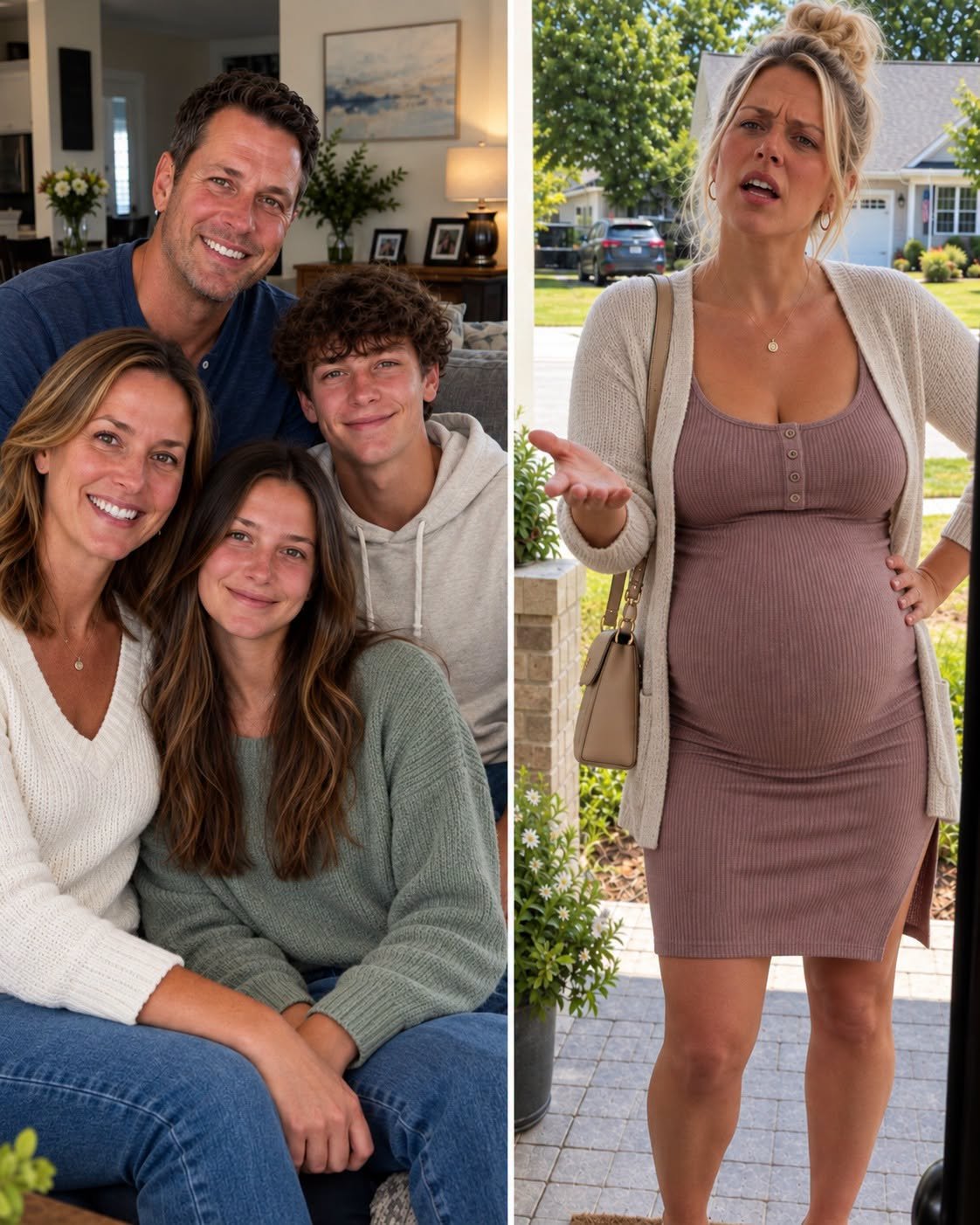
My husband’s mistress came to my door and said, “I’m pregnant with his baby, and we need this house to raise our family.” But what I did next left them both completely stunned.
The Scent I Could Not Ignore
The first undeniable sign was caught in the collar of Tyler’s white dress shirt.
I was standing in the laundry room on a quiet Tuesday morning when I lifted the shirt from the hamper and smelled perfume. It was bright and floral, the kind of fragrance that lingered after someone had already left. I did not own anything like it. For several seconds, I held the fabric in both hands and stared at the pale blue wall as if it might offer a harmless explanation.
Then I placed the shirt in the washing machine with almost ridiculous care. I remember thinking that I was handling it the way a person handles broken glass: gently, even though it has already cut them.
Tyler and I had been married for eighteen years. We had raised two children in that house, measured their heights against the pantry door, and watched them leave for college one year apart. Afterward, the rooms seemed to exhale. The refrigerator hummed louder. The floorboards creaked without being stepped on. Silence settled into the spaces our children had filled, and Tyler and I were supposed to learn how to be a couple again.
Instead, he began disappearing from our life in small, deniable pieces.
He left before sunrise and came home after I had stopped waiting at the dinner table. He took calls in the garage. He kept his phone face down beside his plate. When I asked whether something was wrong, he spoke to me with the tired impatience of a man being inconvenienced by his own secrets.
“It’s a difficult quarter, Debra,” he said one night as he loosened his tie. “I can’t keep explaining the same thing.”
“You haven’t explained anything,” I answered. “You’ve only asked me to stop noticing.”
His expression hardened for half a second. Then he kissed my forehead, called me exhausted, and went upstairs.
There had been other clues. Two calls came to the house that week, but whoever was on the other end hung up when I answered. A credit card statement showed dinner for two at an expensive steakhouse on a night Tyler claimed he had eaten sandwiches in a conference room. Three months earlier, his phone had lit up after midnight with a message from someone identified only as R. The preview read, I keep thinking about Sunday.
Tyler snatched the phone from the nightstand and laughed too loudly. He said it was a joke from someone at work. I wanted to believe him because the alternative would have forced me to examine every compromise I had mistaken for peace.
I had spent years being the reasonable one. I remembered birthdays, paid bills, softened arguments before the children could hear them, and accepted apologies Tyler never quite gave. Whenever doubt pressed against me, I told myself that trust required space. I did not understand that I had been giving him room while making myself smaller.
That morning, with the perfume still clinging to my fingertips, I washed my coffee mug and prepared to leave for a dentist appointment. My grocery list was folded in my coat pocket. My keys were in my hand. I was one turn of the doorknob away from continuing an ordinary day when three firm knocks sounded from the other side.
The knock came again before I could answer. Whoever stood there expected to be let in.
The Stranger on My Porch
The woman outside looked composed enough to have practiced the moment.
She wore a cream-colored coat and held one hand near her stomach. Her hair was smooth, her lipstick perfectly applied, and her smile carried the strange confidence of someone arriving for an appointment. I had never seen her before, but she said my name immediately.
“Debra? I’m Rachel Coleman.” She paused, watching my face. “I’m carrying Tyler’s baby. It’s a boy.”
The hallway seemed to tilt beneath me. My fingers tightened around the edge of the door, and for one wild instant I concentrated on the brass hinge because it was the only object in sight that still made sense.
I expected Rachel to look ashamed, nervous, or even angry. She looked relieved. That hurt in a way I could not yet understand. She was not confessing. She believed she was delivering news that had already been approved.
“How long?” I asked.
“Tyler and I have been together nearly a year.” Her voice softened, but the softness felt rehearsed. “I know this is painful. He told me he spoke to you last week, so I assumed you understood that the marriage was over.”
A fresh layer of betrayal opened beneath the first. Tyler had lied to me for months, but he had also lied to her. He had apparently sent a pregnant woman to my door after convincing her that I had already agreed to disappear.
Rachel continued before I could respond. “We need to make practical decisions now. The baby deserves stability. This house has a yard, several bedrooms, and good schools nearby. Your children are away at college, and you’re here by yourself most of the time. Tyler thought you might be happier somewhere smaller.”
For a moment, grief gave way to disbelief. A stranger was standing on the porch where my children had left muddy shoes, explaining why my life had become too large for me. She spoke about my kitchen, my garden, and my children’s bedrooms as if she were reviewing a property listing.
“What exactly are you asking me to do?” I said.
Rachel drew a quiet breath. “Let Tyler and me have the house. He’ll help you find a suitable apartment. We don’t want this to become ugly, Debra. We want everyone to move forward with dignity.”
Dignity. The word nearly made me laugh, but something colder than anger had begun to settle inside me. It cleared the noise from my mind.
“And Tyler told you I had agreed to this?”
Her smile faltered. “He said the difficult conversation had happened.”
“It hadn’t.”
Rachel blinked. For the first time, uncertainty crossed her face. She recovered quickly and lifted her chin. “Then perhaps he was trying to protect you. Either way, the situation isn’t going to change.”
That sentence told me more than she intended. She did not know Tyler as well as she believed, but she knew enough about our home to covet it. And Tyler, in his arrogance, had promised her something he had no right to give.
I asked her to repeat what she wanted, slowly and without dressing it in concern for me. She did. The baby needed the house. I did not. Tyler would arrange the rest.
Then I stepped back from the doorway. “I need some time. Please wait for Tyler to contact you.”
Rachel studied me, perhaps expecting tears or a scene. My calm seemed to reassure her. She offered a small, satisfied nod, as though politeness meant surrender.
“Of course,” she said. “I know this is a lot to process.”
I closed the door with both hands. I did not slam it. The latch clicked, her heels moved down the path, and only then did my knees begin to shake.

The Papers My Father Made Me Keep
I leaned against the door and listened to my own breathing. Every photograph in the hallway looked suddenly dishonest. Tyler smiling beside me on our wedding day. Tyler holding our daughter after her high school graduation. Tyler standing on a rocky beach in Maine, his arm around my shoulders while his eyes drifted toward a phone outside the frame.
The betrayal did not erase those years, but it changed the light in which I saw them. I could feel grief moving through me, heavy and hot, followed by the humiliating question so many betrayed people ask first: What was wrong with me?
I let the question exist for one breath. Then I refused it.
Tyler’s choices belonged to Tyler. Rachel’s nerve belonged to Rachel. I would not carry their conduct as evidence against my worth.
My eyes landed on the open doorway of the small office. On the wall hung a framed copy of the deed to the house. My father had insisted on the frame after helping me buy the property with money he left in a trust for me.
“Keep the papers where you can find them, Debby,” he had said. “Love people fully, but understand every document you sign.”
At the time, I had teased him for being overly cautious. After his death, the framed deed became a sentimental reminder of the man who had wanted his daughter to feel secure. That morning, it felt like a hand reaching back through time to steady me.
The purchase money had come entirely from my inheritance. The deed carried only my name, and Tyler had signed a written acknowledgment that the property remained mine. He had barely glanced at the paperwork because he assumed a marriage certificate gave him access to anything under our roof.
I walked into the kitchen, picked up my phone, and called my older sister.
Margaret answered on the second ring. “Deb?”
“I need you here. Bring the folder we discussed in the spring. Bring the property papers and the attorney’s notes too.”
She was silent for just long enough to tell me she understood. Months earlier, after the message from R appeared on Tyler’s phone, I had asked Margaret to help me organize my records and check whatever could be confirmed through public sources. I had not been ready to accuse him. I only wanted to know whether I would be safe if my fear turned out to be true.
“Did he finally tell you?” she asked.
“No. She did. She came to my door and asked for the house.”
Margaret inhaled sharply. “I’m leaving now. Don’t sign anything. Don’t promise anything. And don’t be alone with them if they come back.”
Twenty minutes later, her car stopped at the curb. She entered carrying a canvas tote packed with folders, her reading glasses already balanced on her head. Margaret had always been the sister who became steady when everyone else panicked. As children, I cried when I fell from my bicycle; she cleaned the gravel from my knee before she allowed herself to look frightened.
She spread the documents across my kitchen table. We reviewed the deed, the trust distribution, Tyler’s acknowledgment, recent account statements, and the notes from a family-law attorney Margaret had consulted on my behalf. The papers did not remove the pain, but they gave it boundaries.
“The house is protected,” Margaret said. “He cannot simply give it away. The attorney will verify everything before you act, but the title and the money trail are clear.”
I lowered my face into my hands. It was the first moment that morning when I allowed myself to cry. Margaret came around the table and held me without saying that everything would be fine. We both knew it would not be fine for a while. Some losses have to be named before they can be survived.
When the tears passed, she placed one more folder in front of me. Rachel Coleman’s name was written across the tab.
“There is something else you should see,” Margaret said.
The Conversation at My Kitchen Table
The doorbell rang before Margaret could open the folder.
Through the front window, I saw Rachel on the porch again. Tyler stood beside her with his shoulders rounded and his mouth pressed into a thin line. She must have called him from her car, and he must have left the office the instant he realized that the conversation he had invented was about to become real.
When I opened the door, Tyler tried to step toward me. “Debra, we need to handle this calmly.”
The phrase was so familiar that it almost comforted me. For years, calm had meant that I swallowed the wound while he decided how much truth I could bear. This time, calm belonged to me.
“Come in,” I said.
Rachel crossed the threshold first. Her eyes moved over the foyer, paused on the staircase, and traveled toward the living room. I wondered how many times Tyler had described the house to her. Had he told her about the maple tree our son planted in fifth grade? Had he mentioned the loose stair that creaked near the landing? Or had he reduced our home to bedrooms, square footage, and a paid-off mortgage?
They followed me into the kitchen. Margaret sat at the table with the deed and the closed folder arranged in front of her.
Rachel stopped. “I didn’t realize your sister would be involved.”
“You involved yourself in my marriage and my property,” I said. “You can manage one witness.”
Tyler sank into a chair. Rachel remained standing until Margaret pointed to the seat beside him. After a tense pause, she sat.
Tyler cleared his throat. “I am sorry you found out like this. I never meant for Rachel to come here alone. But the baby changes things, and we have to make choices that are best for everyone.”
“Everyone?” I asked. “Name the choice that is best for me.”
He looked down at his hands.
Rachel answered for him. “You would receive help finding a new place. No one is trying to leave you with nothing.”
There it was again, that polished generosity. She was offering me assistance after taking inventory of my life.
I turned to Tyler. “How long has this been going on?”
“It became serious a few months ago.”
Rachel’s head snapped toward him. “Nearly a year, Tyler.”
He winced. Even in betrayal, he had created separate versions of the truth for each woman and expected us never to compare them.
“Did you tell Rachel this house was yours?” I asked.
“I said it was our family home.”
“That isn’t what she asked.” Margaret’s voice was quiet. “Did you tell her you had the right to keep it after a divorce?”
Tyler rubbed his forehead. “I thought we could work something out. Deb doesn’t need all this space.”
The words landed harder than Rachel’s demand because they came from the man who had watched me make that house a home. He had seen me repaint bedrooms at midnight, nurse sick children on the sofa, care for my father during his last winter, and stretch one income when his company struggled. Yet he had decided my right to remain there depended on how efficiently I occupied the rooms.
I slid the deed toward him. “The house was purchased with my inheritance. The title is mine. You signed the acknowledgment yourself. There is nothing to work out.”
Tyler stared at the signature as if someone else had written it.
Rachel leaned forward. “Married people share property. He has rights.”
“My attorney will address legal rights,” I replied. “You came here to discuss what you believed you were entitled to. So let us discuss how you formed that belief. How did you know the house was paid for?”
Her lips parted, then closed.
“Tyler tells me things,” she said at last.
“He does. Especially after a few drinks. At the company holiday party, he complained that my father had structured the inheritance so Tyler could not control it. I was standing close enough to hear him. So were you.”
Rachel’s shoulders tightened.
I remembered her then, not clearly, but enough: a woman near the bar listening while Tyler turned private resentment into entertainment. At the time, she had been only another face from his office. Now I understood why she had remembered every detail.
“You did not begin with the baby,” I said. “You began with the house. That is why you came here before anyone had filed for divorce. You wanted to see whether Tyler had promised you something he could actually deliver.”
“That’s absurd,” Rachel said, but the certainty had left her voice.
Margaret rested her hand on the unopened folder. “Then this should be easy to explain.”

The Truth Tyler Had Refused to See
Margaret pushed the folder across the table. Tyler reached it before Rachel could.
Inside were printouts from public employment pages, court records, archived social posts, and notes from two former employees who had agreed to speak after Margaret contacted them. None of it proved a crime, and Margaret said so. It showed something more personal: a pattern Tyler had been too flattered to question.
At two previous companies, Rachel had become closely involved with senior married colleagues. Both men left their positions within months of the relationships becoming known. Both marriages ended. One former colleague said Rachel had urged him to sell the home he shared with his wife so they could begin a new life with the proceeds. When legal complications delayed the sale, Rachel disappeared before the divorce was final.
The second man had written a public post about being deceived by someone who promised a family while maintaining another relationship. He did not name Rachel, but the dates, photographs, and employment history aligned closely enough to make Tyler turn pale.
Rachel gave a short laugh. “This is gossip assembled by people who hate me. You have no idea what those relationships were like.”
“Perhaps not,” Margaret said. “But Debra knows what this relationship has been like. And Tyler deserves to understand that the language you used with him was not new.”
Tyler read one page twice. Then he looked at Rachel with an expression I had once mistaken for intelligence. It was only dawning fear.
“You told him you needed a home for the family you were meant to have,” he said. “That’s almost exactly what you told me.”
Rachel crossed her arms. “People say similar things when they want a future together. That proves nothing.”
“Are you pregnant?” Tyler asked.
The kitchen went still.
Rachel’s hand moved toward her abdomen, but she did not answer.
“You came here and announced that you were carrying my husband’s son,” I said. “Have you seen a doctor?”
“I took a home test. My appointment is next week.”
Tyler looked up sharply. “Then how do you know it’s a boy?”
Her face changed. It was a tiny shift, but all of us saw it. “I don’t. I said that because you kept talking about wanting another son. I wanted the news to feel real to you.”
Tyler recoiled as though she had struck him. “Is the baby mine?”
“How dare you ask me that in front of them?”
“Answer me.”
She did not.
Her silence did not prove that the pregnancy was false or that Tyler was not the father. It did prove that the confident future they had presented at my door rested on claims neither of them had bothered to verify.
I watched my husband search Rachel’s face for reassurance, and I felt no satisfaction. For eighteen years, I had known the way his eyes crinkled when he laughed, the scar near his thumb, and the exact sound of his footsteps in the hall. Seeing him frightened did not restore what he had broken. It only made the waste of it clearer.
Rachel rose so quickly that her chair scraped the floor. “I will not be interrogated by your wife and her sister.”
“No one is keeping you here,” I said.
She grabbed her purse and turned to Tyler. “Are you coming?”
He remained seated, one hand resting on the papers. When he did not move, Rachel’s expression shifted from anger to calculation. She looked at him, at the deed, and finally at the front door.
She left without saying goodbye.
The door closed, and Tyler began to cry. A year earlier, the sight would have pulled me across the table. That day, I stayed where I was.
“Deb, I made a terrible mistake,” he whispered. “Please don’t decide anything while you’re angry. We have eighteen years together.”
“You are right about the eighteen years,” I said. “That is why you should have protected them. You did not lose this marriage in one morning. You spent months leaving it, one lie at a time.”
He reached for my hand. I moved it into my lap.
“The house remains mine,” I continued. “I am meeting with an attorney tomorrow. We will account for every joint asset properly, and I will request temporary orders so neither of us can move or hide money. You will communicate through counsel about the divorce.”
“Divorce? Just like that?” His voice cracked on the final word.
“There is nothing sudden about this for me. I have been living with the absence of the truth for months. Today, it finally received a name.”
Tyler pressed both palms to his face. “What am I supposed to do now?”
It was the question he had expected me to answer throughout our marriage. This time, I let it remain his.
“Leave my home,” I said.
He looked at Margaret, perhaps hoping she would soften me. She only opened the front door.
Tyler walked past me slowly. On the porch, he paused as if waiting for me to call him back. I did not. When he stepped outside, I shut the door and turned the lock.
Then I stood with my hand on the dead bolt while the grief finally tore through me. Margaret wrapped her arms around my shoulders, and I cried for the husband I thought I had, the years I could not recover, and the woman I had trained myself to silence.
The First Morning That Belonged to Me
The next few days were not triumphant. They were practical, painful, and strangely clear.
I met with an attorney and brought every document my father had told me to keep. I changed the locks after Tyler collected his clothes with Margaret present. I moved my paycheck into an individual account while leaving the joint funds untouched for the legal process. I canceled the extra card on which the steakhouse charge had appeared. Each small action felt less like revenge than returning a misplaced object to its proper shelf.
Telling our children was harder. I did not burden them with every humiliating detail, and I did not ask them to choose sides. I told them their father and I were separating because he had been unfaithful and because trust had been broken beyond what I was willing to repair.
Our daughter cried first. Our son went silent, then asked whether I was safe. That question nearly undid me.
“I am,” I told him. For the first time in months, the answer was true.
On the third morning, I woke before the alarm. Pale light rested across the bedroom floor. For several seconds, habit made me listen for Tyler in the shower or his closet door sliding open. Then I remembered that he was gone.
Pain arrived, but it did not arrive alone. Beneath it was a thin, steady current of relief.
I went downstairs and reached automatically for two mugs. My hand stopped over the second one. I returned it to the cupboard, poured a single cup of coffee, and carried it to the kitchen table.
Margaret was asleep in the guest room after insisting that she stay a few nights. Somewhere down the hall, she began humming in her sleep, the same uneven tune she used to hum when we were girls. The sound made the large house feel warm instead of empty.
For eighteen years, I had occupied the chair nearest the kitchen so I could refill drinks, clear plates, and rise whenever someone needed something. That morning, I sat by the window. It was the chair with the best view of the maple tree and the first strip of sunlight across the yard.
I wrapped both hands around my mug and allowed myself to grieve without questioning the decision I had made. I could miss the life I believed in and still refuse the life Tyler was offering. Love did not require me to surrender my home, my judgment, or my self-respect.
Rachel had arrived expecting me to make room for the future she imagined. Instead, her visit forced every hidden thing into daylight. She came asking for my house. When she left, I still had the deed, and I had my voice again.
The quiet around me no longer felt like abandonment. It felt open.
I took my coffee to the window and watched the branches move in the morning wind. I did not know exactly what would come next. For once, I did not need anyone else to decide it for me.
The future was mine to choose.