
The first tree they cut was the one my grandfather had marked with my height every summer from age four to seventeen.
The second thing they cut was the lock on my north gate.
The third was a certified letter informing me that the Briar Glen Homeowners Association had “exercised its historic firewood rights” across all 9,900 acres of my private forest—and that interfering with their crews could result in fines, liens, and criminal charges.
I read the letter twice.
Then I laid it flat on the hood of my truck and looked past the broken gate.
Thirty yards inside my property, fresh tire tracks pressed deep into the red Arkansas clay. Sawdust floated in the morning light. The clean, sweet smell of white oak hung in the air.
They had cut my grandfather’s witness tree.
They had cut live timber and called it deadfall.
They had cut through a steel chain and called it access.
They had cut six miles of logging road through protected habitat.
They had cut first because they believed I would panic later.
I did not panic.
I photographed the gate.
I photographed the tracks.
I photographed the yellow paint marks on the standing trees.
Then I called the one person in Baxter County who never confused politeness with weakness.
“Claire?” Sheriff Daniel Pike said.
“It’s Whitaker Forest.”
“What happened?”
“Someone cut the north gate and started logging.”
There was a pause.
“How many trees?”
“I can see eleven stumps from where I’m standing.”
“You touch anything?”
“No.”
“Good. Stay outside the gate until I get there.”
“I’m already inside.”
Another pause.
“Of course you are.”
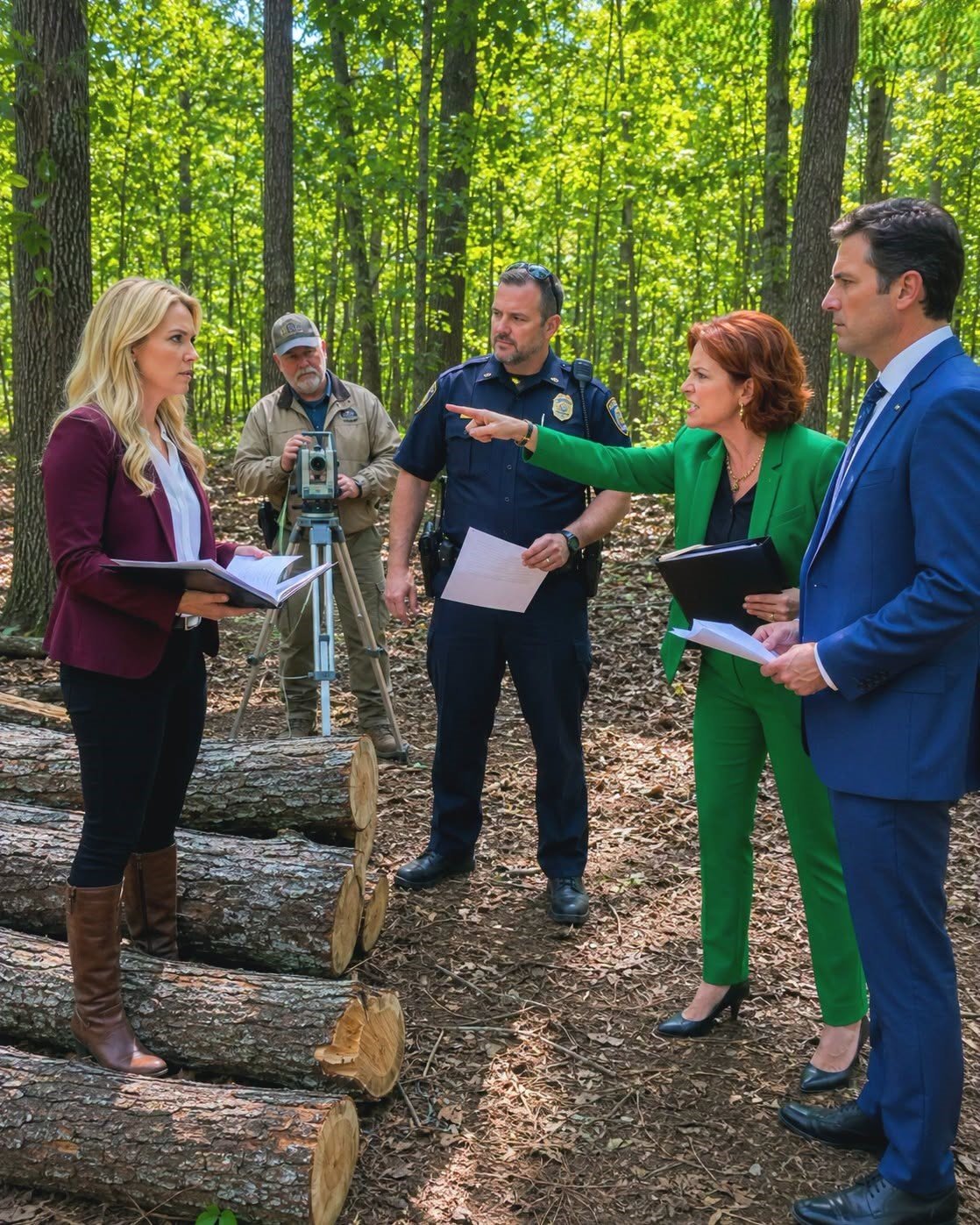
Sheriff Pike arrived twenty-four minutes later in a mud-spattered cruiser, followed by Deputy Elena Ruiz and a county conservation officer named Brent Lawson.
Daniel had known me since high school. He had once driven my grandfather home after a Fourth of July picnic because Grandpa had refused to admit that three glasses of bourbon counted as drinking.
Daniel stepped out, adjusted his hat, and looked at the broken chain.
“Looks like a professional hydraulic cutter,” he said.
“Not bolt cutters?”
“No. Whoever did this came prepared.”
Deputy Ruiz crouched beside the tire impressions.
“Dual rear wheels. Heavy load.”
Brent Lawson walked to the first stump and ran his fingers over the pale wood.
“This wasn’t firewood harvesting,” he said.
“What was it?”
He counted the rings near the bark, then measured the diameter with a folding tape.
“High-grade white oak. Straight trunk. Tight grain. Minimal branching for the first thirty feet.”
Daniel looked at him.
“In English.”
“Barrel wood.”
That got my attention.
“Cooperage grade?”
Brent nodded.
“Could be. A good section of that trunk might be worth thousands after milling. Maybe more depending on quality.”
Behind him stood what remained of my grandfather’s tree.
The trunk had been more than four feet across. The lower section was gone. Only the stump remained, broad and raw, with a dark line where the heartwood had begun to season.
I stepped closer.
On the far edge of the stump, just above the root flare, I found the lowest of Grandpa’s marks.
CLAIRE — 4 YEARS.
The blade had missed it by less than an inch.
The later marks had disappeared with the trunk.
Daniel saw my face.
“You all right?”
“No.”
He waited.
“I’m also not going to do anything stupid.”
“That wasn’t what I asked.”
“It’s the answer that matters.”
A diesel engine rumbled somewhere beyond the ridge.
Deputy Ruiz looked north.
Daniel raised one hand.
A red Ford F-350 came around the bend towing a flatbed stacked with split firewood. The truck bore the green-and-gold crest of Briar Glen Estates.
A second truck followed.
Then a third.
The lead driver slowed when he saw the sheriff’s cruiser but did not stop until Daniel stepped into the center of the road.
The driver rolled down his window.
He was in his mid-fifties, heavyset, with a gray beard and orange safety glasses resting on his cap.
“Morning, Sheriff.”
“Turn off the engine.”
The man hesitated.
Daniel did not repeat himself.
The engine died.
The other trucks stopped behind him.
“Who authorized you to enter this property?” Daniel asked.
The driver reached behind his seat and produced a laminated sheet.
“Briar Glen HOA. We’ve got legal rights.”
Daniel held out his hand.
The sheet was a photocopy of a document titled Community Fuel and Access Easement, dated March 14, 1978.
It claimed that residents of an unnamed “planned residential community lying east of the Whitaker tract” possessed perpetual rights to enter the forest and collect dead, damaged, fallen, excess, or otherwise harvestable timber for household heating.
The document bore my grandfather’s signature.
Or something that looked like it.
At the bottom was the stamp of a notary named Pauline Gentry.
I knew that name.
Pauline had notarized the original deed when Grandpa bought the forest.
She had also died in 1974.
Four years before the easement had supposedly been signed.
I kept my voice level.
“Where did you get this?”
The driver shrugged.
“Office gave it to us.”
“Whose office?”
“HOA management.”
“Who hired you?”
“Briar Glen.”
“Who specifically?”
A woman’s voice came from behind us.
“I did.”
A white Range Rover rolled through the broken gate as if she owned the road.
It stopped beside Daniel’s cruiser.
The driver stepped out wearing cream-colored slacks, polished brown boots, and a quilted green jacket with the Briar Glen crest embroidered over the heart.
Vanessa Halston was fifty-two, controlled, expensive, and permanently arranged for a camera.
She had served as president of the Briar Glen HOA for nine years. Her husband, Grant, had developed the subdivision on the eastern boundary of my land.
Vanessa closed the vehicle door softly.
“Sheriff,” she said. “Claire.”
I looked at the Range Rover’s tires.
Red clay packed the treads.
She had already been deeper in my forest that morning.
Daniel held up the easement.
“You authorize these crews?”
“I authorized the association to exercise rights it has possessed for nearly fifty years.”
“You cut a locked gate.”
“The gate unlawfully obstructed our access corridor.”
“This road belongs to Ms. Whitaker.”
“Not exclusively.”
Daniel pointed toward the stumps.
“Those trees dead?”
Vanessa glanced at them.
“Some were diseased. Others had been designated for sustainable thinning.”
“By who?”
“Our consulting forester.”
“What’s his name?”
“You’ll have to speak with counsel.”
Daniel handed the laminated document to Deputy Ruiz.
“Vanessa, I’m suspending all removal activity until ownership and access rights are verified.”
“You don’t have the authority to suspend a private contractual right.”
“I have the authority to stop possible timber theft.”
Her smile tightened.
“This is not theft.”
“Then you won’t mind leaving the wood here until we sort it out.”
“The association has two hundred and fourteen households depending on that firewood.”
It was late October.
The temperature was sixty-three degrees.
Most homes in Briar Glen had central heat, backup propane, and fireplaces designed more for photographs than survival.
I looked at the neatly split wood on the trucks.
“That came from my oak?”
Vanessa turned to me.
“Our oak, under the easement.”
“No.”
Her expression barely changed.
“That question will be settled by attorneys.”
“You cut the tree my grandfather used to measure me.”
Her eyes shifted toward the stump.
For one second, I saw recognition.
She had known exactly which tree it was.
Then the expression vanished.
“I’m sorry if one tree held sentimental significance.”
“One tree?”
“Claire, you own almost ten thousand acres.”
“Which does not make one acre yours.”
“It makes cooperation reasonable.”
“Breaking my lock was your version of cooperation?”
“The gate should never have been installed across a recorded access route.”
“It’s been there since 1986.”
“Past tolerance does not terminate an easement.”
She spoke too quickly.
Too precisely.
She had rehearsed that line.
I studied her face.
“You expected me to find this today.”
“I expected you to receive our notice.”
“You mailed the notice after you entered.”
“I don’t manage postal delivery.”
Daniel stepped between us.
“That’s enough. Trucks stay. Equipment stays. Nobody cuts another tree.”
Vanessa pulled out her phone.
“I’m calling our attorney.”
“You do that.”
“And the county judge.”
“Call him too.”
“You may regret turning a simple land-use misunderstanding into a public spectacle.”
Daniel nodded toward the three trucks bearing her HOA crest.
“Looks like the spectacle arrived before I did.”
Her gaze returned to me.
“We offered your grandfather a fair arrangement. He understood the community’s needs.”
“My grandfather never signed that document.”
“You’re accusing the association of forgery?”
“I’m telling you the notary died four years before the date on your easement.”
For the first time, Vanessa’s mask moved.
Not much.
Just a slight pull at the corner of her mouth.
She had not known about Pauline Gentry.
But she recovered fast.
“Then perhaps the acknowledgment was added later.”
“By a dead woman?”
“You’re not an attorney.”
“No.”
That was true.
I was not an attorney.
I was a forensic procurement auditor who had spent fourteen years tracing public money through companies that thought adding a second set of books made them invisible.
Paper did not intimidate me.
Paper talked.
Dates talked.
Margins talked.
Staple holes, toner patterns, billing codes, signature pressure, and metadata all talked.
Most frauds were not discovered because the criminal confessed.
They were discovered because the criminal remembered the lie and forgot the printer.
I took out my phone and photographed the easement in Deputy Ruiz’s hand.
Vanessa watched me.
“You do realize,” she said, “that obstructing the association could expose you to substantial liability.”
“Send the invoices.”
“We already have.”
“I mean all of them.”
A truck door slammed behind us.
The bearded crew leader had climbed down.
“Ms. Halston, are we getting paid for today?”
“This is not the time, Mr. Danner.”
“We’ve got fourteen men and two processors in the south section.”
Daniel turned sharply.
“South section?”
Danner looked at Vanessa.
She gave him a warning glance.
Too late.
“How many crews are on this land?” Daniel asked.
Danner removed his cap.
“Three.”
“Where?”
“North road, Millstone Hollow, and the old ranger route.”
My stomach went cold.
Millstone Hollow was nine miles from where we stood.
The old ranger route ran along the deepest stand of mature white oak in the entire forest.
“How long have you been cutting?” I asked.
Danner looked at the ground.
“Today?”
“All together.”
His silence answered before his mouth did.
“Three weeks.”
Vanessa said, “Do not respond further.”
Danner rubbed his beard.
“You told us the owner knew.”
“She does.”
“No,” I said. “She doesn’t.”
He looked at the broken gate, then at my grandfather’s stump.
Something changed in his posture.
“Sheriff, I want my lawyer.”
“You’re not under arrest.”
“I still want one.”
“Fair enough. Hand your keys to Deputy Ruiz and tell your men to shut everything down.”
Vanessa stepped forward.
“You cannot seize association property.”
Daniel looked at her.
“I’m not seizing it. I’m preventing disputed timber from leaving the scene.”
“This county will be sued.”
“Get in line.”
Within an hour, deputies had found eighteen trucks, two tracked feller bunchers, a mobile splitter, four log loaders, three fuel trailers, and a portable office parked inside Whitaker Forest.
They also found a staging yard hidden in an abandoned quarry.
That was where the firewood story started to break.
There were piles of split logs, yes.
But there were also forty-eight full-length white oak trunks stacked with their ends painted blue.
Each trunk was straight.
Each had been selected.
Each had been tagged with a number.
Not firewood.
Inventory.
Brent Lawson stood beside one of the piles, running his hand over the bark.
“This is prime stave timber.”
“For barrels?” Daniel asked.
“Whiskey barrels, probably. Maybe wine.”
“How much?”
Brent looked over the stacks.
“Standing value could be three hundred thousand. Processed value much higher.”
“That’s only what’s here?” I asked.
He nodded.
I looked at the empty trailer tracks leading out of the quarry.
“What was here yesterday?”
No one answered.
The portable office held clipboards, safety forms, delivery schedules, and a locked filing cabinet.
Daniel told his deputies not to force it open.
Vanessa’s attorney arrived just before noon in a black Mercedes that nearly lost its exhaust system on the logging road.
His name was Preston Bell.
He had silver hair, a navy suit, and the expression of a man who billed by the minute and expected every minute to obey him.
He shook Daniel’s hand without warmth.
“Sheriff, my client demands immediate restoration of access and release of all equipment.”
Daniel pointed at the cut gate.
“Your client has plenty of access.”
Preston ignored that.
“This association possesses a recorded easement.”
“Maybe.”
“There is no maybe. It appears in the county record.”
“Which book?”
“Book 162, page 441.”
I looked at him.
“You’ve seen the original?”
“I have reviewed a certified digital copy.”
“That wasn’t my question.”
His gaze moved to me.
“Ms. Whitaker, I strongly suggest you refrain from making allegations until you understand the legal history of your property.”
“I understand the history well enough to know Pauline Gentry was buried in 1974.”
Preston’s eyes flicked to Vanessa.
It lasted less than a second.
He had not known either.
That gave me two things.
The HOA president had not fully briefed her own lawyer.
And whatever they had done, they had believed the document would survive a quick inspection.
Preston adjusted his cuff.
“Errors in acknowledgment do not automatically invalidate the underlying grant.”
“A dead notary is an error?”
“The association will address provenance in the proper forum.”
“Good,” I said. “Bring everything.”
Vanessa folded her arms.
“You seem determined to escalate.”
“You crossed three locked gates, cut live timber, and hid the best logs in a quarry.”
“For sorting.”
“Then bring the sorting records.”
Preston stepped in.
“All further communication should come through counsel.”
“I don’t have counsel yet.”
“I recommend obtaining one.”
“I already called her.”
That was not true.
Not yet.
But it became true eleven minutes later.
Her name was Rebecca Sloan.
She practiced in Little Rock, specialized in timber theft, conservation easements, and complex property litigation, and had once convinced a federal jury that a paper company’s “accidental boundary drift” of eight hundred yards was neither accidental nor drift.
I had met her during an audit involving state-funded land acquisitions.
Rebecca answered on the second ring.
“Tell me nobody’s dead.”
“Only the trees.”
“How many?”
“I don’t know yet.”
“Who cut them?”
“An HOA.”
There was a pause.
“An HOA cut your forest?”
“They claim firewood rights.”
Another pause.
“How much land?”
“They claim rights across all 9,900 acres.”
Rebecca exhaled slowly.
“I’m canceling dinner.”
By sunset, she had filed for an emergency temporary restraining order in Baxter County Circuit Court.
By midnight, she had drafted preservation demands for the HOA, its management company, Vanessa Halston, Grant Halston, Preston Bell’s law firm, Danner Forestry Services, and every vendor listed on the portable office paperwork.
At 1:17 in the morning, she called me.
“Claire, where do you legally reside?”
“Missouri. I moved to Springfield after my mother got sick. The forest is held by Whitaker Land Company.”
“State of formation?”
“Missouri.”
“HOA incorporated in Arkansas?”
“Yes.”
“Excellent.”
“Why excellent?”
“Because if damages clear seventy-five thousand, we have diversity jurisdiction.”
“They’re already over that.”
“And if those logs crossed state lines, we may have more.”
“Civil RICO?”
“Maybe. Don’t fall in love with it yet. Judges hate RICO claims dressed up for ordinary business disputes.”
“This isn’t ordinary.”
“No, but we prove the facts first and choose the weapon second.”
That was why I had called her.
Rebecca did not swing at shadows.
She turned on the lights.
The county judge signed the temporary order at 7:40 the next morning.
No cutting.
No removal.
No destruction of records.
No alteration of electronic files.
No contact with contractors except through counsel.
The order also required the HOA to disclose all timber removed from Whitaker Forest during the previous twelve months.
Vanessa responded by sending an emergency email to every Briar Glen resident.
The subject line read:
LOCAL HEIRESS THREATENS WINTER HEAT PROGRAM.
By breakfast, screenshots were circulating through the county.
The email described me as an absentee landowner who had “inherited vast natural resources but refused to share basic warmth with families, veterans, and retirees.”
It claimed the HOA had responsibly managed deadfall for decades.
It accused the sheriff of political favoritism.
It announced a candlelight gathering at the north gate to “stand for community access.”
The photograph attached to the email showed smiling children beside stacked firewood.
The wood had green bark.
Freshly cut.
Rebecca read the email at my kitchen table while drinking coffee from a mug that said BILLABLE HOURS ARE STILL HOURS.
“She’s building a jury pool,” she said.
“I thought we were going federal.”
“Federal jurors live in communities too.”
“What do I do?”
“Nothing emotional.”
“I wasn’t planning to.”
“Good. No angry interview. No social media argument. No photograph of you standing on a stump with a shotgun.”
“I don’t own a shotgun.”
“Excellent beginning.”
I slid my laptop toward her.
“I do have something better.”
It was an inventory map of Whitaker Forest.
My grandfather had begun it in 1963. My father updated it after taking over management. I had converted the records into a geographic database, dividing the forest into stands based on species, age, soil, slope, and harvest history.
Every marked tree mattered.
The stand near the north gate had not been scheduled for cutting until 2041.
The old ranger route section was managed as mature oak habitat.
Millstone Hollow contained sinkholes, caves, and two nesting sites used by endangered Indiana bats.
Rebecca leaned closer.
“Is there a federal conservation agreement?”
“NRCS Healthy Forests Reserve Program. Signed in 2011.”
“Funding attached?”
“Yes.”
“Active?”
“Yes.”
She sat back.
“Now I’m interested.”
The easement did not transfer ownership to the federal government, but it imposed habitat obligations and brought federal money onto the property.
Unauthorized logging could trigger repayment, penalties, and restoration costs.
It also meant Vanessa’s crews had not merely entered private land.
They had cut inside federally supported conservation acreage.
“Call the NRCS field office,” Rebecca said. “And the U.S. Fish and Wildlife Service.”
“Before or after breakfast?”
“Before Vanessa discovers bats have better lawyers than people.”
By noon, federal wildlife biologist Dr. Mara Ellis was walking through Millstone Hollow.
She was short, sharp-eyed, and unimpressed by expensive boots.
She stopped beside a white oak that had been felled across a limestone opening.
The top branches had crushed a monitoring station.
“Who did this?” she asked.
“The HOA’s contractor,” I said.
She looked toward a cluster of marked trees.
Blue paint bands circled their trunks.
“How many more are marked?”
“At least six hundred across three sections.”
Mara’s jaw tightened.
“Those markings go into the protected buffer.”
“Can you document that?”
“I can document exactly where each tree stands, what habitat function it serves, and what federal agreement it violates.”
She looked at me.
“But I need to be clear. Your family’s enrollment does not automatically create a federal criminal case against the HOA.”
“I understand.”
“It does create reporting obligations.”
“Good.”
“And someone destroyed federal monitoring equipment.”
“Better.”
Mara raised an eyebrow.
“Legally better.”
“Of course.”
She almost smiled.
Briar Glen residents gathered at the gate that evening.
Some held candles.
Some held signs.
OUR HOMES, OUR HEAT.
HONOR THE AGREEMENT.
FORESTS ARE FOR FAMILIES.
A local television crew parked beside the road.
Vanessa stood on a temporary platform in a camel coat, speaking into a microphone.
Behind her, a row of elderly residents sat under blankets.
It was seventy degrees.
Rebecca and I watched from across the road.
“You have to admire the production value,” Rebecca said.
“She scheduled the veterans in front.”
“And put children behind them.”
“Can she use residents as witnesses?”
“She can use anyone willing to repeat what they’ve been told.”
A reporter recognized me and crossed the road.
“Ms. Whitaker, would you respond to allegations that you’ve cut off a decades-old heating program?”
“Yes.”
Rebecca looked at me.
I gave her a small nod.
The camera light came on.
I faced the reporter.
“Briar Glen residents are not losing heat because I stopped anyone from collecting fallen wood. The HOA hired commercial logging crews to cut live, high-value white oak from private land. They broke locks, damaged protected habitat, and removed logs without permission.”
The reporter glanced toward Vanessa’s platform.
“The association says it holds an easement.”
“The document they distributed was supposedly notarized by a woman who had been dead for four years.”
The reporter blinked.
Behind the camera, the operator lowered his head to hide a reaction.
“Are you accusing the HOA of forging a land record?”
“I’m asking them to produce the original.”
“What about residents who need firewood now?”
I pointed toward the western entrance.
“Whitaker Forest has hundreds of cords of storm-fallen wood outside the disputed areas. Beginning tomorrow, any Briar Glen resident who relies on wood as a primary heat source can register directly with my office. We’ll provide one cord at no charge, cut from verified deadfall, with delivery for elderly and disabled residents.”
Rebecca’s eyes turned toward me.
I had not told her that part.
The reporter said, “You’re giving them wood?”
“I’m refusing to let the HOA use vulnerable residents as cover for commercial timber theft.”
On the other side of the road, Vanessa stopped speaking.
Her amplified voice faded.
Every camera turned toward me.
“Do you know how many residents qualify?” the reporter asked.
“We’ll find out.”
“What if it’s all two hundred and fourteen homes?”
“Then I’ll keep my word.”
The clip aired at ten.
By morning, thirty-seven residents had registered.
Only nine used wood as a primary heat source.
Six more used it as a meaningful backup.
The remaining twenty-two admitted they had received annual “firewood allotments” but mostly burned the wood in backyard pits or decorative fireplaces.
One man named Harold Finch called me personally.
“I’m eighty-one,” he said. “Vanessa put me in the front row last night.”
“Do you heat with wood, Mr. Finch?”
“Haven’t since 2009.”
“Why were you there?”
“She said the county was taking away our emergency supply.”
“Did she mention live timber?”
“No.”
“Did she mention commercial logging crews?”
“No.”
“Did she mention barrel-grade oak?”
There was a long silence.
“Barrel wood?”
“Yes.”
“My father worked a cooperage. You don’t split barrel oak into firewood.”
“No, sir.”
“What’s she doing?”
“That’s what we’re finding out.”
He lowered his voice.
“You didn’t get this from me, but the clubhouse basement has been full of shipping paperwork all month.”
“What kind?”
“Freight bills. Vanessa told the maintenance men not to touch them.”
“Do you know who delivered them?”
“No. But there’s a logo. A black barrel with a copper ring.”
I wrote that down.
“Mr. Finch, would you be willing to tell my attorney?”
“Not yet.”
“Why?”
“My daughter’s home is behind on dues. Vanessa’s been threatening a lien.”
There it was.
Not loyalty.
Fear.
“Your name stays with us unless you give permission,” I said.
“You sound like your grandfather.”
“That’s either a compliment or a warning.”
“Both.”
The HOA’s first mandatory disclosure arrived two days later.
It claimed that only eighty-four cords of low-grade firewood had been removed from the forest, all from dead or dangerous trees.
There were no invoices for whole logs.
No mill receipts.
No interstate shipments.
No cooperage buyers.
Rebecca read the disclosure in silence.
Then she held up a single page.
“Vanessa forgot to lie consistently.”
She pointed to the fuel records.
Danner Forestry had billed the HOA for 1,942 gallons of off-road diesel.
“You don’t burn nearly two thousand gallons cutting eighty-four cords,” I said.
“How much would you burn?”
“With three crews? Enough to remove hundreds of tons.”
“Exactly.”
She placed another page beside it.
The HOA had paid $186,400 to Danner Forestry over six weeks.
“That is expensive firewood,” she said.
“Unless the contractor is logging commercially.”
“Or laundering the money.”
“Through what?”
“We find out.”
The original land records should have been simple.
Book 162, page 441.
The county clerk’s office occupied the first floor of a brick courthouse built when people expected public buildings to survive artillery.
The clerk, Janice Bell, had worked there for thirty-two years.
She was also Preston Bell’s older sister.
That did not prove anything.
It did make Rebecca careful.
We requested the physical deed book.
Janice told us it had been transferred to archival storage after water damage in 2017.
We requested the microfilm.
She said the relevant reel had deteriorated.
We requested the backup images.
She said the county had only the certified digital scan.
Rebecca rested both hands on the counter.
“Ms. Bell, this document is evidence in active litigation and subject to a preservation order.”
Janice kept her voice pleasant.
“And I am preserving every record in our possession.”
“Who uploaded the current digital image?”
“Our conversion vendor.”
“When?”
“Between 2018 and 2020.”
“Which vendor?”
“I’d need to check.”
“Please do.”
Janice looked toward me.
“Claire, your grandfather came into this office plenty of times. He wasn’t opposed to neighbors collecting wood.”
“My grandfather let widows and struggling families take fallen branches after storms.”
“That sounds like what Briar Glen is doing.”
“With commercial logging equipment?”
“I wouldn’t know about equipment.”
“Your brother represents them.”
“My brother represents half the county.”
Rebecca slid a copy of the document across the counter.
“Did you notice the subdivision is identified as Briar Glen Estates?”
Janice looked down.
“So?”
“According to the state corporation records, Briar Glen Estates LLC was formed in 1989.”
“The land could have been known by that name earlier.”
“It wasn’t. The developer called the original project Cedar Hills until 1991.”
Janice’s fingers stopped on the page.
Rebecca continued.
“The easement is dated 1978.”
Janice pushed it back.
“I’m not a title attorney.”
“No,” Rebecca said. “You’re the custodian of the record.”
We left with no physical book, no microfilm, and no vendor name.
But we also left knowing Janice Bell had recognized the problem.
That evening, someone broke into the Whitaker forest office.
They ignored three chainsaws, two computers, a locked cash drawer, and a cabinet containing antique survey tools.
They took one thing.
My grandfather’s deed box.
The metal box had held original plats, timber sale contracts, tax receipts, handwritten boundary notes, and seventy years of correspondence.
The thief knew exactly where it was.
The security camera caught a person in a dark jacket entering through a rear window at 2:13 a.m.
Their face was covered.
They were inside for four minutes.
They left carrying the box.
Nothing else.
Daniel stood in the office the next morning, staring at the open cabinet.
“Who knew this was here?”
“Family. Foresters. A few county officials.”
“Vanessa?”
“She visited once with Grant, about twelve years ago.”
“Why?”
“They wanted to buy the eastern ridge.”
“What did your father say?”
“No.”
“Did they see the box?”
“I don’t remember.”
Rebecca crouched beside the window.
“Was the box your only source of originals?”
“No.”
She looked at me.
“Where are the others?”
“Safe-deposit box in Springfield. Scanned archive in a secure cloud account. My father distrusted single copies.”
Daniel smiled faintly.
“I liked your father.”
“He distrusted you too.”
“I know. That’s why I liked him.”
The thief had left a smear of blue paint on the window frame.
The same shade used to mark white oaks for cutting.
That could have been coincidence.
It could also have been someone who had walked through the marked stands.
Daniel sent the sample to the state lab.
Rebecca filed for expedited discovery.
The HOA counterclaimed.
It accused Whitaker Land Company of interfering with easement rights, endangering residents, defaming the association, and violating a fifty-year “course of performance.”
They demanded $4.2 million.
Vanessa gave another television interview.
This time she stood beside a fireplace in the clubhouse.
She described the forest as “historically shared.”
She said my family had “benefited from Briar Glen infrastructure.”
Briar Glen had not existed when my grandfather purchased the land.
Its main road, drainage ponds, and utility corridors all ended at my boundary.
But Vanessa said it smoothly.
People often mistook smoothness for truth.
The case moved to federal court on our motion.
Whitaker Land Company was a Missouri corporation.
Briar Glen HOA was an Arkansas nonprofit.
The claimed damages exceeded the jurisdictional threshold.
The interstate log shipments were not yet proven, but diversity was enough.
United States District Judge Samuel Ortega received the case.
Judge Ortega was sixty-four, patient, and famous for asking quiet questions that ruined loud arguments.
At the first hearing, Preston Bell spent twenty minutes describing community tradition.
Judge Ortega listened.
Then he asked, “Counsel, where is the original easement?”
Preston adjusted his glasses.
“The certified county record is legally sufficient.”
“That was not my question.”
“The physical record was damaged.”
“Where is the microfilm?”
“Apparently degraded.”
“Where is the prior digital backup?”
“The county’s vendor converted the available records.”
Judge Ortega looked at Rebecca.
“Ms. Sloan?”
“We have found three title abstracts prepared between 1982 and 2007. None mentions a firewood easement.”
Preston rose.
“Title abstracts are not conclusive.”
“No,” Judge Ortega said. “But three omissions are interesting.”
Rebecca continued.
“The alleged easement names a subdivision entity that did not exist until eleven years after the document date. It contains a notarial acknowledgment from a woman deceased before execution. It grants rights to harvest live timber but uses a legal description copied from a 1996 boundary survey.”
The courtroom went still.
That last fact was new to Vanessa.
I could tell because she turned toward Preston.
Rebecca placed two enlargements on the evidence screen.
The 1978 easement description included a call reading:
N 41° 18′ 22″ W, 1,427.62 feet to U.S. Forest Service aluminum monument 14-B.
That monument had been installed in 1995.
The survey referencing it was completed in 1996.
Judge Ortega looked over his glasses.
“Mr. Bell?”
Preston stood slowly.
“We will need to investigate.”
“Your client has relied on this document to enter private land with heavy equipment.”
“The association relied on the certified county record in good faith.”
Vanessa’s head turned sharply again.
Preston was building distance.
Judge Ortega said, “Good faith may become relevant to damages. It does not turn a 1995 monument into a 1978 fact.”
He extended the injunction.
He ordered forensic examination of the county’s digital records.
He required the HOA to produce banking, freight, vendor, and electronic communications.
He also required Danner Forestry to disclose every destination receiving timber from Whitaker Forest.
Outside the courthouse, reporters surrounded Vanessa.
She said the ruling was procedural.
She said the association remained confident.
She said no court had found wrongdoing.
All technically true.
Then one reporter asked why the alleged 1978 easement referenced a monument installed in 1995.
Vanessa walked away without answering.
That afternoon, Danner Forestry’s attorney called Rebecca.
They wanted to cooperate.
The meeting occurred at a diner beside Highway 62.
Mr. Danner arrived without his orange safety glasses.
His first name was Owen.
He looked older indoors.
He placed a binder on the table.
“Ms. Halston told me the HOA owned timber rights,” he said.
Rebecca did not open the binder.
“What did you understand those rights to include?”
“Deadfall at first.”
“At first?”
“She changed the scope.”
“When?”
“September.”
“How?”
“She gave us harvest maps.”
“Who prepared them?”
“Halston Development.”
Grant’s company.
“What trees were you instructed to cut?”
“White oak over eighteen inches. Straight sections preferred. No visible rot.”
I leaned forward.
“That isn’t firewood selection.”
“No.”
“Did you ask?”
“Yes.”
“What did she say?”
“That the HOA had a timber revenue agreement and the firewood program was secondary.”
Rebecca’s voice remained neutral.
“Revenue with whom?”
Owen pushed the binder forward.
“Purchase orders are in there.”
The buyer was Ozark Heritage Cooperage, located across the state line in Missouri.
The intermediary was a company called Hearthstone Resource Management LLC.
Hearthstone’s mailing address was a private mailbox in Mountain Home.
Its registered agent was a lawyer in Little Rock.
Its sole member was another LLC.
That company was owned by the Halston Family Trust.
There was our first clean line.
Whitaker oak had been sold across state lines through Vanessa’s family company.
The purchase orders showed 612 premium logs delivered over five weeks.
Total payments: $1,480,300.
The HOA’s financial disclosures showed no matching income.
Rebecca turned a page.
“Where did the money go?”
Owen pointed to the remittance instructions.
“Three accounts. One to the HOA. One to Hearthstone. One labeled restoration reserve.”
The restoration reserve belonged to Halston Development.
Grant Halston’s company.
“How much did the HOA receive?” I asked.
“Two hundred and ten thousand.”
“And Hearthstone?”
“Seven hundred thirty thousand.”
“The rest?”
“Halston Development.”
Rebecca closed the binder.
“Why are you giving us this?”
Owen looked through the diner window.
“My daughter handles billing. She asked why firewood needed export certificates.”
“Did you know the property owner had not consented?”
“I didn’t at first.”
“And later?”
His hands tightened around his coffee cup.
“I started wondering.”
“When?”
“After the north gate.”
“You saw the lock?”
“I saw it cut.”
“Why didn’t you stop?”
He stared down at the table.
“Because I had payroll Friday.”
That was not a noble answer.
It was honest.
Rebecca said, “You understand cooperation does not erase liability.”
“Yes.”
“You may face criminal exposure.”
“Yes.”
“You need separate counsel.”
“I have it.”
“Then why are you here personally?”
“Because Vanessa said you were a rich woman trying to squeeze the HOA. Then I saw that tree.”
“My grandfather’s tree?”
He nodded.
“You don’t cut a marked family tree by accident. It had ribbons, carved dates, and a plaque on the back.”
I had not known about a plaque.
“What plaque?”
Owen looked at me.
“Small brass one. Said ‘First Witness Tree, 1958.’”
The witness tree did more than measure my childhood.
It marked the starting point of my grandfather’s original survey.
Destroying it weakened a visible boundary reference.
That did not change the legal boundary.
But it could help someone create confusion on the ground.
“Who ordered that specific tree cut?” I asked.
Owen did not answer immediately.
“Grant Halston marked it himself.”
My anger came as stillness.
Grant had walked into my forest, touched the tree my grandfather preserved for sixty-five years, circled it with blue paint, and ordered it destroyed.
Not because it was valuable.
Because it testified.
Rebecca watched me.
“Claire?”
“I’m fine.”
“No, you aren’t.”
“No. But I’m useful.”
Owen slid a flash drive across the table.
“This has text messages, route maps, and photos.”
Rebecca did not touch it.
“We’ll arrange forensic collection through counsel.”
He nodded.
Before leaving, he turned to me.
“I’m sorry.”
I looked at him.
“For which part?”
He had no answer.
The federal disclosures arrived in waves.
First came the HOA bank records.
Then Hearthstone’s.
Then Grant’s development company.
Each record created another question.
Hearthstone had transferred $312,000 to a political consulting firm.
The firm had paid $86,000 to a company owned by Janice Bell’s son.
Another $140,000 had gone to Briar Glen Community Outreach, a nonprofit founded by Vanessa.
The nonprofit had paid for the candlelight gathering, television advertisements, resident mailers, and a “winter resilience survey.”
The survey consisted of three questions designed to produce headlines about firewood dependence.
The remaining funds went toward a debt held by Granite State Capital.
Grant’s company owed Granite State $11.6 million.
The loan matured in December.
If he defaulted, he would lose the final undeveloped phase of Briar Glen.
The timber was not keeping elderly people warm.
It was keeping Grant Halston’s company alive.
The HOA board minutes were worse.
For four months, Vanessa had pushed an emergency “woodland stewardship initiative.”
The minutes described storm cleanup, wildfire prevention, and resident fuel support.
No vote authorized commercial sale of live timber.
No vote authorized contracts with Hearthstone.
No vote disclosed that Hearthstone belonged to Vanessa’s family trust.
Two board members had asked for independent legal review.
Their objections disappeared from the final minutes.
One of them was Harold Finch.
The other was the HOA treasurer, a retired accountant named Lena Price.
Rebecca subpoenaed Lena.
Vanessa’s attorneys moved to quash.
Judge Ortega denied the motion in eight lines.
Lena arrived for her deposition carrying three grocery bags.
Preston Bell objected before she sat down.
“What is in those bags?”
“Documents,” Lena said.
“HOA documents?”
“Copies.”
“Taken without authorization?”
“Saved from destruction.”
The room became very quiet.
Rebecca said, “Ms. Price, did you receive a litigation hold notice?”
“Yes.”
“When?”
“October 24.”
“What happened afterward?”
“Vanessa scheduled a records cleanup for October 26.”
“What was to be cleaned?”
“Old minutes, payment records, vendor proposals, and correspondence she called redundant.”
“Did you participate?”
“I copied what I could.”
Preston stood.
“This deposition is suspended until privilege issues are reviewed.”
Rebecca remained seated.
“You can instruct your client not to answer a privileged communication. You cannot suspend a court-ordered deposition because a witness brought evidence.”
“She is an officer of the association.”
“And she is under oath.”
Lena looked at Preston.
“I’m resigning.”
“You should consult counsel before taking any action.”
“I did.”
A man sitting in the corner raised his hand.
“Her counsel.”
Preston turned.
The man introduced himself as Martin Cho, a former federal prosecutor.
That changed the air in the room.
Lena unpacked the grocery bags.
Inside were binders, USB drives, handwritten notes, and printed emails.
One binder contained the original board minutes.
Another contained payment authorizations.
A third contained property research commissioned by Vanessa and Grant eighteen months earlier.
Rebecca opened that binder first.
The report had been prepared by a title consulting firm in Memphis.
Its conclusion was clear:
No recorded rights of entry, timber removal, firewood collection, or community access burdened Whitaker Forest.
The report also identified the 1996 survey and the aluminum monument.
Vanessa had known the HOA possessed no easement.
She had known at least a year before the logging began.
Rebecca looked at Lena.
“Did the board see this?”
“No.”
“Who did?”
“Vanessa. Grant. Preston Bell.”
Preston’s face hardened.
“That answer may disclose privileged information.”
Lena looked at him.
“You sent the invoice to the HOA.”
Rebecca turned a page.
The title firm’s final invoice had been paid from association funds.
That weakened any claim that the report belonged solely to Grant or Vanessa.
“Why was the research commissioned?” Rebecca asked.
Lena’s eyes moved toward me.
“Because Grant wanted the eastern ridge.”
I remembered the offer twelve years earlier.
“What for?”
“He planned another entrance road and eighty luxury lots.”
“There’s no road access through the ridge.”
“He expected Claire to sell.”
“I refused.”
Lena nodded.
“After your father died, Vanessa said you would change your mind.”
My father had died sixteen months earlier.
The logging began fourteen months after his funeral.
Rebecca asked, “What happened when Ms. Whitaker continued to refuse?”
“Grant said ownership was only one kind of control.”
Preston objected.
Lena continued.
“He said if Briar Glen could establish long-term use, access would become harder to deny.”
“Did he mention firewood?”
“Yes.”
“What did he say?”
“That residents had collected branches for years and that custom could be turned into a claim.”
That was not legally enough.
But if they fabricated a document, staged continued use, destroyed boundary markers, and created the appearance of historic access, they could manufacture confusion.
Confusion delayed title.
Delayed title weakened financing.
Weak financing pressured owners to sell.
Grant did not need to win forever.
He needed to make my forest expensive enough to defend that I would accept his offer.
The timber money financed the attack while paying his debts.
One plan served two purposes.
Rebecca asked Lena about the certified easement.
Lena’s hands folded in her lap.
“I saw it for the first time in August.”
“Who presented it?”
“Vanessa.”
“What did she say?”
“That Preston had discovered it in county archives.”
Preston’s attorney, who had joined the deposition by then, placed a hand on his arm.
Rebecca looked at him.
“Mr. Bell, were you aware of that statement?”
On advice of counsel, Preston did not answer.
The deposition ended after seven hours.
Outside, Lena stood beside my truck.
“I should have come sooner,” she said.
“Yes.”
She looked surprised by the directness.
I continued.
“But you came before the records were gone.”
“That doesn’t erase what happened.”
“No.”
“Do you hate everyone in Briar Glen?”
“No.”
“Even after the signs?”
“Most people believed what they were told.”
“Some wanted to believe it.”
“That’s different.”
She looked toward the federal building.
“What will happen to the HOA?”
“That depends on the truth.”
“And the residents?”
“I’m trying not to make them pay for their board’s crimes.”
“You may not have a choice.”
“We always have choices. The law just makes some of them expensive.”
The forensic examination of the county record system produced the result we expected.
The easement scan had been uploaded on July 11, not during the conversion project years earlier.
The file’s creation metadata identified a commercial scanner located inside Preston Bell’s law office.
The PDF had been opened and edited by a user account named PBELL-LAW.
The county indexing system showed Janice Bell had manually inserted the image into Book 162, page 441, replacing a blank page between two unrelated mineral leases.
The original page numbering had been altered.
A prior backup showed no easement.
Janice retained counsel.
Then she took administrative leave.
Preston withdrew from representing the HOA.
Then he retained criminal counsel.
Vanessa hired a new legal team from Dallas.
Their first move was to blame Preston.
Their second was to blame Janice.
Their third was to claim Vanessa had relied on both in good faith.
The text messages from Owen Danner’s drive made that difficult.
One message from Vanessa to Grant read:
P says county image is live. J confirmed no one requests paper books anymore.
Another read:
We need visible use before Claire’s next inspection. Wood crews provide that. Residents provide witnesses.
Grant replied:
Take the witness oak first. Remove plaque.
The message was dated three days before my grandfather’s tree fell.
I read it once.
Then I closed the document.
Rebecca sat across from me.
“Say something.”
“What?”
“Anything.”
“I’m deciding whether I want the plaque back more than I want to know where they threw it.”
“Those aren’t mutually exclusive.”
“No.”
She waited.
“They thought cutting it would cut the story,” I said.
“Instead?”
“It gave us a beginning.”
The civil complaint expanded.
Trespass.
Conversion.
Timber theft.
Fraud.
Civil conspiracy.
Breach of fiduciary duty.
Spoliation.
Violations of federal and state racketeering statutes.
Claims arising from interstate wire communications and shipments.
Restoration costs for protected habitat.
Treble damages where permitted.
Punitive damages.
Attorney’s fees.
The complaint named the HOA, Vanessa, Grant, Hearthstone, Halston Development, and several related entities.
We did not name individual residents.
Vanessa’s new attorneys offered mediation.
Their opening proposal was astonishing.
The HOA would stop cutting.
Both sides would dismiss claims.
I would grant a limited firewood easement.
The HOA would pay $250,000.
The terms would remain confidential.
Rebecca read the offer aloud in my office.
When she finished, I said, “No.”
“Would you like to pretend to consider it?”
“No.”
“Good.”
We countered.
Full admission of no easement.
Permanent surrender of all access claims.
Restoration funded by the wrongdoers, not ordinary HOA members.
Transfer of every remaining log.
Repayment of all timber proceeds.
Removal of Vanessa and complicit directors.
Independent financial oversight.
Public correction.
Personal guarantees from Vanessa and Grant.
Preservation of criminal referrals.
They rejected it in fourteen minutes.
Winter arrived early.
A cold front dropped the temperature to twelve degrees.
My crews delivered firewood to fifteen qualifying Briar Glen households.
Harold Finch received the first cord.
He stood beside the truck in a red flannel shirt and watched us stack it under his lean-to.
“My daughter says Vanessa told people you put tracking chips in the wood,” he said.
“Did she?”
“Vanessa says many things.”
“Are you worried?”
“I split one open.”
“No chip?”
“Only termites.”
“Those are the forest’s surveillance program.”
He laughed.
Then his face became serious.
“They’ve scheduled a special assessment.”
“How much?”
“Eight thousand dollars per home.”
“For legal fees?”
“Legal defense and winter operations.”
“That would raise over one and a half million.”
“I know.”
“Did they disclose insurance coverage?”
“No.”
“Did they disclose the timber income?”
“No.”
I leaned against the truck.
“Harold, residents need their own lawyer.”
“Lena’s organizing them.”
“Good.”
“You won’t object?”
“Why would I?”
“Vanessa says you want the HOA bankrupt.”
“I want the people who profited to pay.”
“Sometimes courts don’t separate people from institutions.”
“That’s why you need counsel.”
He studied me.
“You really don’t hate us.”
“I hate what happened.”
“That’s not the same?”
“No.”
He looked toward the ridge.
“When Briar Glen opened, your grandfather let me collect storm limbs. My wife had cancer. Medical bills ate everything.”
“I didn’t know.”
“He made me sign a card.”
“A contract?”
“No. A Christmas card. Said I had to promise that when I could help someone else, I would.”
“That sounds like him.”
“I kept the card.”
Harold rubbed his hands together.
“He never called it a right.”
“What did he call it?”
“A neighbor.”
The resident group hired counsel.
Ninety-three homeowners joined.
They sued Vanessa, Grant, and the former management company for breach of fiduciary duty, undisclosed conflicts, and misuse of HOA funds.
Judge Ortega coordinated discovery.
Vanessa’s control began to fracture.
Board members resigned.
The special assessment failed.
The management company terminated its contract.
The HOA’s insurer issued a reservation-of-rights letter, warning that intentional fraud might not be covered.
Grant missed his December loan payment.
Granite State Capital began foreclosure proceedings on Briar Glen’s undeveloped phase.
Then someone set fire to the quarry.
The call came at 3:41 a.m.
By the time I arrived, flames had consumed the portable office and reached the edges of the log stacks.
Volunteer firefighters fought the blaze in freezing rain.
The blue-painted white oak trunks smoked but did not fully ignite.
Sheriff Pike stood beside an engine, water running from his hat.
“Accelerant,” he said.
“How do you know already?”
“Fire started in four places.”
“Records?”
“Portable office is gone.”
“The filing cabinet?”
“Still inside.”
“Can it survive?”
“Maybe.”
Rebecca arrived in a raincoat over pajamas.
She looked at the fire, then at me.
“Preservation order,” she said.
“I know.”
“Who knew evidence was stored here?”
“Everyone in the case.”
Daniel joined us.
“We found tire tracks on the western service road.”
“What kind?”
“Passenger SUV. Wide tires.”
“Vanessa’s Range Rover?”
“Too early to say.”
The fire crew recovered the filing cabinet at dawn.
Its exterior was blackened.
The lock had melted.
Inside, waterlogged documents clung together in charred bundles.
A fire investigator photographed every layer.
The bottom drawer contained freight seals, log tags, and a notebook wrapped in a plastic equipment manual.
The notebook belonged to Owen Danner’s site supervisor.
It recorded every truck leaving the quarry.
Dates.
Weights.
Driver names.
Destinations.
One column was labeled BGE.
Another was labeled HSR.
A third was labeled W-RES.
The final entries extended two months earlier than Owen’s disclosed records.
The logging had started before the HOA’s formal contract with Danner.
Another contractor had been there first.
W-RES shipments went to a rail siding in northern Arkansas.
From there, they traveled to Tennessee.
The buyer was not a cooperage.
It was Western Reserve Architectural Salvage.
The company specialized in reclaimed historic timber.
But the trees were not reclaimed.
They were fresh-cut old-growth oak sold as “pre-Civil War recovered structural stock.”
Rebecca stared at the invoices.
“They sold living trees with fake histories.”
“Why?”
“Reclaimed historic timber commands a premium.”
“How much?”
She turned the page.
A single thirty-foot beam had sold for $48,000.
The first contractor had removed only seventy-six trees.
Those trees had generated more than $3.8 million.
None of that money appeared in the HOA books, Hearthstone’s accounts, or Grant’s known companies.
The payment recipient was a trust in Delaware.
The beneficiary was listed as WPF Holdings.
I recognized the initials.
Whitaker Preservation Fund.
That had been the name of my father’s private conservation account.
For the first time since the case began, I lost my calm.
Not loudly.
I did not shout.
I sat down hard in Rebecca’s office and read the beneficiary line again.
WPF Holdings.
Same initials.
Same spacing.
Same name my father had used for decades.
Rebecca closed the blinds.
“What are you thinking?”
“That my father was involved.”
“Based on initials?”
“Based on more than initials.”
I opened the secure archive on my laptop and pulled up old financial statements.
My father’s preservation fund had used the phrase WPF Holdings for land purchases through separate entities.
The logo was different.
The jurisdiction was different.
But the name was identical.
“Could someone be impersonating it?” Rebecca asked.
“Yes.”
“Could your father have created the Delaware trust?”
“Yes.”
“Did he ever sell timber without recording it in company books?”
“Not that I found.”
“You audited him?”
“After he died.”
“Why?”
“Because he taught me to verify everyone.”
“Even family?”
“Especially family.”
Rebecca leaned back.
“Did you find missing money?”
“No.”
“Hidden accounts?”
“One. About forty thousand dollars. It paid medical bills for former employees.”
“Anything suggesting millions?”
“No.”
“Then do not let one shell-company name rewrite your father.”
“I’m not.”
“You are.”
I looked at her.
“What do you suggest?”
“Follow the money.”
We subpoenaed the Delaware trust.
The trustee resisted.
Judge Ortega ordered production.
The trust had been formed nine months before my father’s death.
Its authorized representative was not my father.
It was Grant Halston.
The similarity to my father’s preservation fund was intentional.
Someone wanted invoices to look connected to Whitaker interests if discovered.
The trust funds had purchased land, made loan payments, and transferred money to three recipients.
Grant.
Vanessa.
And a person identified only by the initials D.W.
The largest transfer was $1.2 million.
D.W. had also received monthly payments for fourteen months.
My initials were C.W.
My father’s were Thomas Aaron Whitaker.
D.W. could have been anyone.
Then Rebecca found a note in the fire-damaged notebook.
D.W. approved old stands. Says family won’t survey until spring.
Someone with knowledge of my family’s inspection schedule had helped identify the oldest trees.
Someone close enough to know we surveyed after winter leaf drop.
Daniel ran names.
Former employees.
Consultants.
Relatives.
Foresters.
One name fit too well.
David Whitaker.
My father’s younger brother.
My uncle.
He had worked in the forest for twenty-seven years.
He had taught me to drive a skidder.
He had carried my grandfather’s casket.
He had stood beside me at my father’s funeral with one hand on my shoulder and told me the forest would always remember our family.
David lived in Tulsa now.
He claimed arthritis had forced him out of forestry.
He had visited Whitaker Forest twice in the previous year.
Both visits occurred shortly before illegal cutting began in new sections.
I called him.
He answered cheerfully.
“Claire-bear.”
No one else called me that.
“Where are you?”
“Home. Why?”
“I need to ask you something.”
His voice changed by less than a degree.
“All right.”
“Do you know Grant Halston?”
“I’ve met him.”
“How well?”
“Not well.”
“Have you received money from WPF Holdings?”
Silence.
Not confusion.
Silence.
“Where did you hear that name?” he asked.
“Answer the question.”
“You need to be careful what you accuse family of.”
“I haven’t accused you.”
“You called asking about secret money.”
“I called asking whether you received it.”
Another silence.
Then he said, “Your father promised me part of that forest.”
My hand tightened around the phone.
“He promised you what?”
“Not on paper.”
“Then tell me exactly what he said.”
“He said we built it together.”
“That is not a promise of ownership.”
“He knew I deserved more.”
“Did you receive money from Grant?”
“Your father left me eighty acres of scrub and an old equipment shed.”
“You sold both for nine hundred thousand dollars.”
“And you got 9,900 acres.”
“The land belonged to the company before he died.”
“The company belonged to him.”
“And you owned twenty percent until you sold your shares in 2002.”
“I had debts.”
“You chose to sell.”
“You always sound like him when you want to make selfishness sound orderly.”
I stood and walked to the window.
Rebecca watched from across the room.
“Did you identify stands for Grant?” I asked.
David’s breathing changed.
“Claire, listen to me. Grant said he had legal access.”
“Did you identify the stands?”
“I thought he was negotiating with you.”
“Did you receive $1.2 million?”
“I was owed more than that.”
The room became silent except for the faint hum of the heater.
There was the betrayal.
Not shouted.
Not confessed with dramatic pride.
Just justified.
That was how most people crossed the line.
They convinced themselves the line had been drawn unfairly.
“You marked my grandfather’s witness tree?” I asked.
“No.”
“Grant’s message says he did.”
“I told him not to touch that one.”
“But you showed him where it was.”
“He already knew.”
“You showed him the old ranger stand.”
“I helped your family manage that forest before you could spell oak.”
“And then you sold its location.”
“I sold knowledge your father took for granted.”
“You helped steal live trees.”
“I was correcting an old imbalance.”
“You forged records?”
“No.”
“You knew about the easement?”
“He said lawyers had handled it.”
“Did you know the timber was being sold?”
“Yes.”
“Did you know the HOA residents were being used as cover?”
“I didn’t ask.”
“That is not the same as not knowing.”
He lowered his voice.
“Claire, you can still end this.”
“How?”
“Sell the eastern ridge. Grant will settle. The residents keep their homes. You keep the rest of the forest. Everyone walks away.”
“You’re negotiating for him?”
“I’m telling you what happens if you don’t.”
“What happens?”
“Things come out.”
“What things?”
“Your father wasn’t the saint you remember.”
“My father never claimed to be a saint.”
“He hid things.”
“So do you.”
“He hid something under the old ranger station.”
I looked at Rebecca.
She could hear David through the speaker.
“What?” I asked.
“Ask your lawyer why federal agents requested the 1986 survey.”
“I don’t know what you’re talking about.”
“You will.”
The call ended.
For three seconds, neither Rebecca nor I moved.
Then she said, “That was either a threat, a distraction, or both.”
“He wants me at the ranger station.”
“Which means we do not go alone.”
We called Daniel.
He called the FBI field office already reviewing the interstate fraud evidence.
By sunset, federal agents had secured the old ranger station.
The structure stood near the center of the forest, a one-room stone building built by the Civilian Conservation Corps in 1937.
My family used it for maps, controlled-burn tools, and emergency shelter.
David had helped restore it in the 1980s.

The 1986 survey hung above the fireplace.
Or it had.
When we arrived, the frame was empty.
Special Agent Nora Velez examined the stone wall.
“Someone removed it recently.”
“How recently?” I asked.
“Clean rectangle. Less dust than surrounding surface.”
Daniel checked the back room.
“Door’s locked.”
“It’s always locked,” I said.
“Key?”
I opened a cabinet and removed it from a hook.
The key turned.
Inside were shelves of old maps and fire equipment.
Agent Velez studied the floor.
“Why is that cabinet bolted to the wall?”
“It holds flare boxes.”
She checked behind it.
The cabinet shifted.
The bolts were false.
Four agents moved it aside.
Behind the cabinet was a narrow steel door.
I had spent half my childhood in that station.
I had never seen it.
Daniel looked at me.
“You know about this?”
“No.”
The door had no handle.
Only a circular keyway.
Agent Velez photographed it.
“We’ll need a warrant before forcing entry.”
“It’s my building.”
“And potentially evidence in a federal investigation.”
“What kind?”
“The kind where your uncle warns you about hidden material after receiving money from targets of that investigation.”
The warrant arrived the next morning.
A locksmith opened the door in nineteen minutes.
Behind it, concrete steps descended into darkness.
The chamber below measured twelve feet by twenty.
Metal cabinets lined the walls.
A dehumidifier hummed in one corner, still powered through hidden wiring.
On a table sat survey equipment, sealed document tubes, and a steel case marked with the emblem of the United States Department of Agriculture.
Agent Velez raised a hand.
“No one touches anything.”
The first cabinet contained decades of aerial photographs.
The second held mineral surveys.
The third contained correspondence between my grandfather and federal agencies.
The steel USDA case held soil samples, cave maps, and records from a classified Cold War-era land study that had apparently never been completed.
Nothing immediately explained the timber theft.
Then Agent Velez opened a document tube.
Inside was a map of Whitaker Forest dated 1986.
Large sections were shaded in red.
A note in my grandfather’s handwriting read:
SUBSURFACE RIGHTS RESERVED. NEVER TRANSFER WITH TIMBER OR SURFACE ACCESS.
Another map marked six limestone cavities.
One extended beyond my western boundary onto federal land.
A geologist’s report described deposits beneath the forest.
Not oil.
Not coal.
Rare-earth mineral indicators.
The report repeatedly warned that commercial value was unconfirmed.
But in the margin, my father had written:
Grant H. asked again. Do not disclose. David talks when drinking.
I felt the blood leave my face.
Grant had not wanted eighty luxury lots.
Not really.
The ridge offered access to the subsurface formations.
The timber scheme had funded a manufactured easement claim.
The easement claim created recurring access.
Recurring access could become leverage for roads, surveys, drilling, and eventually mineral rights litigation.
The oak trees were valuable.
What lay beneath them might be worth billions.
Agent Velez looked at Rebecca.
“This just became larger.”
The words landed like a door slamming shut.
The federal court case was no longer about firewood.
It had never been about firewood.
The next forty-eight hours moved quickly.
Agents searched Halston Development’s offices.
They searched Vanessa and Grant’s home.
They searched Preston Bell’s law firm.
They searched David’s house in Tulsa.
David was not there.
His car was found at a private airfield outside Tulsa.
Flight records showed he had chartered a plane to Belize.
The plane landed.
David did not pass through immigration.
Authorities believed he had transferred to a boat.
Grant was arrested while leaving a bank.
Vanessa was taken into custody at the Briar Glen clubhouse.
Preston surrendered through counsel.
Janice Bell surrendered the following morning.
Charges included conspiracy, wire fraud, obstruction, destruction of records, interstate transportation of stolen property, and offenses related to falsified public records.
Additional charges would depend on the mineral-rights scheme.
Civil proceedings paused briefly.
Then Judge Ortega resumed them.
“The existence of criminal proceedings,” he said, “does not restore a single tree.”
The HOA’s new board voted to withdraw its firewood claim.
It acknowledged that no valid easement existed.
It surrendered every asserted access right.
It turned over remaining logs and equipment.
But damages remained.
Restoration alone was estimated at $6.7 million.
Timber value exceeded $5 million.
Habitat mitigation, monitoring replacement, legal fees, and punitive exposure pushed the case far higher.
The HOA did not have the money.
Vanessa and Grant’s companies were collapsing.
Their personal assets were frozen.
Insurance denied coverage for intentional fraud but left open limited coverage for negligent supervision by the association.
Residents feared bankruptcy.
Some wanted to dissolve the HOA.
Others wanted me to release it.
A federal mediator asked whether I would settle.
I agreed under one condition.
The people who profited would carry the largest burden.
The final civil settlement took four months.
Grant and Vanessa surrendered personal assets, including their Briar Glen home, lake property, investment accounts, vehicles, and interests in the undeveloped subdivision phase.
Hearthstone’s remaining funds went into restoration.
Halston Development transferred 640 acres adjoining my eastern boundary to a conservation trust.
The HOA assigned insurance claims and paid a limited amount over ten years, capped to avoid forcing residents from their homes.
No special assessment could be levied for my settlement without resident approval.
The former directors who had objected were released from personal claims.
The directors who approved hidden payments were not.
Owen Danner’s company paid restitution and performed five years of habitat restoration under independent supervision.
He lost his commercial logging license for two years.
It could have been worse.
He knew that.
The county replaced its land-record system.
Every altered image was audited.
Janice Bell pleaded guilty to falsifying a public record and obstruction.
Preston Bell pleaded guilty to conspiracy and surrendered his law license.
Grant took the case to trial.
Vanessa did too.
Their defense rested on three claims.
Preston created the easement.
David identified the timber.
Contractors exceeded instructions.
The jury saw the messages.
Take the witness oak first.
Remove plaque.
They saw the title report proving Vanessa knew no easement existed.
They saw payments to her family trust.
They saw videos recovered from Grant’s phone.
One video showed him standing in Millstone Hollow, pointing toward marked trees.
“These are just the surface crop,” he said. “Once access is established, the real value is underneath.”
Vanessa stood beside him.
“What if Claire fights?”
Grant laughed.
“She audits invoices. She doesn’t fight land wars.”
The courtroom video froze on his smile.
I sat behind Rebecca and felt no triumph.
Only distance.
People imagined betrayal felt like a knife.
Sometimes it felt like watching someone explain your life in a room where they thought you would never enter.
The jury convicted both of every major count.
Grant received sixteen years in federal prison.
Vanessa received eleven.
The judge ordered restitution exceeding $18 million, subject to asset recovery.
Their criminal appeals failed.
David remained missing.
For seven months, there were sightings.
Mexico.
Belize.
The Cayman Islands.
A marina in Honduras.
A casino in Curaçao.
Most were false.
One was not.
A customs officer in Costa Rica recognized him from a federal bulletin.
David was arrested while using a Canadian passport under the name Daniel West.
D.W.
He fought extradition.
He lost.
He returned to Arkansas in handcuffs.
I attended his plea hearing.
He looked thinner.
Older.
His hair had gone almost entirely white.
When the judge asked whether he understood the charges, David said yes.
When asked whether he wished to plead guilty, he looked back at me.
For a moment, I saw the man who had taught me to sharpen a chain, read wind through leaves, and tell red oak from white by the shape of the bark.
Then I saw the man who had sold maps to my family’s oldest trees.
“Guilty,” he said.
Afterward, his attorney asked whether I would speak with him.
Rebecca advised against it.
I went anyway.
We sat across from each other in a small attorney conference room separated by a bolted table.
David’s wrists were cuffed to a chain around his waist.
“You found the chamber,” he said.
“Yes.”
“Your father should have told you.”
“You could have.”
“He didn’t trust me.”
“Was he wrong?”
David looked down.
“No.”
The answer surprised me.
I had expected another justification.
He rubbed one thumb over the edge of the metal cuff.
“Grant approached me after your father refused the ridge deal. He knew there was something under the land. Not what. Just something.”
“How?”
“Your father contacted a mineral-rights attorney. Grant bought information from a clerk.”
“Why did you help?”
David’s eyes hardened.
“Because your father treated me like hired labor.”
“You owned shares.”
“He controlled the votes.”
“You sold the shares.”
“To pay for a mistake.”
“What mistake?”
He looked away.
“Gambling.”
I had known about the debts.
I had not known their source.
“He covered for me,” David said. “Loaned me money. Then made me sell my shares back.”
“He saved you.”
“He made me feel saved.”
“That sounds like pride talking.”
“It is.”
At least he knew.
He leaned closer.
“I told myself I was taking what I’d earned. Then the first payment came. Then another. After that, stopping meant admitting what I’d done.”
“You marked the old stands.”
“Yes.”
“You showed them the witness tree.”
“Yes.”
“Did you tell Grant to cut it?”
“No.”
“Did you stop him?”
“No.”
The room hummed with fluorescent light.
“Where is the plaque?” I asked.
David closed his eyes.
“Grant kept it.”
“Why?”
“Trophy.”
Agents had searched Grant’s properties.
No plaque had been found.
“Where?”
“His cabin near Bull Shoals. Behind the stone fireplace. There’s a wall safe.”
The cabin had been transferred to a shell company and overlooked during the first asset search.
Agents executed another warrant.
Inside the safe, they found the brass plaque.
They also found forty-three deeds, nine blank notarial forms, mineral lease drafts, and a list of rural properties across three states.
Whitaker Forest was not the only target.
Grant and his partners had been building claims against elderly landowners, heirs living out of state, and families with poorly digitized records.
Some claims involved roads.
Some involved water.
Some involved timber.
Some involved fake mineral reservations.
The list opened a larger federal investigation.
For a few hours, it felt like the cliff edge moved farther away.
Then Agent Velez placed one final file in front of me.
The file came from Grant’s safe.
On the cover, in black ink, were the words:
WHITAKER — PHASE TWO.
Inside were photographs of my home in Springfield.
My mother’s assisted-living facility.
Rebecca’s office.
Sheriff Pike’s house.
There were schedules, vehicle descriptions, and notes about pressure points.
The final page showed an aerial image of the old ranger station.
A red circle surrounded the hidden chamber.
Below it, Grant had written:
IF ACCESS CLAIM FAILS, FORCE FEDERAL DISCLOSURE. MINERAL NEWS WILL BREAK FAMILY CONTROL.
I read the sentence twice.
Grant had planned to lose.
Not the criminal case.
Not everything.
But he had prepared for the easement to fail because exposing the mineral reports could destabilize the forest.
Mining companies would circle.
Speculators would approach neighboring landowners.
Political pressure would rise.
The land’s value would become a weapon.
He had created a second battlefield beneath the first.
Rebecca stood beside me.
“He wanted the reports public.”
“They’re evidence now.”
“Some portions may enter the court record.”
“Can we seal them?”
“We can try.”
“And if we fail?”
“Then every mining company in the country may know what the 1986 survey suggested.”
The next morning, three mineral exploration firms contacted Whitaker Land Company.
By noon, there were eleven.
By Friday, an international consortium offered $740 million for subsurface rights.
I declined.
They doubled it.
I declined again.
State legislators called for “responsible development.”
County officials spoke about jobs.
Editorials accused me of hoarding strategic minerals.
Other editorials called the forest a national resource.
People who had never walked beneath its canopy debated what it was worth.
The old war changed uniforms.
Vanessa had used firewood.
Grant had used forged access.
The next group used national security, economic development, and public need.
Their words sounded nobler.
Their destination was the same.
Control.
Rebecca asked whether I was prepared for years of litigation.
“No,” I said.
She looked concerned.
Then I continued.
“I’m prepared for something longer.”
My grandfather had understood that private ownership could protect land for one lifetime.
My father had understood that companies could protect it for a generation.
Neither was enough.
I created the Whitaker Oak Trust.
The trust received all 9,900 acres, the 640-acre settlement parcel, restored habitat, subsurface rights, water rights, and access rights.
Its charter prohibited commercial mining, subdivision development, and sale of old-growth stands.
It allowed selective forestry under independent ecological review.
It established a permanent community firewood program using storm-fallen and responsibly thinned wood.
It funded local wildfire crews.
It guaranteed public educational access by permit.
It created scholarships for forestry students.
It gave no HOA automatic rights.
It gave no developer leverage.
It gave no mining company an opening.
The trust board included foresters, conservation scientists, local residents, tribal historians, and one rotating seat elected by neighboring landowners.
Lena Price accepted the first community seat.
Harold Finch served as an adviser until his health declined.
Owen Danner’s restoration crews planted the first new trees around the witness stump.
Not one sapling.
Forty-seven.
One for every tree taken from the original stand.
I kept the stump.
A woodworker from Mountain Home built a circular bench around it using low-grade oak recovered from the quarry.
At the center of the stump, under clear protective glass, we placed my grandfather’s brass plaque.
FIRST WITNESS TREE, 1958.
Below it, we added another:
CUT WITHOUT RIGHT, 2026.
ROOTS REMAIN.
The federal mineral reports were partially sealed.
Later testing showed the rare-earth indicators were real but scattered, deep, and economically uncertain.
The billion-dollar treasure beneath the forest might have been worth far less.
That almost made the destruction worse.
Grant had risked lives, homes, careers, and generations of trees for a possibility.
But greed rarely waits for certainty.
It only needs a rumor with enough zeroes.
Briar Glen changed too.
The residents rewrote their bylaws.
Board contracts became public.
Related-party deals required independent review.
Meetings were recorded.
Lien authority was limited.
The clubhouse wall that once displayed Vanessa’s portrait now held a framed copy of the corrected land record.
NO EASEMENT.
Harold insisted on that.
Two years after I first found the broken gate, Briar Glen invited me to its winter meeting.
I almost declined.
Then Lena called.
“You should come.”
“Why?”
“You’ll see.”
The clubhouse looked different without Vanessa’s staged banners.
Folding chairs filled the main room.
Children sat on the floor near the fireplace.
The wood burning inside came from a lightning-struck oak removed under the trust’s forestry plan.
Lena stepped to the microphone.
“We have one item before regular business.”
Harold stood slowly from the front row.
His daughter supported one elbow.
He carried the old Christmas card my grandfather had made him sign decades earlier.
The paper had yellowed.
The handwriting remained dark.
Harold read the promise aloud.
When I can help someone else, I will.
Then he looked at the room.
“Briar Glen spent years being told that kindness was a right we could demand. It wasn’t. It was a gift we were supposed to continue.”
He turned toward me.
“We forgot the second half.”
The residents had established a volunteer fund to help rural families with winter heating.
Not just inside the subdivision.
Across the county.
They named it the Neighbor Wood Program.
No one was allowed to call it an entitlement.
No one was allowed to sell the wood.
Every recipient received a card.
When I can help someone else, I will.
I stood at the back of the room, unable to speak for several seconds.
Rebecca, beside me, whispered, “You can cry now. Litigation is over.”
“I’m not crying.”
“You’re doing a poor audit of your own face.”
I laughed.
That made it worse.
After the meeting, I walked outside.
Snow had begun to fall, soft and thin beneath the parking-lot lights.
Beyond the subdivision, Whitaker Forest rose as a dark line against the sky.
The trees did not look endless.
No forest is endless.
That was the mistake people made when they saw 9,900 acres.
They saw abundance and assumed immunity.
They saw thousands of trees and forgot each one could fall.
They saw old roots and assumed nothing could move them.
But permanence was never the promise.
Stewardship was.
Daniel Pike joined me on the steps.
“You did all right,” he said.
“That sounds almost like praise.”
“Don’t get used to it.”
He handed me a small evidence envelope.
“What’s this?”
“Recovered from David’s belongings after sentencing.”
Inside was a brass key.
Small.
Old.
A paper tag hung from it.
Claire — when the trees are safe.
I recognized my father’s handwriting.
On the back was a set of coordinates.
My breath caught.
Daniel watched me.
“You know where that is?”
“Yes.”
The coordinates pointed to a ridge in the far southwestern corner of the forest.
An area untouched by the illegal crews.
An area my father had closed after a landslide twelve years earlier.
Rebecca came down the steps and read the tag.
“Do not tell me there is another hidden room.”
“I don’t know.”
Daniel smiled.
“Wouldn’t be your family without one.”
We went at sunrise.
The snow had stopped.
The forest stood white and silent.
At the coordinates, we found an old survey stone half-buried beneath leaves.
The key fit a metal cap set into the top.
Inside was a sealed glass tube.
It contained one document.
Not a mineral report.
Not a deed.
A letter.
My father had written it six months before his death.
Claire,
If you are reading this, someone finally came for the forest in a way paper alone could not stop.
Your grandfather feared axes.
I feared signatures.
You will face people who use both.
Do not protect this land because it belonged to us.
Protect it because we belonged to it for a while.
Do not confuse ownership with deserving.
Do not confuse generosity with surrender.
Do not confuse peace with the absence of a fight.
The strongest boundary is not a fence.
It is a promise that outlives the person who made it.
I have left you the tools.
You must decide what they are for.
Dad
Below the letter was one final map.
It showed the forest divided not by timber value or mineral potential, but by future purpose.
Habitat.
Education.
Careful harvest.
Community use.
Permanent reserve.
The plan resembled the trust I had already created.
My father had imagined almost the same future.
He had not told me what to do.
He had trusted me to arrive there.
I stood on the snowy ridge with the letter in my hands.
For two years, I had believed the case began when Vanessa’s crews cut the witness tree.
It had begun much earlier.
With my grandfather helping a neighbor.
With my father hiding a map.
With David deciding gratitude felt like humiliation.
With Grant seeing land as leverage.
With an HOA learning that repeated claims could sound like rights.
And with me believing ownership meant control.
It did not.
Control could be forged.
Bought.
Stolen.
Litigated.
Lost.
A promise was different.
A promise had to be renewed every time someone tested it.
I folded the letter and returned it to the tube.
Rebecca looked over the ridge.
“So what happens now?”
“Spring planting starts in March.”
“That’s all?”
“No.”
I pointed through the trees toward the distant line of Briar Glen rooftops.
“We rebuild the north gate.”
“Stronger lock?”
I shook my head.
“Same lock.”
Daniel frowned.
“After everything?”
“The gate was never weak.”
I looked at my grandfather’s map, my father’s letter, and the forest stretching beyond us.
“The people on the other side just believed breaking it made them owners.”
By summer, young oaks had risen around the witness stump.
Most were no higher than my knee.
One reached the first mark still visible in the old wood.
CLAIRE — 4 YEARS.
I placed my hand beside it.
The sapling’s leaves trembled in the warm wind.
Behind me, children from Briar Glen followed a trust forester along the trail.
They learned how to identify white oak.
They learned why deadfall mattered.
They learned that a forest could provide without being emptied.
At the gate, a new sign stood where Vanessa’s crews had entered.
It did not warn people away.
It did not mention lawsuits, prison sentences, damages, mineral rights, or federal court.
It carried only four lines.
PRIVATE LAND.
SHARED RESPONSIBILITY.
ACCESS BY PERMISSION.
KINDNESS IS NOT OWNERSHIP.
I read it once, then continued down the trail.
The forest closed around me.
Not silent.
Never silent.
Leaves moved above.
A woodpecker struck bark in the distance.
Water traveled beneath limestone.
Roots crossed boundaries no courthouse could see.
And somewhere below the witness stump, beneath rings that had counted storms, droughts, births, betrayals, and one family’s imperfect years of stewardship, the old roots remained alive.
THE END