
Grandma’s face appeared on the tablet screen, pale but alert, sitting upright in the blue chair beside her bedroom window.
The entire hotel lobby seemed to contract around that image.
The quartet had stopped playing.
Guests near the atrium bar turned openly now, no longer pretending they were not listening.
Julian’s parents stood several feet away from my family, their expressions sharpened by the realization that the engagement celebration they had flown to Hawaii for had become something else entirely.
My father stared at the screen.
For the first time that morning, Arthur Parker looked afraid.
Grandma spoke slowly, but her voice was steady.
“If this recording is being played, my son has accused Clara of manipulating me.
That accusation is false.
Clara did not ask for control of my trust, my company shares, or my property.
I gave them to her because she was the only person in this family who protected me without demanding payment, praise, or power.”
My mother’s hand rose to her necklace.
Tiffany whispered, “This cannot be legal.”
Margaret Ellis did not look away from the tablet.
“It was recorded in the presence of two attorneys, a physician, and an independent capacity evaluator.”
Grandma continued.
“Arthur has spent years treating Vesta Hospitality Group as his personal account.
He has charged vacations, private events, luxury purchases, and payments to people who performed no legitimate work for the company.
When questioned, he blamed accounting staff or claimed I had approved the expenses.
I did not.”
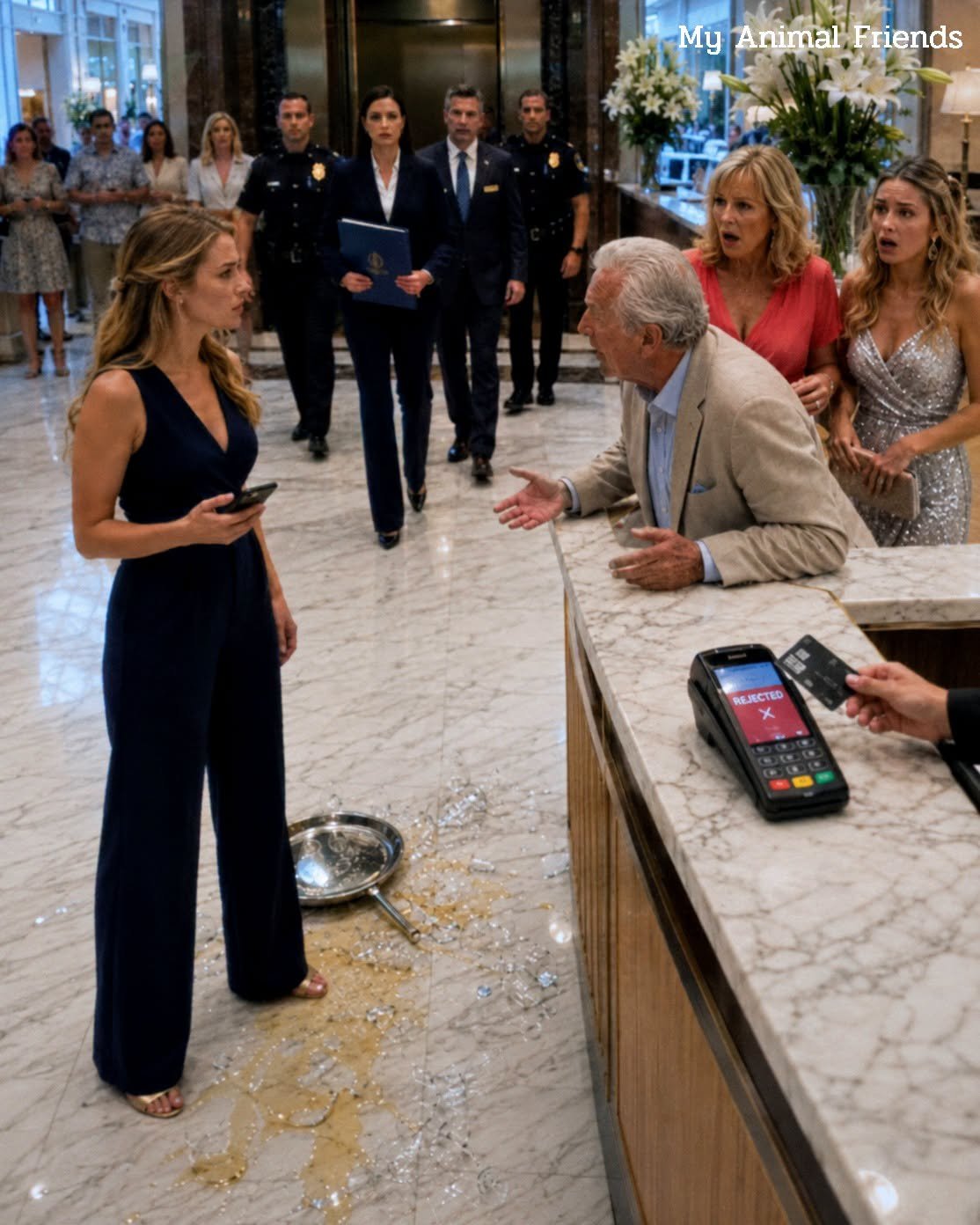
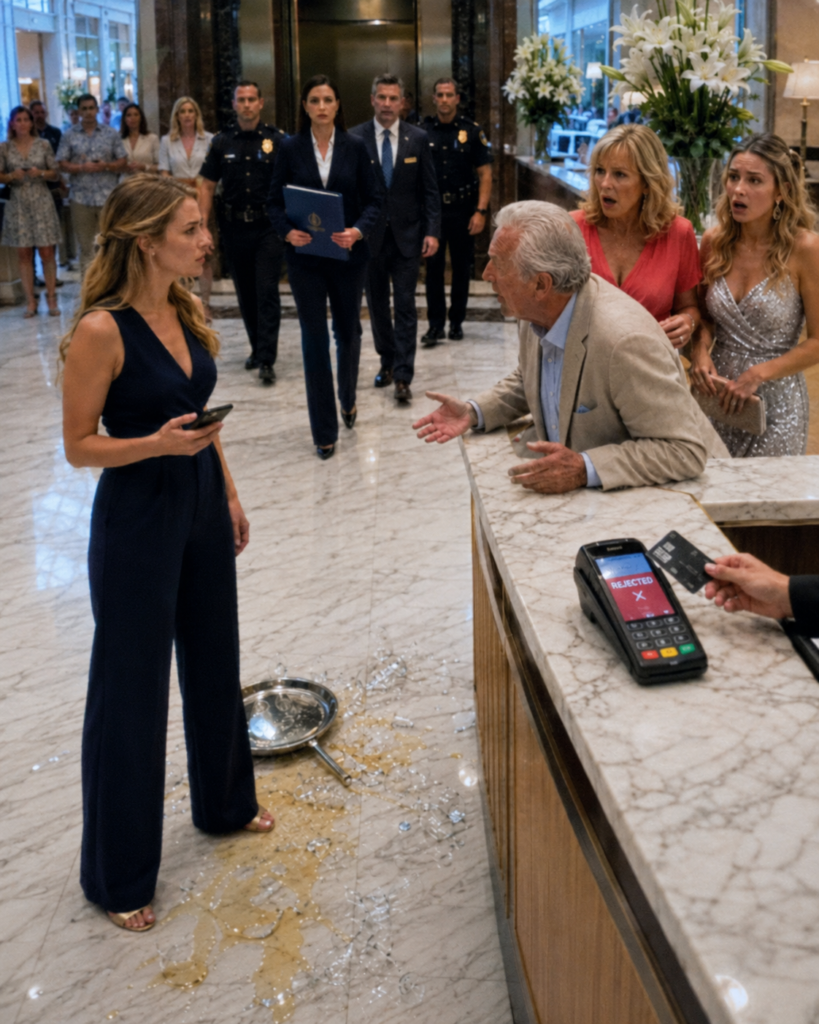
The concierge glanced at the Black Card lying uselessly on the counter.
Arthur lunged toward the tablet.
One security officer blocked him with a forearm.
“Turn that off,” my father snapped.
“That is a private family matter.”
Margaret finally looked at him.
“It stopped being private when company money paid for it.”
The sentence landed harder than shouting would have.
Grandma’s recorded image went on.
She described the first suspicious transfer she had found, then the consulting invoices issued to a shell company connected to one of Arthur’s friends.
She explained how corporate hospitality privileges had been extended to people with no business relationship to Vesta.
She named dates, amounts, and account numbers with the precision of someone who had spent months preparing for the moment when she would no longer be there to defend the truth herself.
My father’s face changed with every detail.
At first, he looked offended.
Then furious.
Then calculating.
He turned to my mother.
“Vivienne, tell them.
Your mother-in-law approved those expenses.
She knew what they were for.”
Mom’s lips parted, but no words came out.
Grandma had anticipated that too.
“Vivienne knew that family trips and Tiffany’s private celebrations were being placed on company accounts,” the recording said.
“I cannot say she knew the full extent of Arthur’s conduct.
I can say she benefited from it and chose not to ask questions.”
My mother took one small step backward.
Julian’s mother, Elena Henderson, looked at Tiffany.
“Was our suite paid for with stolen company money?”
Tiffany’s eyes filled instantly, but even then she was not crying from shame.
She was crying because the room had stopped admiring her.
“I did not know anything about company accounts,” she said.
“Dad told me the suite was part of his executive package.”
“It was,” Margaret replied.
“An executive privilege he retained only because the board had not yet completed its investigation.
That privilege has now been revoked.”
Julian had been silent near the atrium entrance, one hand in his trouser pocket.
He looked from Tiffany to me, then to Arthur.
“You told my parents the Parker family owned the resort,” he said.
Tiffany swallowed.
“We basically do.”
Margaret closed the tablet cover.
“No,” she said.
“Evelyn Parker’s trust holds the controlling voting interest in Vesta Hospitality Group.
As of this morning, Clara Parker is the trustee and controlling representative.
Arthur holds a minority beneficial interest that is now subject to review.”
Tiffany turned toward me so quickly her earrings swung.
“You knew this when you arrived?”
“I knew the probate release had cleared,” I said.
“I did not know you had canceled my room until I reached the desk.”
“Then you set us up.”
The accusation was so familiar that it almost made me laugh.
They had canceled my reservation, taken my money, handed me a serving tray, and humiliated me in public.
Yet somehow, in Tiffany’s mind, my refusal to remain powerless was the betrayal.
“You canceled my room yesterday,” I said.
“The trust transferred this morning.
Those events happened in that order because you chose the first one.”
My mother moved closer, lowering her voice as though privacy could still be restored by speaking softly.
“Clara, we are all emotional.
Reinstate the suite.
Let everyone settle in, and we can discuss this upstairs as a family.”
I looked at her.
She was using the voice she had used throughout my childhood whenever she wanted me to absorb the cost of someone else’s behavior.
Calm, reasonable, almost tender.
It had worked when Tiffany ruined my clothes.
It had worked when Dad missed my graduation but expected me to manage his anniversary dinner.
It had worked when Mom removed me from the holiday photograph because my dress was not the right shade of blue.
It did not work now.
“There is no upstairs discussion,” I said.
Her expression chilled.
“Do not punish your sister for something your father did.”
“Tiffany canceled my room.”
“Because she was under pressure.”
“She handed me a tray.”
“She was joking.”
“You told me I deserved it.”
Mom’s gaze flicked toward the watching guests.
“Must you repeat every unpleasant detail?”
“You were comfortable creating those details in public.”
She had no answer for that.
The hotel’s general manager, Daniel Cho, stepped beside Margaret with a printed folio in his hand.
“Ms.Parker,” he said to me, “we located the history of your reservation.
Your room was not accidentally canceled.
The request came through the family liaison account yesterday afternoon.
It included instructions not to notify you until arrival.”
He turned the folio so I could see the electronic note.
The authorization bore Tiffany’s name.
Below it was a message: Do not offer an alternative room.
She needs to learn that this weekend is not about her.
The sentence was worse in writing.
Tiffany saw it and immediately pointed at my mother.
“Mom told me what to say.”
Vivienne stared at her.
“Tiffany.”
“You did.
You said Clara would make trouble if we warned her early.”
“I told you to handle the reservation discreetly.
I did not tell you to write that.”
The two of them began unraveling in front of everyone, each trying to push the ugliest part of the decision into the other’s hands.
Arthur slammed his palm against the concierge counter.
“Enough.
Clara, unlock the card.”
“No.”
“That account pays for this entire event.”
“That is why it is locked.”
His jaw tightened.
“You have no idea how business works.
A temporary authorization problem could damage relationships that took me years to build.”
Margaret placed another document beside the board resolution.
“The relationships under review include vendors connected to your personal associates, three unapproved consulting agreements, and repeated use of company funds for nonbusiness travel.
The board has appointed outside counsel and a forensic accounting firm.”
Arthur stared down at the paper.
The arrogance left his face so quickly that I understood something important: he had expected family anger, not formal consequences.
He knew how to survive tears, accusations, and private arguments.
He did not know how to survive records he could not intimidate.
“This is a misunderstanding,” he said.
Margaret’s tone remained level.
“Then the audit will clarify it.”
“I want my attorney.”
“Your personal attorney is welcome to contact outside counsel.
Vesta’s corporate attorneys no longer represent you regarding this matter.”
My father looked toward the entrance, perhaps calculating whether he could leave with dignity.
The security officers made the calculation for him.
“Mr.Parker,” Daniel said, “because your executive access has been suspended, we need your company devices, access card, and Black Card.
You may retrieve personal belongings from your room under security supervision.”
Arthur picked up the card from the counter and held it tightly.
“This card has my name on it.”
“The account belongs to Vesta,” Margaret replied.
He looked at me.
There was hatred in his face, but beneath it was something smaller and more revealing.
Disbelief.
He had never imagined that I could become the person who said no and had the authority to make it remain no.
I held out my hand.
“Give her the card.”
For several seconds, neither of us moved.
Then Arthur dropped it onto the marble.
It struck once and slid toward Margaret.
Tiffany made a broken sound behind me.
“What about the suite? My guests have luggage upstairs.
The engagement dinner is tonight.”
Daniel answered professionally.
“The presidential suite was reserved through a revoked executive privilege.
The Henderson family may retain it at the public rate if a personal payment method is provided and the accommodation has not been frozen as part of the account review.”
Elena Henderson looked at her husband.
He shook his head once.
“We will not be staying in a room connected to an investigation,” he said.
Tiffany hurried toward Julian.
“Tell them we will pay for it ourselves.”
Julian did not reach for her.
“With what?” he asked quietly.
Her face tightened.
“I have money.”
“You told me your father was covering the wedding weekend because your family owned the group.
You told my parents the suite, dinner, and yacht were family benefits.”
“That is basically what they were.”
“No,” Julian said.
“They were company assets your father was using as personal gifts.”
Tiffany looked around, searching for someone who would rescue her.
My mother was pale and rigid.
My father was speaking rapidly into his phone, only to discover that his company service had already been suspended.
The relatives who had laughed when Tiffany handed me the tray suddenly found the marble floor fascinating.
One of my cousins quietly removed her staff earpiece from the tray where it had fallen and placed it on the concierge desk.
Julian took a slow breath.
“I am not ending anything in a hotel lobby,” he said.
“But the engagement dinner is canceled.
My parents and I are leaving.”
Tiffany grabbed his arm.
“You cannot humiliate me like this.”
He looked at her hand until she released him.
“Clara asked for her room,” he said.
“You handed her a serving tray.”
The words seemed to shock Tiffany more coming from him than anything I had said.
Julian apologized to me before leaving with his parents.
It was brief and awkward, but sincere enough that I accepted it with a nod.
When the glass doors closed behind them, the lobby felt quieter.
My mother turned on me.
“Are you satisfied now?”
I studied her face.
Even after the recording, the documents, the frozen account, and the canceled engagement dinner, she still believed the central tragedy was that I had allowed consequences to become visible.
“No,” I said.
“I am not satisfied.
I am finished.”
Her eyes narrowed.
“Finished with what?”
“Paying to be mistreated.
Protecting this family from the truth about itself.
Letting you call cruelty a misunderstanding whenever the wrong person gets hurt.”
She folded her arms tightly.
“Your grandmother filled your head with resentment.”
“Grandma gave me evidence.
The resentment came from experience.”
Margaret handed me the blue folder.
The cardboard was worn at the edges from Grandma’s hands.
I remembered carrying it from the cedar chest to her bed, never understanding that she was placing the future of her company into my lap.
Inside the front pocket was a smaller envelope with my name written in her uneven handwriting.
Clara.
I opened it only after Daniel arranged a private conference room away from the lobby.
Grandma’s letter was three pages long.
She wrote that she regretted waiting so many years to confront Arthur.
She had mistaken avoiding conflict for preserving family, and by the time she understood the difference, my father had learned to treat her silence as permission.
She wrote that I had inherited more than voting control.
I had inherited the responsibility to stop confusing loyalty with surrender.
The final paragraph was the hardest to read.
You were never the difficult child, Clara.
You were the child who noticed what everyone else needed you to ignore.
I am sorry they punished you for seeing clearly.
I pressed the letter flat against the conference table and cried for the first time that day.
Not because my room had been canceled.
Not because Tiffany’s engagement dinner was over or because my parents had finally been exposed.
I cried because someone I loved had seen what happened to me and had believed me without requiring one more piece of proof.
Margaret sat quietly until I folded the letter again.
Then we went to work.
The forensic review continued for six months.
Outside counsel found that Arthur had routed substantial personal expenses through Vesta accounts and approved contracts involving undisclosed conflicts of interest.
Some transactions were recoverable.
Others became part of civil claims and a criminal referral that the board was legally obligated to make.
I did not direct the investigators toward a particular punishment.
I gave them access to the records and refused every request from my parents to interfere.
Arthur resigned before the board could remove him.
His remaining distributions were restricted under the trust terms while the financial claims were resolved.
He sold the house he had used for years as proof that he was more successful than everyone around him.
My mother moved into a smaller property and told relatives that I had destroyed the family over a hotel reservation.
For a while, several of them believed her.
Then the audit findings became impossible to dismiss.
Tiffany sent me twelve messages during the first week.
Some were furious.
Some were pleading.
One accused me of stealing her future.
Another asked whether I could at least restore the yacht reservation because deposits had already been announced to guests.
I answered only once.
I sent her the cancellation note she had written about my room.
Do not offer an alternative room.
She needs to learn that this weekend is not about her.
Under it, I wrote: I learned.
Months later, Tiffany requested a meeting without Mom or Dad.
She arrived at a quiet café without diamonds, without an audience, and without the practiced smile she used when she wanted something.
She apologized badly at first.
She said she had been stressed.
She said Mom had encouraged her.
She said Dad had made the suite sound harmless.
I listened until she ran out of explanations.
Then I asked, “Why did you hand me the tray?”
That question stripped away every excuse.
Tiffany stared at the table for a long time.
“Because everyone was watching,” she finally said.
“And I wanted them to see that I mattered more.”
It was the first honest thing she had said.
I did not forgive her that afternoon.
Forgiveness was not a door she could demand I open because she had finally knocked politely.
But honesty was a beginning.
We established boundaries.
She entered counseling.
She found work outside the family company and learned what things cost when no corporate account appeared beneath them.
Our relationship remained cautious, but it became real in a way our old closeness had never been.
My mother never offered the same honesty.
She sent birthday cards filled with lines about letting go of the past.
She never named what she had done.
I stopped accepting apologies written entirely in the passive voice.
As for Vesta, I did not become a hotel executive overnight.
I appointed experienced directors, strengthened expense controls, and required independent approval for family-related benefits.
Margaret became chief operating officer the following year.
The Hawaii resort created a written policy prohibiting staff from being pressured into participating in personal humiliation disguised as guest service.
Daniel also refunded my $5,000 contribution after investigators traced it to the family event account.
I used part of it to establish a caregiver travel fund in Grandma’s name for employees supporting elderly relatives.
On the final night of that first trip, I stood alone on the balcony of the room the hotel had arranged for me.
It was not the presidential suite.
I had declined that.
It was a quiet ocean-view room with a small table, a white robe, and sliding doors open to the sound of waves.
Grandma had wanted one last family trip.
For weeks, I carried guilt because I believed I had failed to give her that.
Then I understood that keeping a family together was not the same as keeping its lies intact.
Sometimes the most loving thing you can do is refuse to help people hide what they are doing to one another.
I placed Grandma’s blue folder on the table and watched the sun lower over the water.
My phone buzzed with a message from Margaret confirming that Arthur’s remaining access credentials had been disabled.
For once, there was no crisis I needed to soften, no insult I needed to pretend was a joke, and no seat at the table I had to purchase with silence.
The room was mine.
Not because someone had finally allowed me to stay.
Because I had stopped asking permission to belong.