
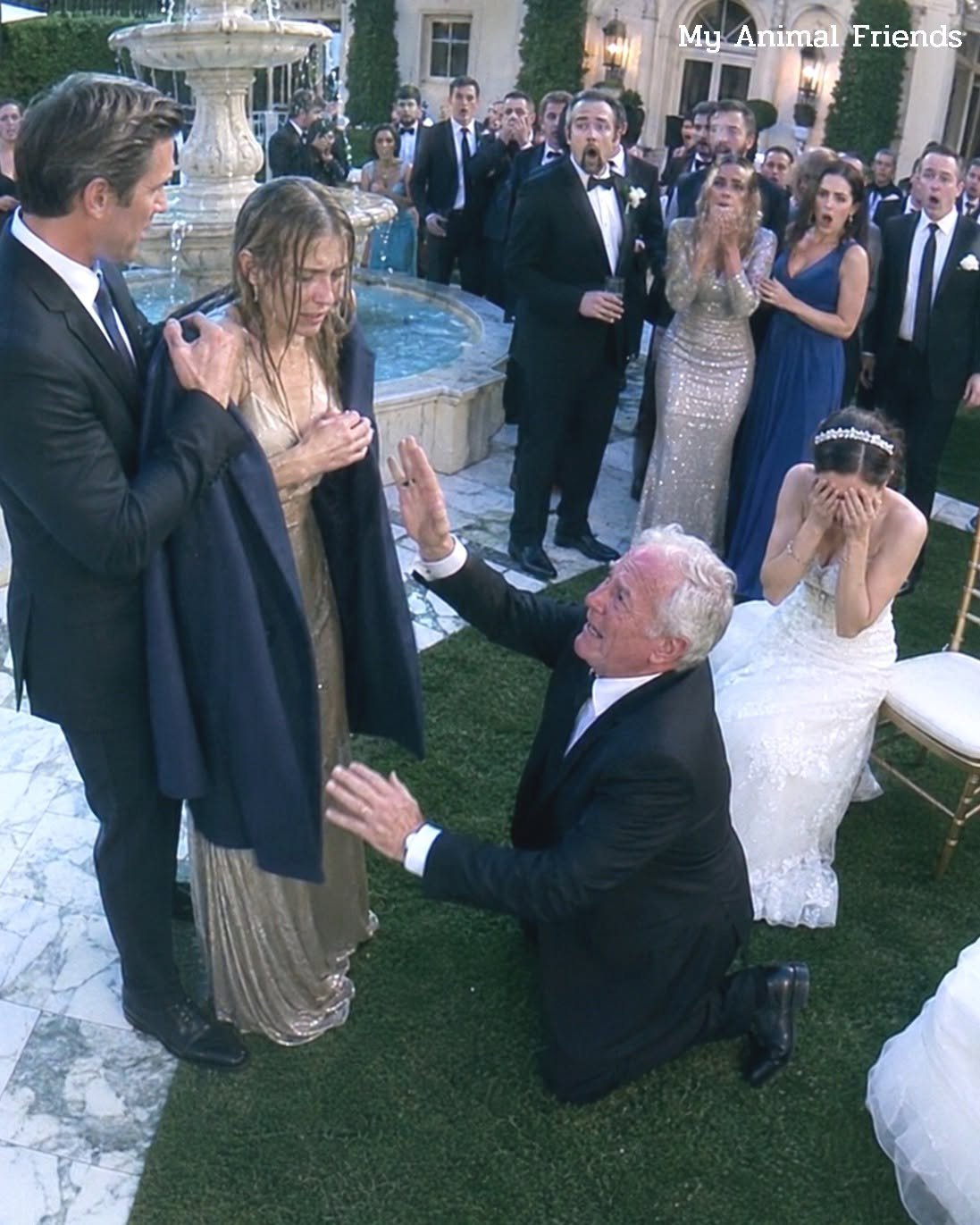
Blake looked down at me, his dark eyes searching my face.
“Are you hurt?” he asked softly.
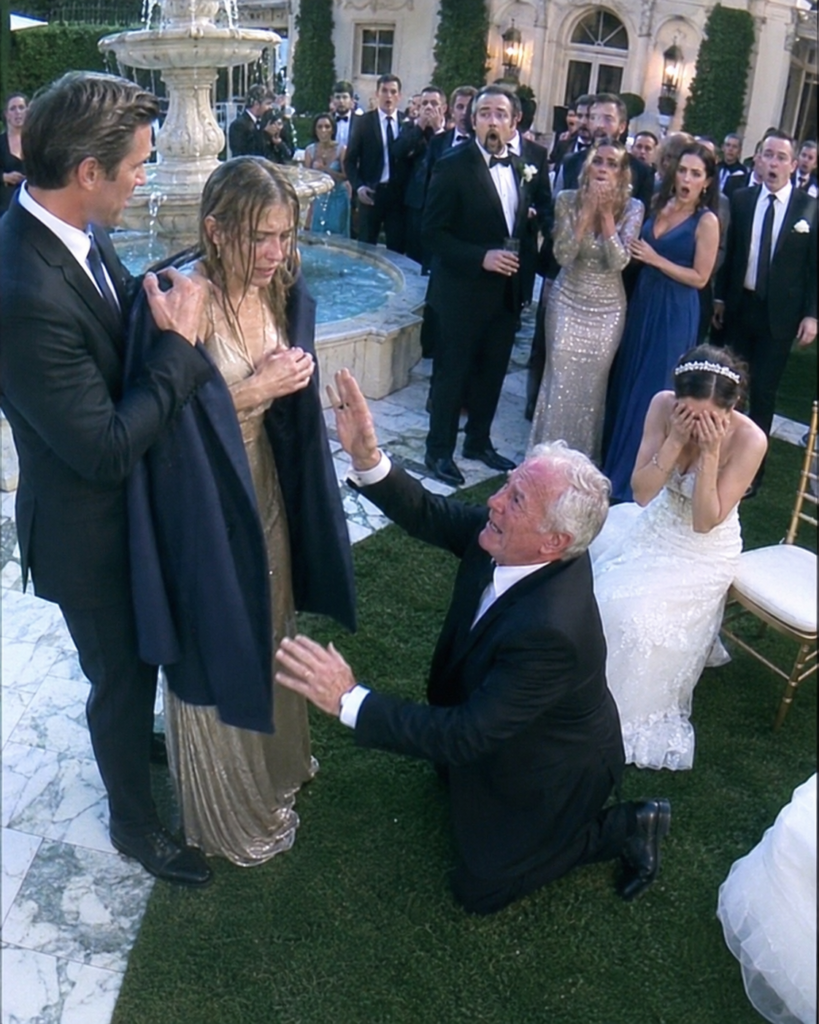
It was the first sound anyone had made since he entered the courtyard.
I shook my head once.
“No.”
His jaw tightened. He knew I was lying. Not about broken bones or bruised skin. About the kind of hurt that didn’t show clearly beneath soaked silk and ruined makeup.
Behind him, my father cleared his throat.
It was a small sound, but in that moment it felt enormous.
“Mr. Campbell,” he said, forcing a laugh that failed halfway through. “What an unexpected honor.”
Blake did not turn around.
He kept looking at me.
“Did he touch you?” he asked.
I swallowed.
Everyone waited.
My father’s face drained of color, but he tried to recover by stepping forward with an expression that resembled concern only because he had practiced it in mirrors all his life.
“This is a misunderstanding,” he said quickly. “A family joke that went too far. You know how weddings are. Emotions run high.”
Blake finally turned.
He did not raise his voice. He didn’t need to.
“A family joke?” he asked.
My father’s smile twitched.
Penelope, still standing beside her groom beneath an arch of white orchids, pressed one hand to the front of her wedding dress. She looked from Blake to me and back again, as if trying to rearrange reality into something she could understand.
“Blake,” she said, her voice suddenly sweet. “I’m so sorry you had to see this. My sister has always been very dramatic. She—”
“Do not speak about my wife that way.”
The word moved through the reception like a match dropped onto silk.
Wife.
A dozen gasps rose at once. Someone dropped a fork. A woman near the champagne tower whispered, “His wife?” as if the phrase belonged to another language.
My father stared at Blake.
Then at me.
Then back at Blake.
“That’s impossible,” he said.
It came out too quickly.
Too honestly.
Blake’s expression did not change.
“It has been true for eight months.”
Eight months.
There it was, finally spoken aloud in the place I had dreaded most.
I had imagined telling them someday. Maybe over a quiet dinner, if quiet dinners were something my family had ever known how to have. Maybe after Penelope’s wedding, when no one could accuse me of stealing attention. Maybe never, if I was honest.
Blake and I had married in a small courthouse ceremony on a rainy Tuesday morning in Boston, with two witnesses, a coffee-stained marriage certificate folder, and a promise that felt more real because no one was watching us make it.
No photographers.
No announcements.
No glittering ballroom.
Just us.
At first, secrecy had been practical. Blake lived with a level of public attention I had never wanted. His name could turn an ordinary breakfast into a headline. Mine, if attached to his, would become something other people felt entitled to examine.
Later, secrecy became personal.
Because I was afraid.
Afraid my family would call me a liar. Afraid they would say I trapped him. Afraid they would reach for him the way people reached for expensive things at charity auctions—with greedy hands and polite smiles.
And somewhere beneath all of that was the most painful fear of all.
That if my family saw Blake love me, they would only finally see me because of him.
Not because I was their daughter.
Not because I was Penelope’s sister.
Because I had become useful.
Blake knew every part of that fear. He had never pushed me to reveal our marriage before I was ready.
But now, standing in the middle of that wedding garden with his coat around me and my family looking as though the earth had slipped beneath their feet, ready had arrived without asking permission.
My father recovered first, because men like him always mistook speed for strength.
He laughed again.
This time, no one joined him.
“Well,” he said, spreading his arms. “Why didn’t you say so, sweetheart? You know how families tease. If we had known you were bringing Mr. Campbell—”
“I didn’t bring him,” I said.
My voice was still quiet, but it cut through the courtyard.
Blake’s hand moved lightly to my back. Not possessive. Not performative. Just there.
“I came because my wife stopped answering her phone,” he said.
I looked at him then, startled.
“I told you I’d be busy.”
“You did,” he said gently. “Then you sent me one message that said, ‘I should have stayed home.’ After that, nothing.”
I closed my eyes for half a second.
I had forgotten sending it.
Or maybe some part of me had wanted him to know without asking him to save me.
My mother finally turned toward us.
For the first time that afternoon, she looked at me directly.
Her face was pale, carefully powdered, impossible to read.
“Claire,” she said.
My name sounded unfamiliar in her mouth. Softened. Almost pleading.
I waited.
She said nothing else.
That was my mother’s talent. She could turn silence into a hallway and expect everyone else to walk down it first.
Penelope stepped off the small platform where her wedding party stood. Her husband, Julian, reached for her hand, but she pulled free. Her veil trailed behind her like a white cloud caught on stone.
“You got married?” she asked.
I nodded.
Her eyes shimmered—not with happiness, not exactly with anger either. Something more complicated passed across her face. Disbelief, embarrassment, calculation, hurt. For one strange second, she looked less like the perfect bride my parents had polished for thirty years and more like the little girl who used to cry when I beat her at chess and then ask me to teach her how I did it.
“To him?” she asked.
Blake did not answer for me.
I appreciated that more than anyone in that garden could have known.
“Yes,” I said.
Penelope’s mouth parted.
“Why didn’t you tell me?”
The question almost made me laugh, except there was no humor left in me.
“Would you have been happy for me?”
Her eyes flicked toward the guests. The photographer had lowered his camera, unsure whether this was something he should capture or pretend not to see. The band stood motionless beside their instruments. Somewhere near the bar, a waiter held a tray of champagne flutes with both hands, frozen in place.
Penelope’s face tightened.
“That’s not fair.”
“No,” I said. “It isn’t.”
A breeze moved through the palms overhead, carrying the scent of orchids, salt air, and expensive perfume. My wet dress clung to my legs. I could feel everyone studying me differently now, as if Blake’s coat had transformed me from spectacle into mystery.
That hurt more than the laughter had.
Blake leaned close enough that only I could hear him.
“Do you want to leave?”
The answer should have been yes.
Every sensible part of me wanted to walk out through those iron gates and never see any of them again. I wanted to peel off the ruined dress, wash the fountain water from my skin, and let Blake take me somewhere quiet where no one knew my maiden name.
But my eyes moved across the courtyard.
To my father, whose panic was hiding behind a tightening smile.
To my mother, whose composure was beginning to crack at the edges.
To Penelope, whose wedding day had become something she could not control.
Then to Julian.
He had not laughed.
I remembered that suddenly.
When I fell into the fountain, his expression had shifted to shock. He had taken one step forward before Penelope grabbed his arm. At the time, water had filled my ears and shame had blurred my vision, but now the memory sharpened.
Julian had wanted to help.
He was looking at me now with guilt written plainly across his face.
“I don’t know,” I whispered.
Blake nodded as if that was a complete answer.
Then he faced the guests.
“My wife came here today because she was invited as family,” he said. “Not as a curiosity. Not as a joke. Not as someone to be measured by whether she arrived beside a man.”
Every word landed quietly.
Cleanly.
“My presence does not change who she is,” he continued. “It only changes what some of you are willing to see.”
No one spoke.
My father’s eyes darted around the crowd, searching for allies. For once, he found none eager enough to step forward.
Blake turned slightly toward the two security guards who had stopped several feet away.
“You were asked to remove her?” he said.
The taller guard shifted uncomfortably.
“Yes, sir,” he said. “We were instructed by Mr. Whitmore.”
My father’s face flushed.
“That was before I understood—”
“Before you understood she was connected to someone you feared offending?” Blake asked.
My father’s mouth closed.
That was the thing about Blake. People expected him to dominate a room with volume, because wealth had taught so many men to confuse noise with command. But Blake’s power lived in stillness. He asked simple questions, and people betrayed themselves trying to answer.
Julian stepped forward.
“Everyone,” he said, his voice strained but steady, “please give us a moment.”
Penelope turned sharply.
“Julian.”
He looked at her with an expression I couldn’t quite read.
“Penelope, this needs to stop.”
Her eyes widened.
For the first time that day, someone had interrupted the script she had written.
Julian looked toward me.
“Claire, I’m sorry,” he said. “I should have stepped in sooner.”
The apology landed somewhere unexpected.
I had prepared myself for excuses, defensiveness, maybe even more laughter. I had not prepared myself for someone in that family circle acknowledging the obvious without being forced.
Penelope’s face went pink.
“This is our wedding,” she said under her breath.
Julian’s expression softened, but his voice did not.
“And she is your sister.”
The courtyard shifted.
Not dramatically. Not like a movie scene where everyone suddenly understands the truth and becomes better. Real people rarely change that quickly. But something subtle moved through the group, a discomfort settling where amusement had been.
My father felt it and hated it.
He straightened his jacket and looked at Blake with a businessman’s smile.
“Mr. Campbell, perhaps we should discuss this privately. There’s no reason to make a family matter public.”
Blake’s hand remained at my back.
“That decision belongs to Claire.”
All eyes returned to me.
For most of my life, my family had spoken over me so often that silence had become my native language. At dinners, my father corrected my opinions before I finished forming them. My mother smoothed over my discomfort with a look. Penelope filled every empty space with charm, leaving me to become the quiet one, the difficult one, the one who “took things too seriously.”
And yet here was Blake, one of the most powerful men in Miami, refusing to take a single decision out of my hands.
It made my throat ache.
I looked at my father.
“I’m not leaving because you ordered me out,” I said. “And I’m not staying because Blake came.”
My father frowned, uncertain.
“I’m leaving because I deserve better than this.”
A murmur moved through the guests.
Penelope’s eyes glistened.
“Claire, wait.”
I did.
Maybe because some part of me still wanted her to say something that could not erase the past but might at least step toward honesty.
She pressed her lips together.
“I didn’t know,” she said.
“About Blake?”
“About how bad it felt for you.”
The words were small.
Too small, maybe.
But they were not nothing.
My mother inhaled sharply, as if Penelope had broken an old family rule by admitting pain existed where guests could hear.
I pulled Blake’s coat tighter around me.
“You knew enough to laugh.”
Penelope flinched.
A few guests looked down.
My father made a sound of impatience.
“For heaven’s sake, Claire, must you always turn everything into an injury? It was a joke. It was a shove into a fountain, not some great tragedy.”
Blake’s expression cooled.
But before he could speak, I lifted one hand.
This time, I wanted to answer for myself.
“You’re right,” I said.
My father blinked, surprised.
“It wasn’t a great tragedy. Not by itself.”
I looked from him to my mother.
“It was one more small thing. One more dinner where I was the punchline. One more birthday where Penelope’s plans mattered more. One more time you told me I was too sensitive because being kind would have required you to change.”
My mother’s eyes shone suddenly.
“Claire—”
“No,” I said. “Please don’t make that sound now.”
She stopped.
The silence that followed was different. Less stunned, more exposed.
“I came today because I thought maybe weddings made people generous,” I continued. “I thought maybe seeing Penelope happy would make all of us softer. I even brought her something.”
Penelope stared at me.
“What?”
I looked toward my small silver clutch lying abandoned near the fountain where it had fallen. One of Blake’s drivers moved to pick it up, but Julian got there first. He lifted it carefully and brought it to me.
“Thank you,” I said.
His eyes held mine.
“I’m sorry,” he repeated quietly.
I opened the clutch with damp fingers and took out a folded envelope. The paper had softened at the edges from the water, but it had survived.
Penelope looked at it as if it might burn her.
“I wrote you a letter,” I said. “This morning.”
Her voice dropped.
“Why?”
“Because I wanted to remember us before all this.”
I held it out.
For a moment, she didn’t move. Then she took it with both hands.
My father scoffed.
“Enough theatrics.”
Penelope turned on him.
“Dad.”
One word.
Sharp as glass.
He stared at her, shocked.
The bride who had laughed at me twenty minutes earlier now stood between us, holding my water-damaged letter like it weighed more than her bouquet.
“Not now,” she said.
Something broke across his face—not remorse, but wounded authority. He was used to Penelope reflecting him back to himself as charming, generous, adored. He did not know what to do with her disappointment.
Blake bent close again.
“We can go,” he murmured.
This time I nodded.
“Yes.”
He guided me toward the exit, not rushing, not performing. His security team cleared a path only by standing aside, letting the crowd part on its own. No one dared stop us.
But just before we reached the stone archway leading to the drive, my mother called my name again.
“Claire.”
I turned.
She stood near the fountain, her hands clasped tightly in front of her. For once, she looked older than her carefully maintained image allowed. Not fragile. Not innocent. Just tired.
“I didn’t know you were married,” she said.
“I know.”
Her lips trembled.
“Would you have told me?”
I looked at her for a long moment.
When I answered, the truth came out softer than I expected.
“I wanted to.”
That hurt her.
I saw it.
Maybe that was cruel. Maybe it was necessary. Maybe those two things sometimes looked the same from a distance.
Blake helped me into the back seat of the waiting SUV. The leather was warm against my cold skin. As the door closed, the noise of the reception disappeared into a muffled hush.
For several seconds, neither of us spoke.
Through the tinted glass, I watched the wedding garden shrink into the distance. White flowers. Golden lights. Beautiful people standing beneath palm trees, trying to understand what story they had just become part of.
Then Blake took my hands.
They were freezing.
He rubbed them gently between his.
“I’m sorry I didn’t arrive sooner.”
I looked at him.
“You came.”
His mouth tightened.
“I should have been there from the beginning.”
“No,” I said. “I asked you not to come.”
“I still hated it.”
That sounded so much like him that despite everything, a small laugh slipped from my throat. It broke halfway and became something dangerously close to a sob.
Blake pulled me into his arms.
I went.
Not elegantly. Not like the kind of woman who knew how to be married to a billionaire in public. I folded into him like someone who had been standing too long in a storm and finally found a doorway.
“I thought I could handle it,” I whispered against his shirt.
“You did handle it.”
“I ended up in a fountain.”
“And walked out of it with more grace than anyone standing dry.”
I closed my eyes.
The SUV moved through Miami traffic, away from Royal Palms Plaza and toward the quiet stretch of coast where Blake’s house stood behind sea grapes and pale stone walls. The city blurred past in gold and blue, all sunlit glass and swaying palms, as if nothing important had happened.
But inside me, something had shifted.
For years, I had imagined escape as a door slamming shut.
Instead, it felt like finally setting down a bag I had forgotten I was carrying.
At Blake’s house, Elena, his housekeeper, met us at the entrance with towels, slippers, and the kind of warm outrage only people who truly love you are allowed to show.
“Oh, sweetheart,” she said, wrapping another towel around my shoulders. “That family.”
“Elena,” Blake said gently.
“No,” she said, pointing at him. “You may be diplomatic in boardrooms. I am not required to be diplomatic in this kitchen.”
I smiled despite myself.
Elena had known about our marriage from the beginning. She had cried at the courthouse and then scolded Blake for not arranging flowers. A week later, every vase in the house had overflowed with white roses, pink peonies, and tiny yellow blossoms whose names I never learned.
She led me upstairs herself and ran a hot bath scented with lavender. By the time I emerged in a soft robe, my hair towel-dried and my skin finally warm again, the sky outside had deepened into evening.
Blake was waiting on the balcony off our bedroom, two mugs of tea on the small table between the chairs.
He had changed out of his suit jacket, but his expression still carried the tension of the garden.
I sat across from him.
For a while, we listened to the ocean.
“I didn’t tell you everything,” I said finally.
He looked at me.
“About today?”
“About why I went alone.”
A line appeared between his brows.
“You said your family didn’t know about us.”
“They didn’t.” I wrapped both hands around the mug. “But Penelope asked me last month if I was seeing anyone.”
“What did you say?”
“I said there was someone important.”
Blake waited.
“She smiled and told me not to invent a relationship just to feel less embarrassed at her wedding.”
His face went still.
“That’s why you didn’t want me there.”
“Partly.”
“And the other part?”
I looked out over the darkening water.
“The other part is that I didn’t want to test whether they’d respect me only after seeing you.”
Blake’s silence was heavy, but not with anger at me.
“I understand that,” he said.
“I know you do.”
That was one of the reasons I had fallen in love with him. Blake had grown up with a different kind of loneliness, but loneliness recognizes itself across crowded rooms. His father had built the Campbell empire with discipline so severe it left little room for affection. Blake inherited buildings, companies, and expectations, but not many memories of being held without having achieved something first.
We had met in a hospital hallway.
Not at a gala.
Not across a boardroom.
I was volunteering with a literacy nonprofit that worked with children receiving long-term care. Blake was there because the pediatric wing carried his family’s name, and he had arrived for a donor tour he clearly wanted to finish as quickly as possible.
A little boy named Mateo had been struggling to read a book about sea turtles. Blake had paused outside the room and listened. I had looked up and found him standing there, all expensive suit and unreadable expression.
“Do you want to help,” I had asked, “or are you planning to intimidate the alphabet into behaving?”
Mateo had laughed.
Blake had blinked as though no one had spoken to him that way in years.
Then he came in, sat in a chair too small for him, and read three pages in a voice so careful and earnest that I knew immediately there was more to him than the newspapers ever printed.
Love did not arrive all at once.
It gathered.
In hospital rooms. In late-night phone calls. In quiet breakfasts. In the way he remembered details I mentioned only once. In the way he never treated my gentleness like weakness.
And now, in the way he sat across from me, giving me room to tell the truth in my own time.
“My family called twice while I was upstairs,” he said.
I looked at him sharply.
“My family?”
He nodded.
“Your father first. Then your mother.”
I almost laughed.
“What did they say?”
“I didn’t answer.”
That surprised me.
Blake lifted his mug.
“I assumed you should decide whether either of us speaks to them.”
I stared at him, and something in my chest loosened.
“Thank you.”
“There’s more.”
The softness in his voice changed. Not alarmed, exactly. Careful.
“What?”
He reached into the pocket of the cardigan he had thrown on and removed my silver clutch.
“I asked Julian to give this to one of my drivers after he picked it up. I didn’t look inside. But when Elena set it on the counter, something fell out.”
He placed a small cream-colored card on the table.
It was not mine.
I picked it up slowly.
The card was thick, expensive, and folded once. On the outside, in neat handwriting, was my name.
Claire.
No last name.
No explanation.
I opened it.
There were only two sentences inside.
You were right to leave today. But before you decide never to speak to us again, ask your mother about the blue room at Coral House.
My skin prickled.
Blake leaned forward.
“What is Coral House?”
I stared at the words until they blurred.
“It was my grandmother’s house,” I said. “On the Keys. We used to go there when I was little.”
“The blue room?”
I shook my head.
“I don’t know.”
But that wasn’t entirely true.
A memory rose—not clear, not complete, more feeling than image.
A closed door painted pale blue.
My mother crying on the other side.
My father’s voice low and furious.
Penelope, small and barefoot, standing beside me in the hallway with one finger pressed to her lips.
And me, holding something in my hand.
A ribbon?
A photograph?
A key?
I looked at Blake.
“Who put this in my clutch?”
His answer was quiet.
“I was hoping you knew.”
I turned the card over. Nothing.
No signature.
No initials.
Only that elegant handwriting, unfamiliar and strangely deliberate.
My phone buzzed on the table.
We both looked at it.
My mother’s name glowed across the screen.
For a moment, neither of us moved.
Then the call ended.
A second later, a message appeared.
Claire, please don’t ask about Coral House over the phone.
Another message followed almost immediately.
And do not tell your father about the card.
I stopped breathing.
Blake read the message over my shoulder, his expression darkening not with anger, but with concern.
Outside, the ocean moved steadily beneath the moonlight, calm and unknowable.
My hands tightened around the phone.
For the first time all day, the humiliation at the wedding no longer felt like the beginning of the story.
It felt like the thing that had finally cracked open a door someone had been holding shut for years.
Then a third message arrived.
It was from Penelope.
Claire, I read your letter. I need to talk to you. I think Mom has been lying to both of us.