
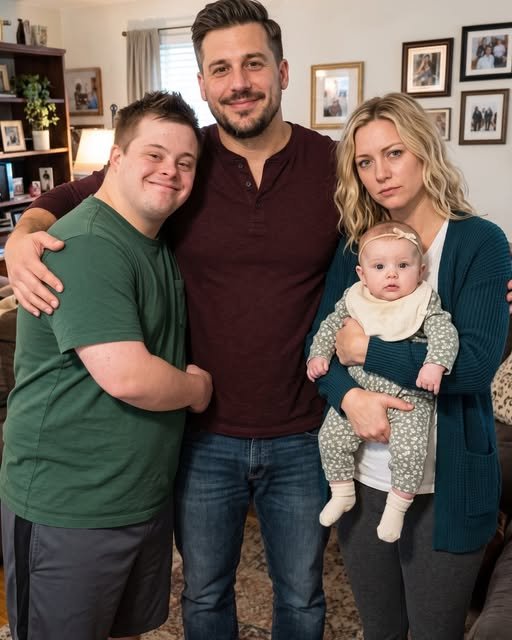
When our mother died, I promised my little brother he would never have to leave. Thirteen years later, my wife wouldn’t let him hold our newborn daughter, and he started hiding something in his bag. I told her she was wrong about him, but I couldn’t explain what he was doing. Then, at 2:13 one morning, our baby’s scream changed everything.
Part 1: The Knock on the Doorframe
Mom died of a stroke on a Tuesday in March. I was twenty-four. My brother Jamie was sixteen.
Jamie has Down syndrome, and for sixteen years Mom had been the fixed point his whole world turned around. She packed his lunches. She knew which shirts itched. She knew he needed to hear the plan for the day before he could eat breakfast. Then, one ordinary afternoon, she was gone, and the plan was gone with her.
Three days later, at the funeral, everyone said the same thing.
“If you need anything, call me.”
“Anything at all, sweetheart.”
I think they meant it. But by four o’clock the church was nearly empty. The casseroles had been promised, and the only people left were me, my brother, and a man stacking folding chairs in the back.
Jamie sat in the front pew, tugging at a tie two sizes too big for him.
“Where do I live now?”
He didn’t look at me when he asked. He was staring at the floor, at his good shoes, at nothing.
“With me,” I said.
“For how long?”
“What do you mean?”
He shrugged. “Until you get married?”
Something in my chest cracked right down the middle. He had already thought it through. While people hugged him and told him how sorry they were, my little brother had been sitting in that pew working out how long he had before he became somebody’s problem.
“Jamie, you’re my brother. You’re not going anywhere.”
He nodded once, the way he did when he was filing something away to check later. I put my arm around his shoulders.
“Come on, Jamie-Bamie. Let’s go home.”
I didn’t know that one sentence would shape the next thirteen years of my life. I’d have said it anyway.
Those first years were a crash course for both of us.
The first time he rode the bus alone, I texted him before it even pulled away from the stop.
Call me when you get there, Jamie-Bamie.
When he finally called, he sounded deeply offended. “You said I do it myself.”
“You can do it yourself and still call me.”
“I did. I’m calling.”
“Good.”
“Bye.”
Click. I stood in my kitchen grinning at the phone like an idiot.
His first paycheck from the garden center came a month after he started. He frowned at it for a full minute.
“They paid me wrong.”
“How do you know?”
He looked at me like I’d asked something stupid. “Because I can count.”
He was right. They’d shorted him six hours. He marched in the next morning, set the stub on his manager’s desk, and didn’t leave until it was fixed.
At nineteen, he made soup for the first time. He’d written the recipe on an index card, and he talked himself through every step out loud. “Onion. Pot. Lid. Spoon. Stir.”
When it was done, he set a bowl in front of me and stood over me with his arms crossed.
“Be honest.”
I tasted it. “Needs salt.”
“Salt’s not on the list.”
“Then the list needs salt.”
He took the bowl straight out of my hands. “Get out of my house.”
It was my house. Neither of us said so.
Jamie had rituals, and one of them became ours. Every time he left a room, he stopped in the doorway and knocked twice on the frame. Then he waited. I had to knock back, twice. If I forgot, he simply stood there until I remembered.
“Why two?” I asked him once.
“Two means, are we okay?” he said, as if it were obvious. “You knock back. Means yes.”
After that, I never skipped it. Not once.
At twenty-two, Jamie moved into his own apartment, ten minutes away by bus. He worked four mornings a week. He had friends I’d never met, routes I didn’t know about, a favorite booth at a diner I’d never set foot in. He was building a life.
I wasn’t. I checked on him constantly. I dated, but the moment anything started to feel serious, I found a reason to end it.
Jamie noticed before I did.
“You broke up with Emily,” he said one afternoon, dropping onto my couch.
“It wasn’t working.”
“You said that about Sarah too.”
“Since when are you keeping track?”

He turned and looked at me, completely serious.
“I don’t want to be your job.”
The smile slid off my face. “You’re not my job.”
“Then stop acting like you can’t have a life because of me.”
I had no answer to that. So when Claire came along a few months later, it was Jamie who pushed.
“You like her?”
“Yeah.”
“Then call her.”
“Jamie…”
“Call her.”
I called her. Sometimes I wonder whether my brother ever regretted that push. Especially after everything turned into a nightmare.
Claire met Jamie three months later, at his apartment.
I’d watched people meet my brother a thousand times, and it almost always went one of two ways. Either they talked over his head as if he weren’t in the room, or they slowed down and used that careful, singsong voice, like he was five.
Claire did neither. She asked about the garden center. When Jamie announced that his manager was an idiot, she asked him why and actually listened to the answer. When he told her a joke, she laughed, then informed him it was bad.
“It’s good joke,” Jamie said.
“It’s a terrible joke. Tell me another one.”
He grinned like he’d won a prize. Then she tasted his soup.
“Needs salt.”
I nearly choked. Jamie stared at her.
“Get out of my house.”
“It’s your apartment,” Claire said, and took another spoonful.
He laughed so hard he had to sit down on the floor.
She never gave him a discount. If he said he’d do something, she expected it done, same as anyone. I loved her for that. I had no idea it would one day turn into something cruel.
At the door that night, Jamie knocked twice on the frame. Claire glanced at me. I held up two fingers. She knocked back without a single question.
While she went down to the car, Jamie leaned toward me.
“I like her.”
“Good.”
“You should marry her.”
“We’ve been dating three months.”
“You’re slow.”
I married her eleven months later. For a while, the three of us were happy. Sunday dinners. Bad jokes. Never quite enough salt.
Then one evening, something happened in our kitchen, and from that night on, my wife never looked at my brother the same way again.
Part 2: The Hand Sanitizer at the Door
I called it an accident. Everybody did. Claire said she forgave him, and for a long time I wanted badly to believe her.
But something had shifted. She tensed up whenever Jamie was close. Her eyes followed his hands. She started quietly taking things from him: a bag of groceries, a serving dish, a glass of water he was carrying to the table.
“I’ll do it.”
“I got it.”
“I’ll do it, Jamie.”
He noticed. Jamie noticed everything. He never said a word.
Claire had never gone easy on my brother, and I’d always thought that was the highest form of respect she could give him. She expected him to get things right, the same as anyone. Then she got pregnant, and somewhere along the way, the expecting turned into fear.
Jamie, on the other hand, was over the moon. He counted the weeks out loud every Sunday. He bought a pair of tiny yellow socks with his own paycheck and carried them in his jacket pocket for a month before he worked up the nerve to give them to us. He told every customer at the garden center he was about to be an uncle, whether they asked or not.
When Sophie was born, he beat Claire’s parents to the hospital. He stood in the doorway of the room, hands freshly scrubbed, and held them both out.
“Can I hold her?”
Claire pulled the baby tight against her chest. “No. Absolutely not.”
“Claire…” I said. “He’s held babies before.”
“And if he squeezes too hard? Drops her? Gets excited and forgets she isn’t a doll?” Her voice was sharp. “I’m not experimenting with my daughter.”
Jamie lowered his arms slowly. “Okay.”
He put his hands in his pockets. I stared at my wife. She wouldn’t look at me.
I told myself it was exhaustion. Twenty hours of labor, hormones, a brand-new person to keep alive. I told myself it would pass.
It didn’t. It got worse.
After we brought Sophie home, Jamie kept coming every Sunday, same as always. Now Claire met him at the door with a bottle of hand sanitizer.
“Hands.”
“I washed already. At home.”
“Wash again. For Sophie.”
He washed again. Then he sat at the far end of the couch, hands folded in his lap, and watched his niece from across the room.
A few Sundays later, while Claire was warming a bottle, he tried.
“I can feed her,” he offered. “I watched a video. You hold the bottle tilted.”
Claire laughed. She actually laughed.
“I already have one baby to watch. I’m not supervising you, too.”

Jamie’s face went completely blank. I’d seen that look only a handful of times in my life, and every one of them was a moment when someone had told him, without quite saying it, that he didn’t belong.
“Okay,” he said.
He stood up and went into the hall for his coat.
I took Claire by the elbow and steered her into the kitchen.
“That was cruel,” I said, keeping my voice low. “Don’t you ever talk to him like that again.”
“I’m protecting my daughter.”
“From her uncle?”
She turned to face me. Her eyes were wet and furious at the same time.
“You weren’t the one he poured boiling water on.”
The kitchen went silent except for the hum of the bottle warmer.
Boiling water. That’s what she called it now.
It was soup.
Two years earlier, Jamie had been carrying a pot from the stove to our table, proud as anything, the index card with his recipe sticking out of his back pocket. Claire turned away from the counter and stepped right into his path. They collided. The soup went down her forearm and soaked her side. She needed weeks of burn dressings, and I changed every one of them.
Jamie apologized every single day for those weeks. He’d show up with a card, or a flower from the garden center, or nothing at all, just to stand in the doorway and say he was sorry.
“You said it was an accident,” I said.
“It was an accident. He didn’t mean to burn me. That’s the whole point.” She crossed her arms over the place where the scar still was. “What happens when he doesn’t mean to drop Sophie?”
“You used to tell him his jokes were bad. You used to treat him like a person.”
“That was before I had a baby! He’s unpredictable, okay? He’s not safe around her.”
“You’re judging him for one accident from years ago.”
“And you pretend he can do everything because he’s your brother. Somebody in this house has to be realistic.” Her voice cracked. “Last time it was my skin. This time it would be hers.”
I didn’t have an answer for that. I only knew, down to my bones, that it wasn’t fair.
Then I noticed a shadow on the kitchen floor.
Jamie was standing in the doorway with his coat zipped up. I don’t know how long he’d been there. Long enough. His face didn’t move at all.
He didn’t say a word. He stepped back into the hall, lifted his hand, and knocked twice on the frame.
Are we okay?
I knocked back, twice.
Claire didn’t.
Jamie waited. One second. Two. Three.
Then he turned around, and a moment later the front door clicked softly shut behind him.
In thirteen years, my brother had never once left a room without an answer.
Part 3: The Doll in His Bag
Sophie’s first family photo shoot was booked for the end of that month. I spent the whole week before it half-expecting Jamie to make an excuse not to come.
He came. He showed up in a pale blue button-down shirt, ironed and tucked in. It was the last shirt Mom ever bought him. He’d been saving it.
We took the first pictures all together on a blanket in the park: Claire, Sophie, me, and Jamie at the end, grinning so wide his eyes nearly disappeared. Then Claire turned to the photographer.
“Can we get a few with just the immediate family?”
Jamie blinked. “I am immediate family.”
Claire sighed, a long, tired sound. “Jamie, please. I just want one normal picture.”
Normal.
I opened my mouth, but Jamie moved first. He didn’t argue. He didn’t even look upset. He just stood up, brushed the grass off his knees, and stepped out of the frame. He waited by the wall at the edge of the park, hands behind his back, until we were done.
I’ve looked at those photos a hundred times since. In every one, I’m smiling like a man who doesn’t know where his brother is.
After that day, Jamie stopped asking to hold Sophie.
He still came every Sunday. He still washed his hands twice. But he stayed on the far side of the room and talked to her from a distance, telling her about the new shipment of tomato plants and the customer who’d tried to return a dead cactus. When he left, he waved at her the way you’d wave at a neighbor across the street.
He never reached for her again.
That wasn’t the only thing that changed. My brother, who in thirteen years had never kept a single secret from me, started disappearing.
His shift at the garden center ended at noon, so one Tuesday I called him on my lunch break.
“I’ll pick you up. We’ll get burgers.”
“Can’t. I have class.”
“What class?”
“Just class. Tuesday and Thursday.”
“Since when do you keep secrets from me?”
I could hear him grinning through the phone. “It’s a surprise.”
I let it go. But it stuck with me, like a pebble in a shoe.
The next Sunday, Jamie dropped his backpack on the hall bench and went to wash his hands for the second time. The bag tipped over. The zipper hadn’t been pulled all the way, and it slid open.
Claire froze.
Lying on top of his gray sweatshirt was a plastic baby doll. Life-sized. Bald. Its painted eyes staring straight up at our ceiling.
Jamie came out of the bathroom, saw her looking, and lunged for the bag. He zipped it shut so fast he caught his finger.
“Jamie,” Claire said slowly. “Why do you have a baby in your bag?”
“I have to give it back.”
“To who?”
“Someone.”
“Jamie…”
“It’s a surprise!”
He clutched the bag to his chest and hurried back into the bathroom. The lock clicked.
Claire turned to me. Her face had gone pale.
“Why is your twenty-nine-year-old brother secretly carrying around a baby doll?”
“I don’t know.”
“And that doesn’t bother you?”
“No,” I said.
She looked at me for a long moment, then walked out of the room without another word.
I’d lied to her. It did bother me. It bothered me a lot.
Not the way she meant. I never once thought Jamie would hurt Sophie. But I’d watched him step out of that photo. I’d watched him stand by the wall with his hands behind his back. I didn’t know what it had done to him, being told he wasn’t family by the woman he’d pushed me to call. I didn’t know what he was trying to fix, or what he thought was broken inside him.
And he wouldn’t tell me.
It was pouring that Saturday.
Jamie had come over for dinner, and by nine o’clock the storm was getting worse instead of better. Rain hammered the windows sideways. The streetlight outside flickered twice and went dark.
I looked out at the flooded gutter. “You’re not taking the bus home in this.”
“I’m okay.”
“Guest room. I’m not arguing.”
Claire didn’t argue either. She just went very, very still, the way she did when she was holding something in. Before bed, I watched her check the baby monitor twice and turn the volume all the way up.
I fell asleep listening to the rain.
At 2:13 a.m., a scream tore through the baby monitor.
I was out of bed before I was fully awake. Sophie cried every night, hungry cries, fussy cries, but never like that. Never a sound like that. Claire’s hand clamped around my arm.
Then the scream cut off.
Mid-breath. It just stopped.
Through the monitor came a rustle. Then a heavy thud.
Then nothing at all.
We ran barefoot down the dark hallway. The nursery door was already half open, a slice of light spilling through it from the guest room across the hall. Claire shoved past me.
“Jamie! Get away from her!”
I stopped dead in the doorway.
The crib was empty.
My brother was on his knees on the nursery floor. Sophie lay on the rug in front of him, limp and terrifyingly quiet. His hands were shaking. One of them was clenched into a tight fist around something I couldn’t see.
Claire’s hand flew to her mouth. “Oh my God…”
I watched it all hit her at once. The soup. The bandages. The doll in the bag. And now her baby, motionless on the floor at his knees.
“What did you do?!”
She lunged for Sophie.
“DON’T PICK HER UP YET!”
Part 4: The Bead in His Fist
Jamie’s voice cracked through the room like a whip.
I had never heard my brother shout like that. Not at the funeral, not at his manager, not ever. Claire froze with her arms still outstretched. So did I.
“Jamie,” I said. “What happened?”
He looked up at me. His hands were still trembling, but when his voice came, it was steady.
“Call 911.”
I grabbed my phone and dialed with fingers that didn’t feel like mine. While I stammered our address to the dispatcher, I watched my brother do something I had never seen him do in twenty-nine years.
He bent over Sophie and whispered to himself, exactly the way he talked through his recipes.
“Face down. Head lower. Five hits. Check mouth.”
He laid her along his forearm, belly down, her tiny head cupped in his palm and tipped toward the floor. With the heel of his other hand, he struck firmly between her shoulder blades. Once. Twice. Three times. Four. Five. He turned her over, careful as anything, and looked in her mouth.
He didn’t panic. He didn’t rush. He moved one step at a time, like he’d done it a hundred times before.
Then Sophie coughed.
It was a small, wet, awful sound. She dragged in a breath. Her face crumpled.
And she started to cry.
It was the most beautiful sound I have ever heard.
Claire dropped to her knees beside them, sobbing. Jamie didn’t let go of Sophie until Claire’s hands were under her. Only then did he sit back against the crib, and his own breath came out of him in one long, shaking rush.
The paramedics arrived within minutes, rain streaming off their jackets. One of them knelt beside Sophie, listened to her chest, and checked her airway with a small light.
“She’s breathing well. Good color.” He glanced up. “What was she choking on?”
Jamie looked down at his fist. He’d kept it clenched the whole time, even while he was working on her. Slowly, he opened his hand.
A tiny wooden bead sat in his palm, still damp. One letter was painted on it.
P.
Claire stared at it. Then her eyes went to the crib rail, where a pacifier clip hung loose, its cord snapped clean through. The remaining beads dangled in a crooked line.
S-O-_-H-I-E.
She’d made it with her own hands.
I remembered the clip then. A week after we brought Sophie home, I’d found Claire on the couch, stringing little wooden letter beads onto a cord, her tongue between her teeth in concentration.
“Isn’t she a little young for that?” I’d asked. “Loose beads shouldn’t go anywhere near the crib.”
“It’s a pacifier clip, not a necklace. I’ll hang it on the rail.”
I’d let it go. I’d let it go because I didn’t want to fight.
At the hospital, the doctor confirmed it. The bead had snapped off the clip, Sophie had found it, and it had gone straight into her mouth, the way everything does at that age.
“She’s going to be fine,” he said. “Whoever got to her first did exactly what needed to be done.”
He turned to Jamie, who sat in a plastic chair in his socks with a hospital blanket around his shoulders.
“Where did you learn infant first aid?”
“My class.”
I stared at him. “Your class?”
“Tuesday and Thursday. Infant CPR.” He rubbed the back of his neck, embarrassed. “That’s why I got the doll. I practice on it. I have to give it back when I finish.”
Everything clicked into place at once. The bag. The secret. It’s a surprise.
“Why didn’t you tell me?”
“I didn’t want anyone laugh.” Then he looked past me, straight at Claire, and said it plainly. “You said I’m not safe.”
Claire opened her mouth. Nothing came out.
“So I learn to be safe.” He swallowed. “I thought maybe then you let me hold Sophie.”
Claire’s face crumpled. She turned to me, her voice barely a whisper. “You told me. You told me about the beads, and I…”
She couldn’t finish.
For two years, she had looked at my brother and seen one terrible accident. Tonight, in the dark, with a storm raging outside and her baby unable to breathe, he had been the only one of us who knew what to do.
“A few minutes later,” the doctor said quietly, “and we’d be having a very different conversation.”
He left us alone.
Claire sat down in the chair beside Jamie. For a long time, she didn’t say anything at all. She just reached over and held the hand that had been clenched around the bead.
“I’m sorry,” she said finally.
He looked at her.
“I was wrong about you. I was so wrong.”
He didn’t tell her it was okay. Jamie never says things he doesn’t mean. He only asked, “Is Sophie okay?”
“Yes.”
“Can I see her?”
A nurse led us down the hall to Sophie’s room. She was asleep in a little hospital bassinet, pink-cheeked, one fist curled beside her face.
Jamie stopped at the threshold, the way he’d learned to. He lifted his hand and knocked twice on the doorframe.
Are we okay?
Then he waited.
Claire lifted Sophie gently into one arm. With her free hand, she reached out and knocked twice on the metal bed rail.
Yes.
“Jamie-Bamie,” Claire said, her voice thick. “Hold out your arms.”
He didn’t move. “…Me?”
She nodded. He raised his arms slowly, carefully, as if they might break. Claire placed Sophie in them.
“Am I doing it right?”
“You’re doing perfect.”
I pulled out my phone.
“What are you doing?” Jamie asked.
“Taking a picture.”
He glanced at Claire, bracing himself, waiting to be asked to step out of the frame.
Instead, she sat down beside him and leaned in until her shoulder touched his.
I took the picture of my family.
And nobody asked for another one.
What This Story Taught Me
Fear can wear the mask of protection. Claire believed she was keeping her daughter safe, but she was guarding against the wrong danger while the real one hung on the crib rail she’d decorated herself.
Being underestimated doesn’t make someone less capable. Jamie answered “you’re not safe” not with an argument, but by quietly learning exactly what to do, and by being ready when it mattered.
And the people we push to the edge of the picture are often the ones holding the whole family together.
Note: This story is a work of fiction inspired by real events. Names, places, and details have been changed, and any resemblance to real people is coincidental.