
Part 2: The Cold Dish
Marcus pulled three crisp copies of the master property title from his leather folder, smoothing them down against the glass table. “The moment your mother called that unauthorized locksmith to alter the locks on a property registered solely under your name, she committed unlawful entry and property destruction. When Violet posted video footage of herself operating your vehicle—which is registered to your private LLC—she established grand theft auto. Coupled with the certified medical report of third-degree thermal assault from the emergency facility, you possess absolute leverage.”
“I don’t just want them out, Marcus,” I said, tracing the cold silver of my father’s necklace around my throat. “I want every single trace of our life stripped from those walls before they realize the floor has dropped out beneath them.”
Marcus offered a slow, sharp smile. “Then we begin the liquidation protocol immediately.”
By eight o’clock the following morning, while my mother and Violet were away at an upscale brunch paid for with a credit card they assumed I would eventually settle, three unmarked commercial moving vans pulled into the circular driveway of the estate. Accompanied by Marcus, a bonded estate management team, and a court-appointed custodian, I stepped back across the threshold of my home.
The house smelled of cheap perfume, spilled champagne, and stale takeout. Violet’s dirty clothes were thrown over my father’s hand-carved mahogany chairs. My mother had already moved her belongings into the primary master suite, rearranging my late father’s private study to make room for her vanity.
“Every piece of furniture, every oil painting, every rug, and every piece of silverware was purchased by my father or me prior to their marriage,” I instructed the crew captain, handing him a notarized inventory list spanning forty pages. “Leave nothing except the bare structural walls and the items purchased strictly with their personal bank accounts.”
For five relentless hours, the house was systematically emptied. The Italian leather sofas, the crystal chandeliers, the brass light fixtures, the Persian rugs, the grand piano, and even the custom drapery were cataloged, wrapped in heavy protective plastic, and loaded into the moving trucks to be transported to a secure, climate-controlled storage facility. My father’s extensive library was packed away box by box. By two in the afternoon, the vast multi-million-dollar estate was reduced to an echoing, cavernous shell of cold hardwood and bare plaster.
In the double-height marble foyer, Marcus placed two inexpensive canvas suitcases on the floor. Inside were the clothes, cosmetics, and basic personal effects my mother and Violet had brought into the house six years ago. Beside the bags, Marcus laid a red folder containing the formal eviction notice, a emergency restraining order, and a police summons for criminal assault and grand theft auto.
At three-fifteen, the heavy front doors swung open.
My mother walked in first, laughing loudly with a shopping bag from an expensive boutique dangling from her arm. Violet followed right behind her, sipping an iced latte, keying away on her phone.
Their footsteps abruptly stopped as their eyes adjusted to the space.
The foyer was completely hollow. The grandeur was gone. The grand staircase looked naked without its velvet runner; the living room beyond was a vast, silent box of shadow and bare floorboards. Their laughter died instantly, replaced by a suffocating, heavy silence.
“What… what is this?” my mother gasped, dropping her shopping bag. The parchment paper inside rustled loudly in the empty space. “Where is the furniture? Where is the art?!”
“It has been returned to its rightful owner,” Marcus said smoothly, stepping out from the shadows of the dining room archway with two uniformed police officers standing silently behind him.
Violet backed up, her eyes wide with sudden panic. “You… who are you? This is breaking and entering! Mom, call the police!”
“The police are already here, Miss Vance,” Officer Miller replied, stepping forward with his hands resting casually on his utility belt. “And we are here to enforce a legal writ of immediate vacate.”
My mother’s face turned an ugly, mottled shade of crimson. She lunged forward, her fingers twitching with rage. “This is my home! I am the mistress of this estate! I had the locks changed! You have no right to strip my house!”
“You had the locks changed on a property you have never legally owned,” Marcus replied calmly, handing her a stapled document. “This is the deed executed eight years ago by late owner Arthur Pendelton. The sole owner of this land, this structure, and every asset previously contained within it is Nora Pendelton. You are a non-tenant occupant operating without a lease, without equity, and without legal standing.”
“She’s my daughter!” my mother shrieked, her voice echoing frantically off the naked high ceilings. “She owes me! I raised her! I took care of this place!”
“You lived here out of my generosity,” I said, walking slowly down the master staircase.
Both of them froze. I was dressed in a tailored charcoal suit, my posture straight, my face calm. The white medical bandage on my right cheek was stark and blinding under the recessed ceiling lights.
Violet flinched backward, instantly hiding her hands behind her back. “Nora… we were just… we were taking care of the car…”
“The car that you drove without insurance, without a valid operator’s permit, and without my permission,” I said smoothly, stopping on the final step. “The vehicle has already been towed to an off-site facility. The master key code has been reset. The charge of grand unauthorized use of a motor vehicle has already been filed with the district precinct.”
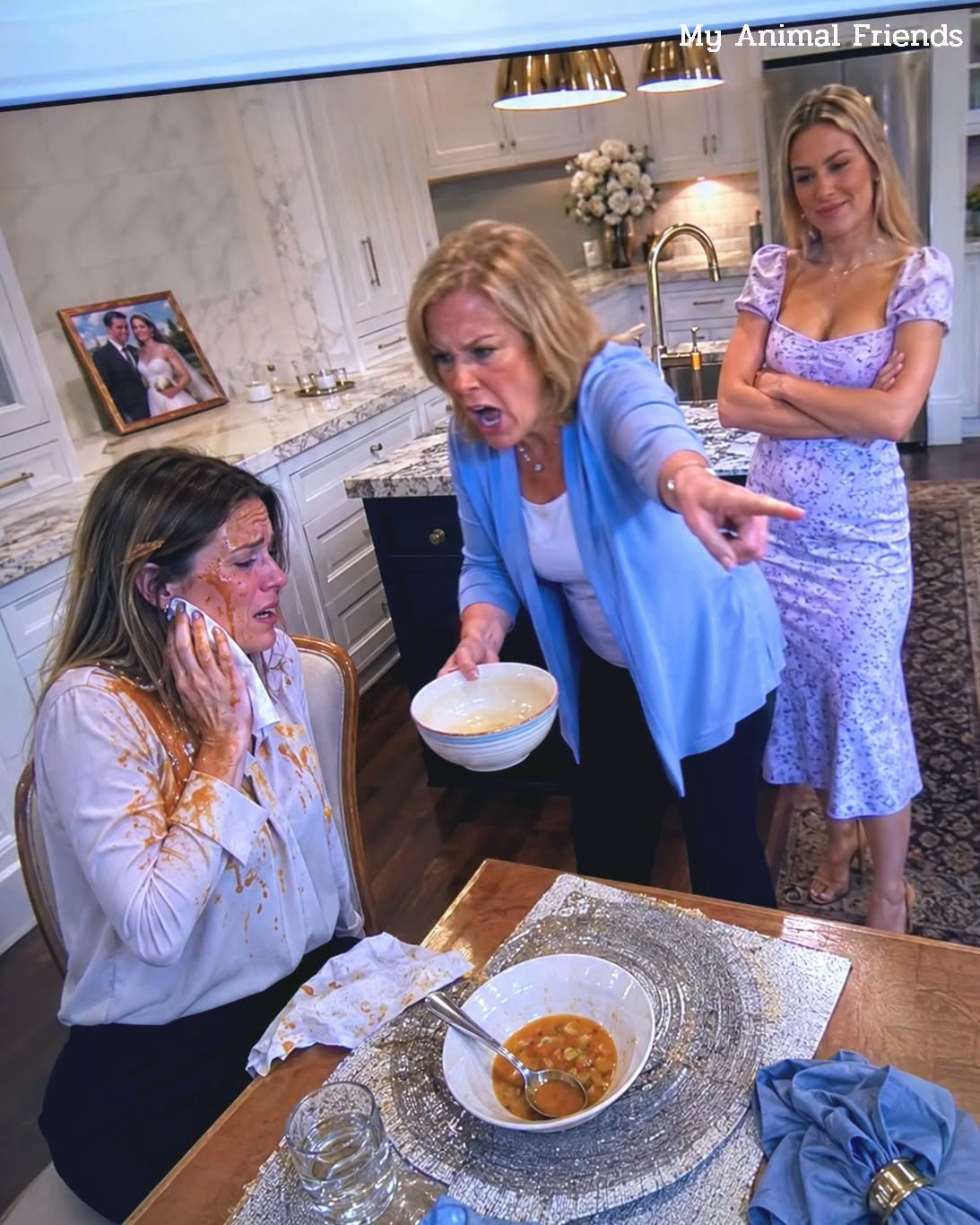
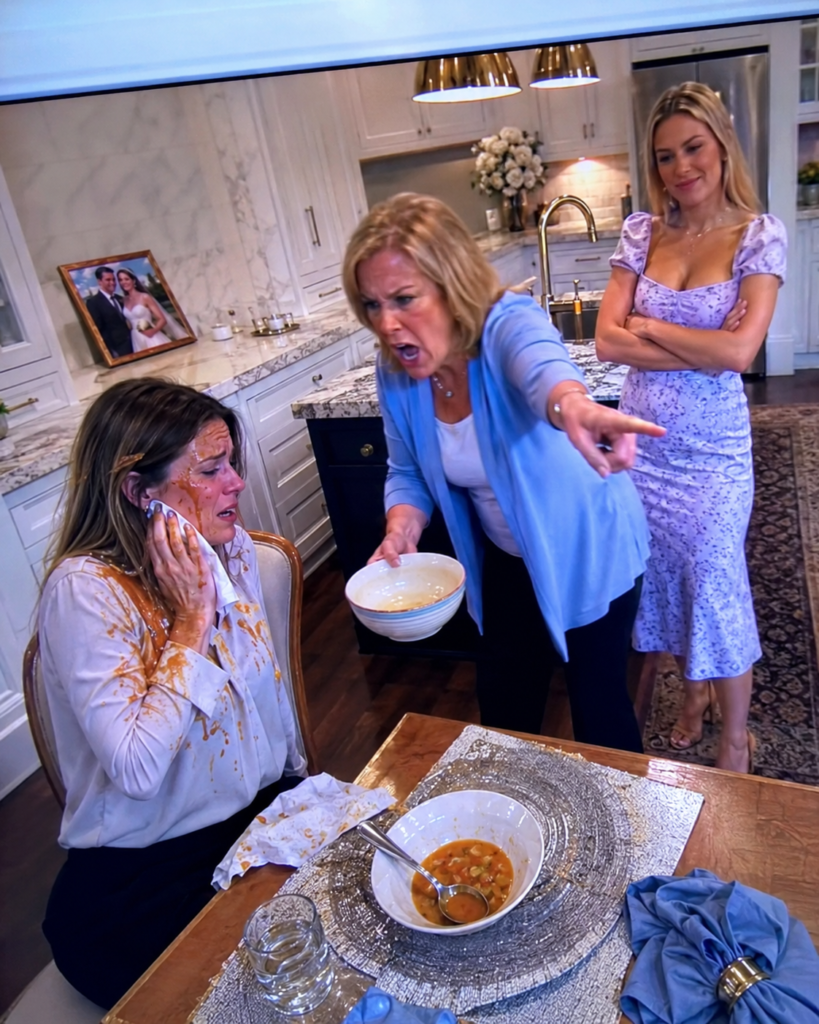
“Nora, please!” my mother cried, her voice cracking as the reality of the situation crashed down upon her. She took a step toward me, her hands clasped in a desperate plea, but Officer Miller politely held out an arm to block her path. “It was an accident! I was stressed! Violet was nervous about her interview—I lost my temper with the soup! You can’t do this to your own mother! Where are we supposed to go?”
“You are going wherever two suitcases can take you,” I replied coldly. “You told me three days ago to give Violet everything I owned or get out. I chose option three: I reclaimed what was mine and left you with what you earned.”
“You monster!” Violet screamed, her face contorting into tears of rage and humiliation. “You ruined my life! I missed my interview because the car wasn’t in the driveway this morning! You’re throwing us onto the street!”
“You threw yourself onto the street the moment you confused my silence for ignorance,” I said. “Dad always warned me that people who don’t read the contract end up paying the price. You enjoyed the luxury, but you never checked who owned the foundation.”
Marcus stepped between us, holding out his pen. “Mrs. Vance, Miss Vance, you have exactly ten minutes to collect those two bags and step off the perimeter of this property. If you remain past four o’clock, the officers will place you under arrest for criminal trespass, violating a protective order, and felony assault.”
My mother looked around the massive, hollow house, her eyes darting frantically from the bare windows to the cold marble floor. The illusion of her wealth, her status, and her power had collapsed into nothingness. She looked at the police officers, whose faces were rigid and unyielding, then back at me.
For the first time in six years, she did not look like a matriarch. She looked small, fragile, and utterly defeated.
Without another word, Violet grabbed her suitcase, sobbing loudly as she dragged it across the hardwood floor toward the front door, her designer shoes clicking pitifully against the empty space. My mother picked up her bag with trembling hands, staring at me with a mixture of terror and profound regret.
“Nora…” she whispered.
“Goodbye, Mother,” I said softly.
They walked out into the bright afternoon sun. On the sidewalk outside, several neighbors had gathered near the gate, whispering and recording on their phones as the two women were escorted past the boundary line by the police officers. The heavy wrought-iron gates swung shut behind them with a loud, definitive metallic click.
The house was silent once more.
Marcus walked over, handing me a final tablet to sign the official reclamation paperwork. “The restraining orders are permanent. The restitution hearing for your medical bills and property damage is set for next month. They won’t be coming back.”
“Thank you, Marcus,” I said, signing my name neatly at the bottom of the screen.
After everyone had left, I walked into the empty kitchen. The marble counter where the bowl of scalding soup had sat three days ago was clean, polished, and cold. The burn on my cheek still throbbed slightly under the bandage, but the suffocating weight in my chest was gone, replaced by a deep, absolute quiet.
I walked out to the sunlit terrace overlooking the garden, pulled up a simple folding chair I had brought with me, and sat down. I opened a small thermal flask, poured a cup of warm, fresh tea, and took a slow sip, looking out over the quiet trees of the estate.
The dish had been served cold, and for the first time in my life, I was completely at peace.
Epilogue: The Fine Print of Freedom
Six months after the iron gates closed behind them, the final gavel fell in a quiet, paneled courtroom downtown.
Neither my mother nor Violet looked at me from the defense table. The months of legal proceedings had stripped away the last of their polished veneer. Without my bank account to fund their lifestyle, the high-end boutiques, salon visits, and luxury leases had vanished overnight. Violet ended up taking a retail job across town to pay for a tiny studio apartment, while my mother took a administrative position at a local dry cleaner—the very kind of work she used to look down on with sneering disdain.
The court granted full restitution for my medical expenses, mandated two years of probation for my mother’s assault conviction, and ordered Violet to complete two hundred hours of community service for grand unauthorized use of a motor vehicle. As Marcus and I walked out of the courthouse into the crisp morning air, there were no dramatic tearful confessions, no theatrical begging for forgiveness, and no cinematic reconciliations. There was only the quiet, indisputable weight of consequences.
By autumn, the estate had been fully restored.
I didn’t replace the overly ornate, ostentatious furniture my mother had favored. Instead, I filled the high-ceilinged rooms with warm timber, soft textiles, tailored bookshelves, and sunlight. My father’s study was preserved exactly as he had kept it—his solid oak desk polished, his fountain pens aligned, and his law journals resting neatly on the shelves.
On a quiet Tuesday afternoon, I sat at that very desk, sipping warm tea while reviewing property deeds for a local women’s shelter project I had begun funding. The scar on my cheek had faded to a fine, pale silver line—a quiet physical reminder that pain is often just the catalyst required for clarity.
My phone chimed with an email notification. It was a formal notice from the county registrar confirming that all legal ties, joint accounts, and lingering administrative connections between my mother and myself had been permanently severed.
I closed the file, leaned back in my father’s leather chair, and looked out the window at the golden leaves falling across the garden. The air was cool, the house was warm, and every inch of the life I was building belonged entirely to me.