
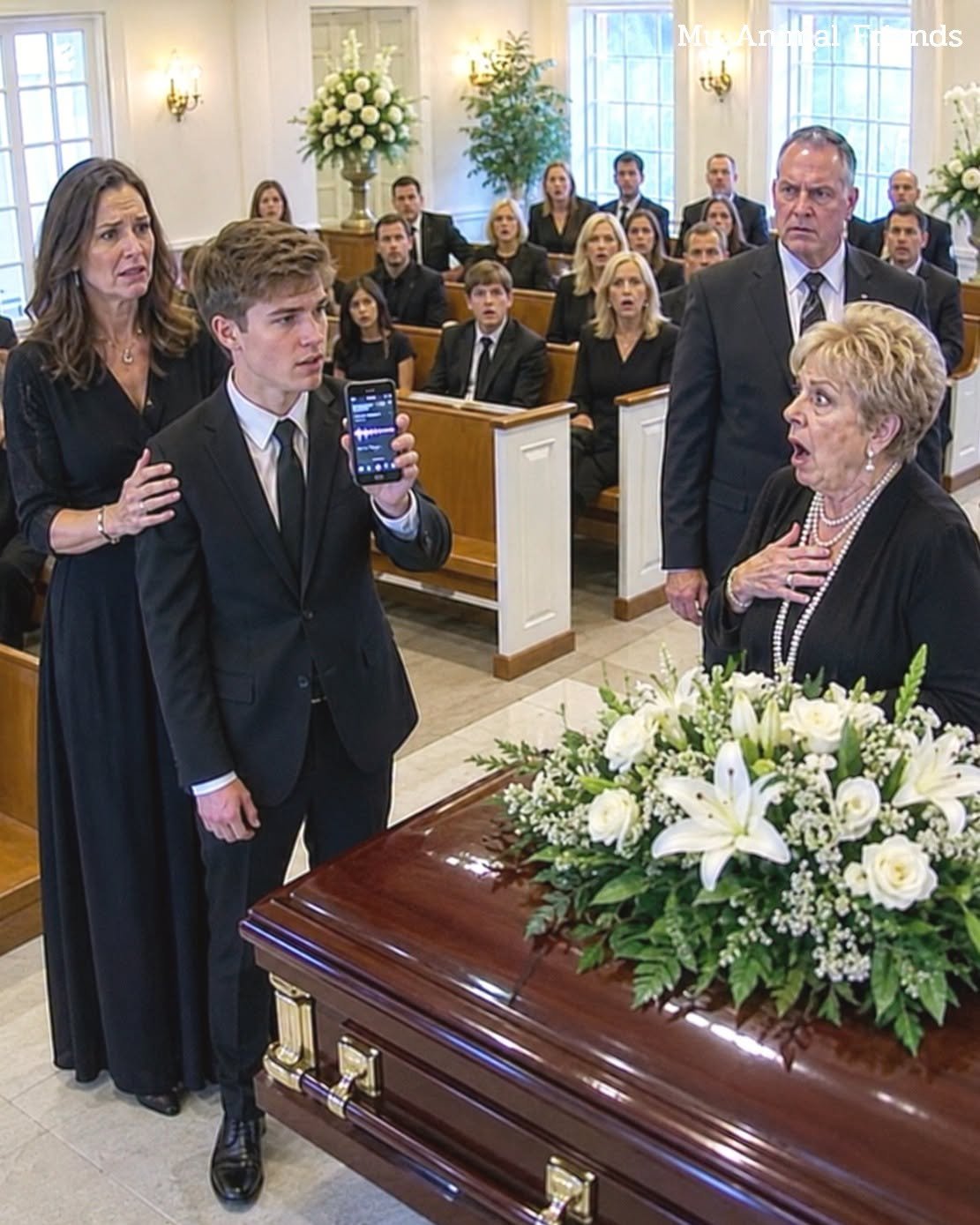
She thought I had no answer until our eight-year-old son stood up with Daniel’s phone and asked if she wanted everyone to hear the recording his father had made about her.
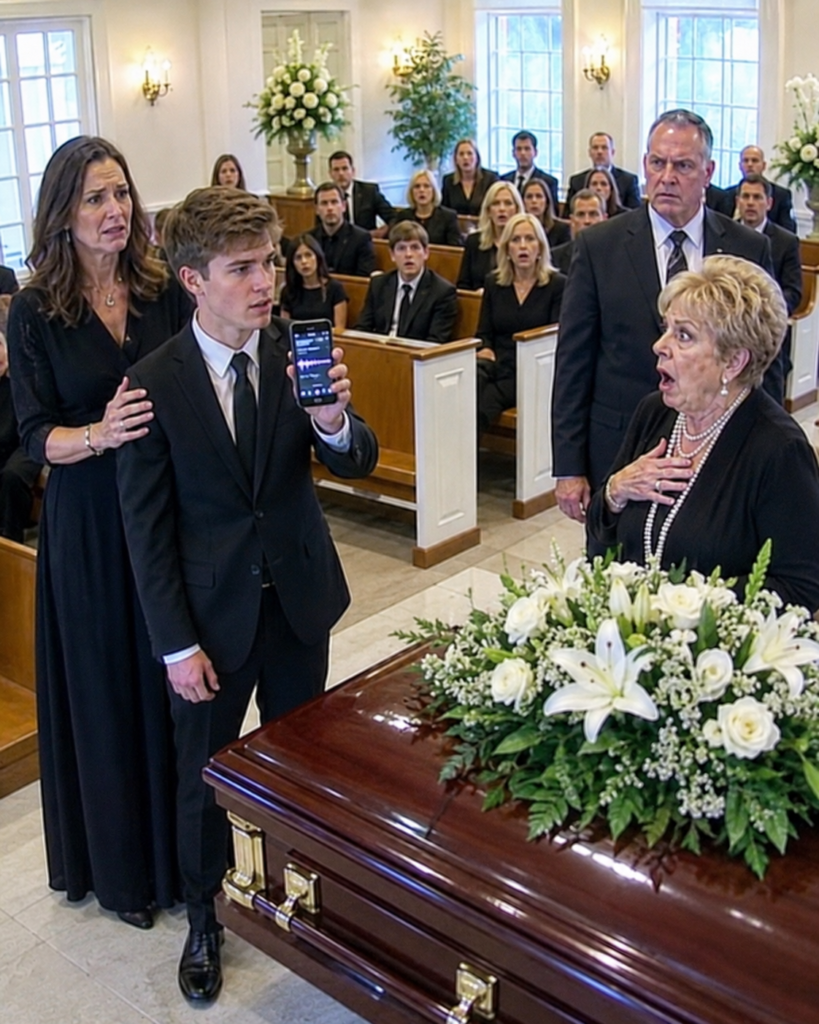
Vivian’s pearls gleamed beneath the chapel lights as she faced the mourners.
“Better he’s gone now than forced to live with the embarrassment she brought him,” she said.
The room went still.
Then Aunt Marlene nodded. Two cousins lowered their eyes in agreement, and someone behind me whispered, “Poor Daniel. He deserved better.”
My husband lay six feet away in a polished mahogany casket, wearing the navy tie I had chosen for our anniversary dinner three weeks before the accident.
I sat in the front row with my hands folded over my black dress while every stare cut into me. Noah sat beside me, small and rigid in his suit.
Vivian turned her grief into theater—one handkerchief, one trembling breath, one poisoned sentence at a time.
“She came into this family with nothing,” she continued. “Daniel gave her a home, a name, and a life. She repaid him with secrets, debt, and humiliation.”
My brother-in-law, Grant, stood behind her with his arms crossed. He had asked about Daniel’s life insurance before the funeral home had even collected Daniel’s body from the hospital.
Now he stared at me as though I were trespassing at my own husband’s funeral.
Vivian stepped closer. “You should be grateful we’re allowing you to sit with the family.”
A few relatives heard her. None defended me.
I didn’t cry. That seemed to irritate her more than tears would have. She wanted me shattered. She wanted me begging the family to believe I had not forged Daniel’s signature on a loan, hidden hundreds of thousands of dollars, or destroyed the business his father had built.
Those were the rumors she had spread during the six days between Daniel’s accident and his funeral.
I had not answered a single one.
Daniel had taught me something during our twelve years together: never interrupt someone while they are exposing themselves.
Vivian turned toward the casket and rested her fingers on its polished edge.
“My son spent his final months trying to clean up her mess,” she announced. “Now Grant and I will have to protect what remains of Daniel’s legacy.”
Grant gave a solemn nod.
There it was. Not grief. Ownership.
Vivian believed Daniel’s company, our house, and the insurance money would fall into her hands before the flowers on his grave had wilted. She believed the documents blaming me were real. She believed Daniel had died before discovering who created them.
And she had no idea what he had placed on his phone seven days before the accident.
Noah’s hand moved beside me. At first, I thought he was reaching for mine.
Then I saw the black phone between his palms.
Daniel’s phone. The police had returned it with his wallet and wedding ring. I had locked it in my bedroom drawer because I could not bear to hear his voicemail greeting.
Noah must have found the spare key. His knuckles were white around the case.
“Noah,” I whispered.
He looked at me, and for one painful second, I saw Daniel’s dark, steady eyes staring back.
Then my son stood.
Every face in the chapel turned toward him. Vivian’s expression tightened with annoyance.
“Sit down, sweetheart,” she said. “The adults are speaking.”
Noah did not move.
“Grandma,” he said, his voice clear enough to reach the last pew, “do you want me to play the recording Dad made about you last week?”
The color vanished from Vivian’s face. Grant uncrossed his arms.
“What recording?” he demanded.
Noah looked down at the screen. Vivian hurried toward him, but I rose and stepped between them. For the first time that morning, I looked her directly in the eyes.
“Don’t touch my son.”
Her mouth opened, but nothing came out.
Noah tapped the screen. A file appeared with the date from one week before Daniel’s accident. Its title was only three words:
FOR MY FAMILY.
Grant moved into the aisle. “That phone belongs to Daniel’s estate,” he said. “Hand it over.”
“No,” I replied.
His jaw tightened. “You have no idea what you’re doing.”
But I did.
I also knew why Vivian’s hands had begun to shake. Daniel had confronted her in his office after discovering a loan secured with my forged signature and a transfer routed through a company Grant secretly controlled.
He had told me he was collecting proof. He had not told me he had recorded the confrontation.
Vivian glanced toward the chapel doors as if measuring the distance.
Then Noah pressed play.
Daniel’s voice filled the room. Calm. Clear. Alive.
“If you’re hearing this at my funeral,” he said, “my mother has already blamed Elena for the crime she and Grant committed.”
Vivian stumbled backward.
And Noah’s thumb moved toward the next recording.
Part 2
The voice echoing through the vaulted ceiling of the chapel did not belong to a memory. It was heavy, resonant, and entirely undeniable.
“If you’re hearing this at my funeral, my mother has already blamed Elena for the crime she and Grant committed. They didn’t expect me to look at the secondary ledger. They didn’t expect me to trace the wire transfers back to the offshore shell company registered under Grant’s college pseudonym.”
Vivian staggered, her manicured hand flying to her throat as if to pry invisible fingers away. Her pearls, which had gleamed with such righteous arrogance moments before, now looked like cheap plastic beads rattling against her collarbone.
Grant lunged forward, his boots scraping sharply against the polished stone floor. “Turn that off!” he roared, his face flushing a violent shade of crimson. “That device is stolen property! It contains confidential corporate data protected by probate law!”
Before Grant could cover the distance between the aisle and my son, Aunt Marlene stood up from the third pew. Her mouth was slightly open, her eyes darting between Vivian’s frozen posture and Noah’s small, steady frame.
“Let the boy play it, Grant,” Marlene said, her voice cutting through the sudden uproar like glass. “Unless there’s something you don’t want us to hear.”
“Marlene, shut your damn mouth!” Grant snarled, abandoning all pretense of funeral decorum. He reached out to snatch the phone from Noah’s hand, but I didn’t hesitate. I stepped squarely into his path, my shoulder colliding hard against his chest.
“Touch him again, and I’ll break your wrist,” I said. My voice wasn’t loud. It didn’t need to be. It carried the chilling, flat certainty of a woman who had nothing left to lose.
Grant stared down at me, his eyes wide with a mixture of fury and sudden, frantic disbelief. The meek widow who had sat quietly in the front row for an hour, absorbing their venom without a single tear, was gone. In her place stood someone terrifyingly calm.
From the speakers of the black phone, Daniel’s voice continued, unrelenting.
“I trusted them,” the recording played on. “For years, I let my mother handle the family trust because I believed she valued our legacy more than her own greed. But she didn’t just forge Elena’s signature on the commercial real estate loan. She and Grant used Elena’s identity to create a massive financial liability, planning to use the upcoming bankruptcy to strip our household assets while leaving my wife facing federal fraud charges.”
A low, collective murmur rippled through the packed pews. Heads turned, eyes shifted from Vivian—who was now gripping the back of an empty wooden pew for physical support—to Grant, who stood paralyzed in the center aisle, exposed under the glaring afternoon light.
“Daniel is lying!” Vivian shrieked suddenly, her voice cracking into an ugly, desperate pitch. She abandoned her theatrical grief entirely, pointing a trembling finger directly at me. “She manipulated him! She poisoned his mind against his own flesh and blood while he was under heavy medication following the crash! It’s a deepfake! Everyone knows you can fake a voice with software nowadays! It’s all a lie!”
Noah didn’t flinch. He looked down at the screen, his thumb hovering over the interface, completely immune to his grandmother’s hysterical defense.
“It’s not a deepfake, Grandma,” Noah said, his eight-year-old voice carrying an eerie, adult composure. “Dad showed me how to check the metadata on his phone last month when we backed up his photos. The audio file has his digital certificate and voice signature embedded directly from his secure workspace.”
Silence descended on the chapel—a heavy, suffocating stillness where the only sound was the low hum of the ceiling fans overhead.
Part 3
The police did not arrive in a dramatic flurry of sirens, but rather with the quiet, devastating efficiency of a scheduled appointment.
Twenty minutes after Daniel’s voice finished playing the first recording, two uniformed officers and a plainclothes detective from the municipal financial crimes division walked through the heavy oak doors of the chapel. They didn’t look at the mahogany casket. They didn’t offer condolences to the weeping mourners or the stunned relatives.
They walked straight up to Grant.
“Grant Sterling?” the lead detective asked, flipping open a small leather notebook. “And Vivian Sterling?”
Grant’s face drained of whatever color had managed to return to it. He looked wildly around the room, as if expecting his business associates, his country club friends, or his extended family to stand up and form a human shield around him. But the pews behind him were emptying fast. Cousins, uncles, and lifelong family friends were sliding out into the side aisles, desperate to put as much physical distance between themselves and the crumbling Sterling name as humanly possible.
“There’s been a mistake,” Grant stammered, holding up his hands defensively. “This is a private family dispute. A civil matter regarding probate and estate distribution. You have no jurisdiction here.”
“Actually, Mr. Sterling, we have a warrant,” the detective replied smoothly, pulling a folded document from his coat pocket. “Issued twenty minutes ago by Judge Harrison based on digital evidence submitted via secure cloud backup from the late Daniel Sterling’s device, corroborating ongoing wire fraud, identity theft, and corporate embezzlement.”
The word embezzlement hung in the air like a physical blow.
Vivian let out a sharp, breathless gasp and sank heavily onto a pew, her posture collapsing in on itself. The grand matriarch, who had spent the last week orchestrating smear campaigns and mourning her son with manufactured artistry, looked suddenly ancient. The expensive black designer dress she wore seemed too large for her shrinking frame.
“Elena,” Grant whispered, turning his desperate gaze toward me as the detective’s handcuffs clicked into place behind his back. “Elena, please. We can talk about this. We’re family. If you drop the formal complaints, we can settle the estate equitably. The house, the accounts—everything can be yours. Just tell these officers it’s a misunderstanding.”
I stepped closer to him, stopping just inches away. I could smell the expensive cologne he wore—the same scent Daniel used to buy him for Christmas, paid for with funds drained from accounts bearing my forged signature.
“You stood at the back of this room and watched me drown in your lies for six days,” I said softly, ensuring my words were meant for him alone. “You thought I was weak because I didn’t scream back. You forgot one fundamental rule about Daniel’s family, Grant: we keep our receipts.”
The detectives escorted Grant down the center aisle, past the rows of empty pews and out into the glaring sunlight. Vivian remained seated, utterly abandoned by the son she had protected, the allies she had manipulated, and the fortune she had tried to steal.
Part 4
By evening, the chapel was entirely empty, save for the funeral directors waiting quietly by the side exit and the damp flowers wilting in the late afternoon heat.
The police had taken Daniel’s phone into evidence for the ongoing criminal investigation, but not before Noah had transferred all remaining mirrored files to a secure external drive that now sat safely in my coat pocket. The authorities had confirmed what Daniel’s voice had indicated: the paper trail of fraudulent loans and hidden debts led directly to Grant’s personal offshore accounts, with Vivian acting as the primary orchestrator of the corporate shell game.
The funeral was postponed indefinitely. The burial could not proceed until the state probate court verified the authenticity of Daniel’s final amended will—a document we found locked in his office safe later that afternoon, dated the exact same day as the audio recordings.
In it, Daniel had left everything cleanly and unequivocally: his share of the business, our family home, and his personal estate to his wife, Elena, and his son, Noah. Furthermore, it contained an explicit disinheritance clause for Vivian and Grant, citing documented financial malfeasance and breach of fiduciary trust.
When we returned home, the house felt vast and quiet, yet for the first time in a week, it didn’t feel like a cage.
Noah sat at the kitchen island, quietly turning a small wooden puzzle piece in his hands. The frantic energy of the morning—the courage that had fueled an eight-year-old boy to stand up against a room full of hostile adults—had given way to the quiet exhaustion of a child who had lost his father.
I walked over, pulled out the stool next to him, and sat down.
“You were very brave today, Noah,” I whispered, wrapping my arm around his small shoulders.
He leaned against me, burying his face in my sleeve. “I just missed him, Mom,” he said, his voice thick with unshed tears. “Dad told me I had to take care of you if anything ever happened to him. He said the truth was the only armor we needed.”
“He was right,” I murmured, pressing a kiss to the top of his dark, unruly hair—hair that matched Daniel’s exact wave, Daniel’s exact texture, and Daniel’s unyielding strength. “He was right.”
Outside the kitchen window, the sun dipped below the horizon, painting the sky in deep shades of amber and bruised purple. The storm that Vivian and Grant had manufactured to crush us had instead blown away every shadow, leaving behind the hard, clean light of reality.
Part 5
Three months later, the legal proceedings concluded with quiet finality.
The financial crimes division unraveled the entire network of deception that Vivian and Grant had spent years constructing. With the undeniable proof contained in Daniel’s digital archives, along with the forensic accounting reports ordered by the court, Grant was indicted on multiple felony counts of wire fraud, grand larceny, and identity theft. Facing overwhelming evidence and a potential prison sentence exceeding fifteen years, his defense attorneys dropped all countersuits and focused entirely on securing a plea bargain.
Vivian avoided a prison sentence due to her failing health and advanced age, but her social standing was utterly dismantled. Stripped of her access to the Sterling family fortune, abandoned by the elite social circles she had cultivated for decades, and forced to sell her sprawling estate to pay off accumulated legal debts, she retreated into a modest, forgotten apartment on the outskirts of the city.
The business that Daniel’s father had built—the legacy Vivian had tried to weaponize against us—was officially restructured under my sole directorship, with provisions placed into a protected educational trust for Noah’s future.
On a crisp autumn Saturday morning, exactly one hundred days after the accident, Noah and I drove out to the quiet hillside cemetery overlooking the valley.
The grass around the polished mahogany marker had grown in thick and green, dotted with the small white wildflowers Noah insisted on planting himself. There were no cameras, no weeping relatives looking for theater, and no poisonous whispers carried on the wind.
Just the steady rustle of the trees and the bright, clear sky overhead.
I knelt beside the stone, placing a single, perfect navy tie across the polished granite surface—the exact color Daniel had worn three weeks before everything changed, and the color I had chosen to remember him by.
Noah stood beside me, holding a small silver pocket watch his father had given him on his seventh birthday. He flipped it open, listening to the steady, rhythmic ticking of the internal gears.
“He would have been proud of us, Mom,” Noah said softly.
I smiled, reaching out to take my son’s hand, feeling the warm, unyielding grip of the future we had fought so hard to reclaim.
“He always knew we would be,” I replied. “We just had to let the truth speak for itself.”