
Chapter One
The Positive Test
“My ten-year-old daughter’s pregnancy test came back positive. When her biological father arrived at the hospital, he pointed at my husband and said, ‘Arrest him.’”
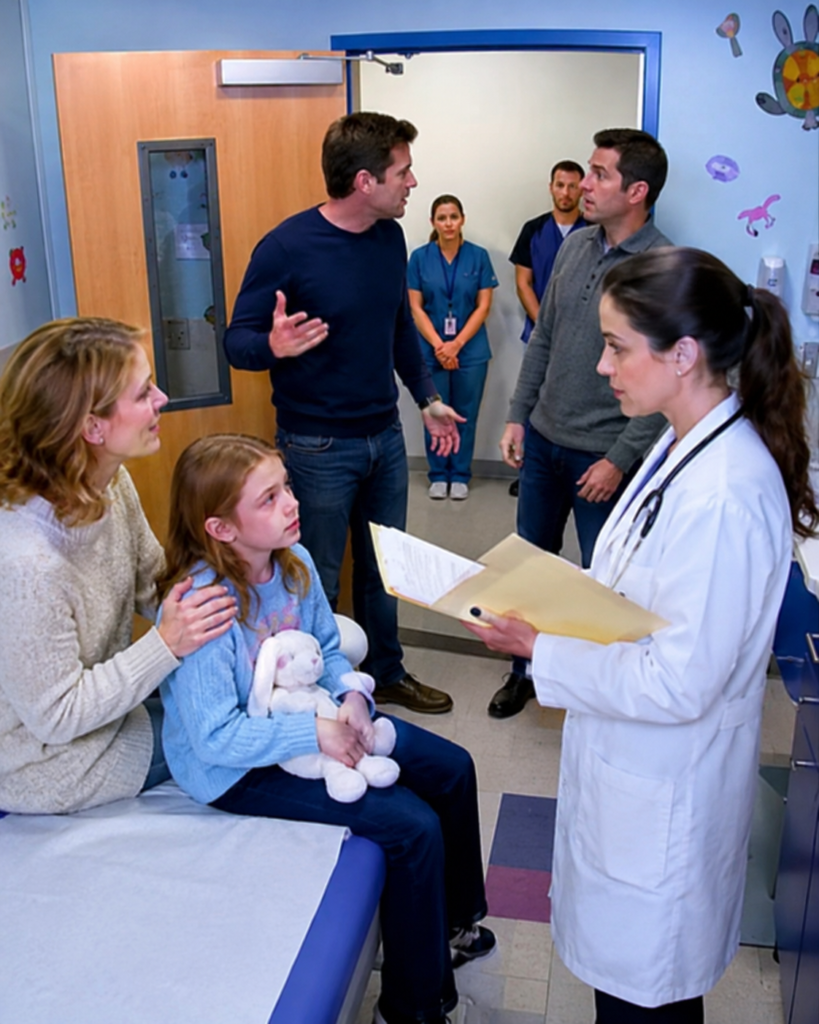
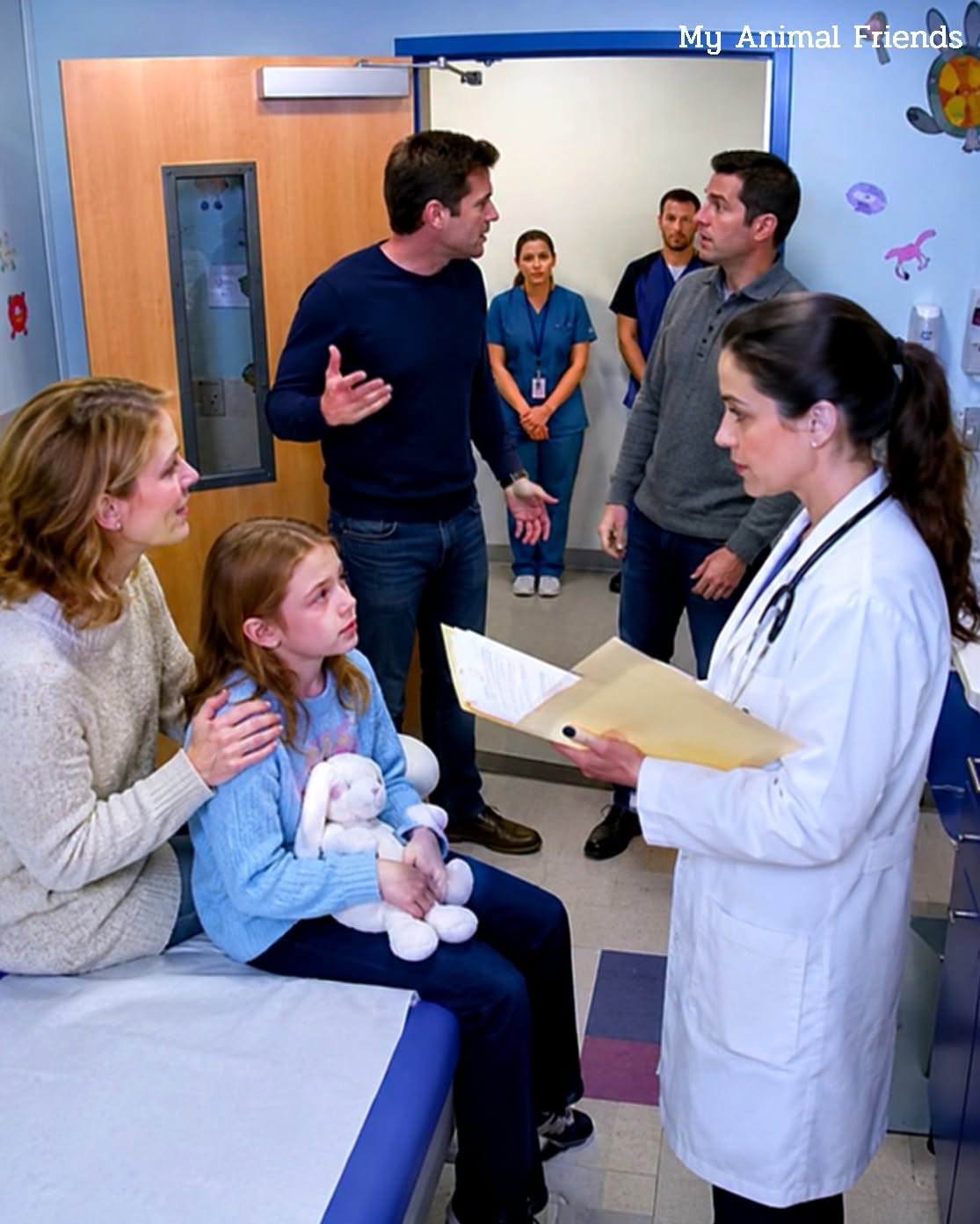
Two hours earlier, Sophie had been sitting between Daniel and me in the emergency room, swinging her sneakered feet beneath the chair.
She looked too small for the adult blood pressure cuff wrapped around her arm.
For six weeks, she had complained of headaches. At first, they came after school. Then they began waking her before dawn. That Monday morning, she vomited during math class and walked into a row of lockers on her way to the nurse’s office.
Her pediatrician told us to take her to the hospital.
“She’s also been developing early,” I told Dr. Lena Ortiz. “She needed her first training bra before most of her friends. I thought she just took after me.”
Dr. Ortiz asked Sophie several questions, then ordered bloodwork and a urine sample.
No one mentioned a pregnancy test.
Twenty minutes later, Dr. Ortiz returned without the easy smile she had worn before.
“Mrs. Morgan, may I speak with you privately?”
“You can talk in front of Daniel.”
Her gaze moved toward my husband.
“I need to examine Sophie alone first.”
Daniel immediately stood.
“Of course.”
He kissed the top of Sophie’s head, but she grabbed his hand.
“Don’t leave.”
“I’ll be right outside, bug.”
After the door closed, Dr. Ortiz pulled a chair beside Sophie’s bed.
“Sophie, I’m going to ask you some uncomfortable questions. You aren’t in trouble.”
Sophie looked at me.
“What kind of questions?”
“Has anyone ever touched you beneath your clothes?”
Her feet stopped swinging.
“No.”
“Has anyone asked you to keep a secret about touching?”
“No.”
My heart began pounding.
“Why are you asking her that?”
Dr. Ortiz turned the computer screen away from Sophie.
“Her urine pregnancy test was positive.”
For several seconds, the room made no sound except for the air conditioner.
Then I laughed.
Not because it was funny. Because the words were impossible.
“She’s ten.”
“I understand.”
“She still sleeps with a stuffed rabbit.”
“A test can occasionally be wrong. We’re repeating it with bloodwork.”
Sophie’s face had gone white.
“Am I having a baby?”
I pulled her against me.
“No. There’s been a mistake.”
Hospital policy required them to contact both a social worker and Sophie’s other legal guardian. Daniel was not allowed back into the room.
Eric arrived thirty minutes later.
He came through the doors so quickly that a security officer followed him down the hall. Daniel stood when he saw him.
“What happened?” Eric demanded.
Daniel raised both hands. “Let the doctor explain.”
Eric looked through the window and saw Sophie crying against my shoulder. Then he noticed the social worker sitting beside her bed.
His expression changed.
“No.”
“Eric—”
“You live in the same house as her.”
Daniel stepped backward as if he had been struck.
“I have never hurt Sophie.”
Eric pointed directly at him.
“Arrest him.”
A nurse pulled the curtain, but Sophie had already heard.
She slid out of my arms and ran toward the door.
“Dad, stop!”
Eric tried to enter. The security officer blocked him while the social worker guided Sophie back.
Daniel stood motionless in the hallway.
Sophie pressed both palms against the glass.
“He didn’t do anything!”
Dr. Ortiz returned carrying a printed laboratory report. She shut the door behind her.
I searched her face for reassurance.
“The urine test was wrong, wasn’t it?”
She didn’t answer immediately.
“We repeated the test using Sophie’s blood.”
My stomach tightened.
“And?”
“The result is positive.”
Sophie began shaking her head.
“But I’ve never even kissed anyone.”
“I believe you,” Dr. Ortiz said.
Outside the room, Eric was still shouting at Daniel. Every person in the hallway had turned to watch the man they already believed had harmed my child.
Dr. Ortiz lowered her voice.
“The laboratory ran the sample twice. Sophie has a significant amount of pregnancy hormone in her blood.”
I gripped the side of the bed.
“What happens now?”
“We need an ultrasound immediately.”
“To find the baby?”
Dr. Ortiz looked at Sophie, then back at me.
“To determine whether there is a baby at all.”
Chapter Two
The Man Everyone Blamed
The hospital separated all of us.
Sophie remained with me. Daniel was taken to a consultation room at the opposite end of the pediatric wing. Eric refused to leave the hallway until a security officer warned that he would be removed.
A social worker named Marissa Cole entered Sophie’s room carrying no notebook.
She sat beside the bed and spoke gently.
“I’m going to ask Sophie some questions alone.”
Sophie tightened her arms around her stuffed rabbit.
“I want my mom.”
“I’ll be right outside,” I promised.
I hated myself for saying it. Everyone Sophie trusted had already been pushed behind a different door.
Eric was waiting when I stepped into the hallway.
“You let that man live with our daughter.”
“Daniel has never harmed her.”
“You don’t know that.”
“I do.”
Eric laughed without humor.
“Did you know he goes into her bedroom at night?”
My stomach dropped.
“How did you know that?”
“Sophie told me last weekend.”
He saw my expression and moved closer.
“You didn’t know, did you?”
I did know.
Three weeks earlier, I had awakened at four in the morning and found Daniel sitting on the floor outside Sophie’s open door. She had another headache and was afraid to sleep. He had brought her water, placed a cold washcloth over her forehead, and stayed where she could see him.
I had thought it was kindness.
Now Eric was turning it into evidence.
“She’s been waking up sick,” I said. “He checks on her.”
“A ten-year-old girl has pregnancy hormone in her blood, Rachel.”
“Stop saying that like it proves Daniel did something.”
“What else could it prove?”
I had no answer.
Across the hall, Daniel sat behind a glass partition while a detective questioned him. His hands rested flat on the table. He looked toward me once, but I looked away.
That single act broke something in his face.
The door to Sophie’s room opened forty minutes later. Marissa invited us back inside, but Eric was told to wait.
Sophie was curled beneath a hospital blanket.
“What did she say?” I asked.
Marissa’s expression remained neutral.
“Sophie has consistently stated that no one has touched or frightened her. She explained why Daniel sometimes checks on her at night.”
“Then he can come back?”
“Not yet. The medical team still needs to determine why her test is positive.”
Eric heard through the open door.
“Children protect people they’re afraid of.”
Sophie sat up.
“I’m not afraid of Daniel!”
Eric stepped inside before security could stop him.
“I’m trying to protect you.”
“You’re making everything worse!”
He froze.
Sophie pointed toward the hallway.
“Daniel believed me. You didn’t even ask.”
Eric’s face hardened, but I saw hurt beneath the anger.
Dr. Ortiz returned before he could answer.
“The ultrasound department is preparing a room,” she said. “Sophie needs a full bladder for the scan, so we’re giving her fluids.”
Eric turned toward her.
“How far along is she?”
“We don’t know that she is pregnant.”
“You said the blood test was positive.”
“I said it detected hCG. That is an important distinction.”
I clung to those words.
“What does that mean?”
“It means the hormone is present. It does not yet tell us why.”
Daniel was released from the consultation room but instructed to remain outside the pediatric unit. He stopped beside the exit.
“Rachel, I need you to look at me.”
I did.
“I would die before I hurt her.”
Eric muttered something under his breath.
Daniel ignored him.
“Tell Sophie I’m not leaving the hospital.”
A nurse escorted him through the double doors.
As they closed, Sophie began crying quietly.
Dr. Ortiz examined the new laboratory report. Her brow tightened.
“Did they make another mistake?” I asked.
“No. They tested a second portion of blood.”
She turned the paper toward me, although the numbers meant nothing.
“The result is not borderline. Sophie’s hCG is significantly elevated.”
Eric stared through the doors Daniel had disappeared behind.
“So there is a baby.”
Dr. Ortiz folded the report.
“We won’t know until we look.”
A transport aide arrived with a wheelchair.
Sophie reached for my hand.
As I helped her into the chair, Eric asked the question none of us wanted answered.
“And if the ultrasound shows nothing?”
Dr. Ortiz looked directly at him.
“Then we have a different emergency.”
Chapter Three
The Empty Ultrasound
The ultrasound room had pictures of smiling cartoon animals taped to the ceiling.
Sophie stared at them while the technician moved the probe across her lower abdomen.
I held her hand. Eric stood near the door with his arms crossed. Daniel remained somewhere downstairs, waiting for news from a family that had just treated him like a criminal.
The screen showed shifting fields of gray.
I kept searching for the shape of a baby even though every part of me rejected the possibility.
The technician measured something, erased it, then measured again.
“Do you see anything?” Eric asked.
“I’m not permitted to interpret the images.”
“That means you don’t.”
“It means a radiologist will review them.”
Sophie turned toward me.
“If there’s a baby, will I have to keep it?”
My throat closed.
“We don’t know that there is one.”
“But the test said—”
“The test found a hormone,” I reminded her. “That’s all we know.”
The technician abruptly stopped moving the probe. She saved several images, then left the room without explaining why.
Eric began pacing.
“This is what happens when everyone worries about Daniel’s feelings instead of finding out what happened to Sophie.”
“Your accusation did not create the test result.”
“No, but living with him might have.”
Sophie covered her ears.
“Stop!”
A radiologist entered with Dr. Ortiz. They spoke quietly while reviewing the images.
Finally, Dr. Ortiz came to the bedside.
“There is no pregnancy visible inside Sophie’s uterus.”
The air left my lungs so quickly that I nearly collapsed.
“No baby?”
“We do not see one.”
Eric did not look relieved.
“What about an ectopic pregnancy?”
“We examined the areas around both ovaries. We found no gestational sac, suspicious mass, or internal bleeding.”
“Could it be too early?”
Dr. Ortiz hesitated.
“In very early pregnancy, an ultrasound may not show anything. But Sophie’s hormone level, her examination, and the appearance of her reproductive organs do not fit together the way we would expect.”
I pulled Sophie against me.
“So Daniel is innocent.”
“The medical findings do not indicate an identifiable pregnancy,” she said carefully. “The investigation and the medical diagnosis are separate matters.”
Eric seized on her caution.
“You still can’t rule it out.”
Dr. Ortiz looked at him.
“We cannot explain the hCG yet. That is not the same as accusing someone without evidence.”
For the first time since he arrived, Eric went silent.
While we waited for transport, Sophie asked to use the bathroom for the third time in less than an hour.
“She drank a lot for the ultrasound,” I said.
“I’m always thirsty now,” Sophie replied. “Even at school.”
Dr. Ortiz stopped near the door.
“How long has that been happening?”
“I don’t know. A few weeks.”
“Months,” I corrected. “She carries two water bottles to school.”
The doctor stepped closer.
“Has she been waking at night to urinate?”
“Almost every night.”
Eric frowned.
“Why didn’t anyone tell me?”
“Because you turned every conversation into a custody fight.”
Dr. Ortiz asked Sophie to sit upright. She held one finger in front of Sophie’s face and moved it slowly from side to side.
“Keep looking at my nose. Tell me when you can see my fingers.”
Sophie answered correctly when the doctor’s hand was near the center.
When it moved farther to the right, she said nothing.
Dr. Ortiz tried the left side.
Sophie still stared forward.
“Now?” the doctor asked.
“What am I supposed to see?”
The room changed.
The ultrasound had frightened Dr. Ortiz. This frightened her more.
She shone a small light into Sophie’s eyes, then asked whether the words on the wall appeared blurry.
“Only on the sides,” Sophie said. “It’s like things disappear.”
I remembered the call from school.
She had not stumbled into those lockers because she was dizzy.
She had not seen them.
Dr. Ortiz stepped into the hallway and made a phone call. When she returned, two more doctors were with her.
“What’s happening?” I asked.
“We’ve been looking below Sophie’s waist because of the pregnancy test,” she said. “But her headaches, thirst, early development, and vision changes suggest the source may be somewhere else.”
“Where?”
She glanced toward Sophie before answering.
“We need an MRI of her brain.”
Eric’s face lost all its anger.
Sophie squeezed my hand.
“Mom, what are they looking for?”
Before I could answer, Dr. Ortiz did.
“Something that should not be there.”
Chapter Four
The Second Place They Looked
Daniel was waiting outside the MRI department.
He stood when Sophie’s wheelchair appeared, but he did not approach us. A security officer remained nearby—not because Daniel had been arrested, but because Eric had warned the hospital there would be trouble if Daniel came near his daughter.
Sophie saw him and held out both arms.
“Daniel.”
The officer looked at me.
I nodded.
Daniel crossed the waiting room and knelt in front of her. Sophie buried her face against his shoulder.
“I told them you didn’t do anything,” she whispered.
“I know.”
“Dad didn’t believe me.”
Eric stood ten feet away. He looked as though he wanted to argue, but no words came.
Daniel pulled back and touched Sophie’s stuffed rabbit.
“I’ll be right here when you finish.”
“You promise?”
“I promise.”
The MRI took forty-seven minutes.
I counted every one of them.
When Sophie was brought back, she complained that the machine had been loud but said the headache was worse. A nurse dimmed the lights and gave her medicine.
Then Dr. Ortiz asked the adults to follow her into a consultation room.
Sophie refused to let me leave, so the meeting happened at her bedside. Daniel sat on her right. I sat on her left. Eric remained near the window.
A new doctor introduced herself as Dr. Priya Shah, a pediatric endocrinologist.
She placed an MRI image on the monitor.
Most of it looked like meaningless shades of black and gray. Near the center was a pale, irregular shape.
“We found a mass near the base of Sophie’s brain,” Dr. Shah said.
I waited for someone to correct her.
No one did.
“What kind of mass?” Daniel asked.
“We believe it may be a germ cell tumor located near the area that controls hormone production, thirst, and several aspects of development.”
Eric gripped the windowsill.
“Are you saying she has cancer?”
“We need additional imaging and tumor-marker studies before we can determine the exact type.”
I looked at Sophie. She was watching all of us, trying to decide how frightened she should be.
“Is that what caused the headaches?” I asked.
“Most likely. It is also pressing near the pathways involved in peripheral vision.”
Sophie touched the side of her head.
“But what does that have to do with the pregnancy test?”
Dr. Shah pulled her chair closer.
“A pregnancy test does not actually look for a baby. It looks for a hormone called hCG.”
“The hormone in my blood?”
“Yes. Pregnancy is the most common reason for that hormone to appear. But some germ cell tumors can produce it too.”
No one spoke.
The truth was too large to enter the room all at once.
“There was never a baby?” Sophie asked.
“No,” Dr. Shah said. “You are not pregnant.”
Sophie’s entire body relaxed. Then she studied the image on the monitor.
“So that thing tricked the test?”
“That is one way to describe it.”
Eric lowered himself into a chair.
He stared at Daniel for several seconds.
“I thought—”
“I know what you thought,” Daniel said.
“I was trying to protect her.”
“You accused me before you even asked her.”
“I heard the word pregnant. She’s ten. What was I supposed to think?”
“You were supposed to believe your daughter when she told you the truth.”
Eric looked toward Sophie, but she turned her face into my shoulder.
Dr. Shah explained that Sophie would be admitted that night. More blood tests and scans would help identify the tumor. A neurosurgeon and an oncology team were already reviewing her case.
“Can you remove it?” I asked.
“Treatment depends on the exact diagnosis. Many germ cell tumors respond well to therapy, but we need to move quickly.”
The phrase respond well was meant to comfort me.
The words move quickly erased that comfort.
A nurse entered to place an identification band on Sophie’s wrist. Only hours earlier, hospital staff had treated her room like the scene of a hidden crime.
Now we understood that something truly had been hurting her.
It was not Daniel.
It was not an unborn baby.
It was growing inside her head.
Sophie looked at the adults gathered around her bed.
“Does this mean Daniel can come home?”
Eric closed his eyes.
Dr. Shah answered gently.
“It means the pregnancy test did not prove that anyone hurt you.”
Daniel took Sophie’s hand.
She held on tightly.
I stared at the glowing image of the tumor and understood the terrible bargain we had been given.
The test that nearly destroyed our family might also have saved my daughter’s life.
Chapter Five
The Damage Done Before the Diagnosis
Sophie was admitted to the pediatric oncology floor shortly after midnight.
By morning, the story had escaped the hospital.
Daniel’s phone began ringing before sunrise. He ignored the first two calls, then stepped into the hallway to answer the third. When he returned, his face was empty.
“What happened?” I asked.
He looked at Sophie before lowering his voice.
“Brookfield placed me on administrative leave.”
Daniel taught fifth-grade science. He had worked at the same elementary school for eleven years without a single complaint.
“Why would the school even know?”
Daniel looked toward Eric, who was sleeping in a chair near the window.
Someone had contacted the superintendent while we were waiting for the ultrasound. The caller reported that Daniel was being questioned after a ten-year-old girl in his home tested positive for pregnancy.
I woke Eric.
“Did you call Daniel’s school?”
He sat up slowly.
“I believed a child might be in danger.”
“You knew the ultrasound found no pregnancy.”
“I made the call before the ultrasound.”
“Then call them again.”
Eric rubbed both hands over his face.
“The doctors still haven’t explained the hormone.”
“They found a tumor in her brain!”
“That doesn’t automatically erase every concern.”
Daniel stepped between us.
“Stop.”
His voice was quiet, but Sophie opened her eyes.
“Why are you fighting?”
“No reason, bug,” Daniel said.
Sophie looked at him.
“Why aren’t you at school?”
None of us answered quickly enough.
Her gaze moved from Daniel to Eric.
“You told people he hurt me.”
Eric stood.
“I was trying to protect you.”
“I told you he didn’t.”
“Sophie, sometimes children—”
“I am not lying!”
The heart monitor beside her bed began beeping faster. A nurse entered and asked everyone except me to leave.
Sophie turned her face toward the wall.
“They keep saying they believe me, but they don’t.”
I sat beside her.
“The doctors believe you.”
“What about you?”
The question cut deeper than anything Eric had said.
“I believe you.”
“Did you believe me yesterday?”
I remembered looking away from Daniel through the glass.
“I was frightened,” I admitted. “And for one moment, I let that fear become doubt. I am so sorry.”
Dr. Shah arrived with a neurosurgeon later that morning. Additional blood tests showed that Sophie’s hCG remained elevated. Another tumor marker was also abnormal.
They needed a small tissue sample to identify the exact tumor and choose the safest treatment.
“Will you cut my head open?” Sophie asked.
The neurosurgeon explained that the procedure would be performed through a small opening using image guidance. He spoke carefully, without making promises he could not keep.
Sophie listened, clutching her rabbit.
“Can the tumor hear us?”
“No,” he said.
“Good. I don’t want it to know we found it.”
The biopsy was scheduled for the following morning.
After the doctors left, Eric approached Daniel in the hallway.
“I will contact your school.”
“That isn’t enough,” Daniel said.
“What do you want me to do?”
“Tell them you accused me without evidence. Use those exact words.”
Eric’s jaw tightened.
“You weren’t the one who got that test result.”
“No. I was just the person you decided to destroy with it.”
From her bed, Sophie called both men into the room.
They stood on opposite sides of her.
“I don’t care which one of you wins,” she said. “I don’t care who Mom loves more or who gets more weekends.”
Eric lowered his eyes.
Sophie held out her hands.
“I need both of you to stop fighting long enough to help me.”
Daniel took one hand.
After a long pause, Eric took the other.
The next morning, orderlies arrived to take Sophie to surgery. She handed me her stuffed rabbit, then looked toward the three adults gathered beside her bed.
“If I wake up and you’re fighting again, I’m asking the nurses to remove all of you.”
It was the first time any of us had laughed since the pregnancy test.
Then the doors closed behind her.
The rabbit remained in my arms.
And we waited to learn the name of the thing growing inside my daughter.
Chapter Six
What the Test Had Really Found
The biopsy lasted three hours.
Daniel paced the waiting room. Eric sat beneath the television with his elbows on his knees. Neither man spoke.
When the neurosurgeon finally appeared, I knew Sophie was alive because he was walking instead of running.
“The procedure went as planned,” he said. “She is awake.”
My legs nearly gave way.
“Did you remove the tumor?”
“Removing it now would risk damaging structures involved in vision and hormone regulation. Today’s goal was diagnosis.”
We were allowed to see Sophie one at a time. She was sleepy and pale, with a small bandage hidden near her hairline.
Her first question was not about the surgery.
“Did Daniel’s school let him come back?”
Daniel smiled, but his eyes filled.
“Not yet.”
“Dad?”
Eric stood behind me.
“I called the superintendent,” he said. “I told her there was no pregnancy and no evidence Daniel had harmed you.”
“Did you tell her you were wrong?”
Eric hesitated.
“Yes.”
Sophie closed her eyes again.
“Good.”
The pathology report arrived two days later.
Dr. Shah gathered us in a conference room and wrote the diagnosis on a whiteboard: an hCG-secreting intracranial germ cell tumor.
The words looked less frightening than the MRI image. They were not.
“The tumor produced the hormone that caused Sophie’s positive pregnancy tests,” Dr. Shah explained. “It also disrupted the part of her brain that regulates thirst and development.”
Daniel leaned forward.
“Is it cancer?”
“Yes.”
I heard the word, but my mind refused to hold it.
Dr. Shah continued. The tumor was serious, but this type could respond to chemotherapy. Sophie would receive several treatment cycles, followed by focused radiation if the oncology team believed it necessary.
“What are her chances?” Eric asked.
“We have reason to hope,” Dr. Shah said. “But treatment must begin immediately.”
Sophie understood more than we wanted her to.
That evening, she asked me whether cancer meant she was going to die.
I climbed into bed beside her.
“It means the doctors know what they have to fight.”
“That isn’t what I asked.”
“No,” I whispered. “It isn’t.”
I held her face between my hands.
“I don’t know everything that will happen. But the doctors believe they can treat this, and we are going to stay with you through every part of it.”
Her first chemotherapy cycle began three days later.
Daniel slept in the reclining chair beside her bed. Eric brought breakfast every morning, even when Sophie could not eat it. I learned to measure time by medications, blood tests, and the changing numbers on Dr. Shah’s reports.
A detective returned during Sophie’s treatment.
He told us the medical findings and Sophie’s consistent statements provided no basis for a criminal case against Daniel. The hospital social worker documented that no pregnancy had been found.
Daniel was officially cleared.
But innocence on paper did not erase the parents who had already whispered his name in the school parking lot.
“I can handle it,” he told me.
I knew he was lying.
After the first treatment cycle, Sophie’s nausea worsened. She slept most of the day and cried when strands of hair began collecting on her pillow.
Then Dr. Shah entered holding a laboratory report.
For the first time since we met her, she smiled before speaking.
“Sophie’s hCG has begun to fall.”
I looked at the page. The number was still far above normal.
“How much does that mean?”
“It means the tumor is responding.”
Sophie touched the bandage covering her IV.
“So the thing in my brain is getting weaker?”
“That is what we hope.”
She reached beneath her blanket and pulled out the stuffed rabbit.
“Then it should be scared.”
Daniel laughed softly. Eric turned toward the window and wiped his eyes.
The pregnancy hormone that had accused an innocent man had become something else.
It was now the number telling us our daughter might survive.
Chapter Seven
The Number That Kept Falling
By Sophie’s third treatment cycle, most of her hair was gone.
Daniel helped her shave the remaining strands. He shaved his own head afterward, although Sophie told him it made his ears look enormous.
Eric offered to do the same.
“No,” Sophie said. “One bald dad is enough.”
It was the closest our family came to normal.
The headaches became less frequent. Sophie stopped waking every hour for water, and during a vision test, she saw movement farther to each side than she had before treatment.
Every improvement came with a price. She lost weight. Food tasted metallic. Some mornings, she was too tired to lift her stuffed rabbit.
Still, her hCG fell after every cycle.
The school district completed its review of Daniel. He was allowed to return, but several parents requested that their children be moved from his class.
“The district cleared you,” I said.
“Rumors don’t care what a district decides.”
Eric stood in the hospital doorway and heard him.
“I can speak at the school board meeting.”
Daniel looked up.
“That would make this public again.”
“It’s already public.”
“You don’t get to play the hero after starting it.”
“No,” Eric said. “But I can tell the truth.”
The meeting was held the following Thursday. Daniel refused to attend, so I watched the livestream from Sophie’s hospital room.
Eric stood alone at the microphone.
He did not mention the details of Sophie’s illness. He simply stated that he had contacted the district while terrified and without complete information. He said the medical investigation found no evidence that Daniel had harmed any child.
Then he said the words Daniel had demanded.
“I accused him without evidence. I was wrong.”
When the meeting ended, Sophie looked toward Daniel.
“Are you still mad at Dad?”
“Yes,” he answered honestly.
“Are you going to stay mad forever?”
“I don’t know.”
She considered that.
“You tell me science changes when there’s new evidence.”
Daniel smiled faintly.
“People are harder than science.”
“But you can try.”
The next MRI showed that the tumor had shrunk significantly. The pressure near Sophie’s visual pathways had decreased, although Dr. Shah warned that treatment was not finished.
“The scan looks better,” she said. “And the hCG is approaching the normal range.”
Eric stared at the monitor.
“How can something that small have done all this?”
“It affected a very sensitive area,” Dr. Shah replied.
I thought of how the test result had done the same thing to our family. A few words on a screen had exposed every crack between us and forced those cracks wider.
Eric withdrew his emergency custody petition. He did not ask me to forgive him. He only asked for permission to keep showing up.
I gave it because Sophie wanted him there.
After the final chemotherapy cycle, we gathered around her bed while a nurse drew one more blood sample. Sophie watched the vial leave the room as though it carried the verdict on her entire future.
The result took four hours.
Dr. Shah arrived just before sunset.
She carried the report against her chest.
Daniel stood. Eric stopped pacing. I felt Sophie’s fingers close around mine.
“Please don’t make us wait,” I said.
Dr. Shah looked at Sophie.
“Your hCG is now below the laboratory’s detectable level.”
For a moment, none of us moved.
Then Sophie began to cry.
“Does that mean it’s gone?”
“It means the treatment has stopped the tumor from producing the hormone. That is an excellent sign.”
Daniel hugged her from one side. Eric leaned in from the other.
They did not look at each other.
They did not need to.
For the first time, both men were holding our daughter instead of fighting over her.
Chapter Eight
The Test That Saved Her
Four months after Sophie’s first positive pregnancy test, we returned to the same hospital for her final scheduled scan.
She wore a purple knitted cap over the soft hair beginning to grow back. Her stuffed rabbit remained at home for the first time.
“I’m eleven now,” she explained. “He needs to learn independence.”
Daniel had returned to his classroom. Some parents still avoided him, but most had accepted the investigation’s findings. Eric continued attending counseling with Sophie. The two men were not friends, and I no longer expected them to become friends.
They had learned something more important.
They could stand in the same room without making Sophie choose between them.
Dr. Shah entered with the MRI results.
The tumor had shrunk to a tiny area of inactive tissue. Sophie’s hCG remained undetectable. Her peripheral vision had mostly returned, although an endocrinologist would continue monitoring her hormones and development.
“Are you saying she’s cured?” I asked.
“I’m saying there is no evidence of active disease today,” Dr. Shah replied. “We will continue watching closely.”
Months earlier, I would have hated the caution in that answer.
Now I understood that hope did not require certainty.
Sophie looked at the scan.
“So that little mark is what’s left?”
“It may eventually become even less visible.”
“Can I keep the picture?”
Dr. Shah smiled.
“We can print one for you.”
Eric shifted beside the window.
“I owe this hospital an apology.”
“You owe several people an apology,” Sophie said.
He nodded.
“I know.”
Then she looked at Daniel.
“And you have to stop making that face every time Dad enters the room.”
“What face?”
“The one that says you smelled something bad.”
Dr. Shah covered a laugh with her hand.
Daniel glanced at Eric.
“I’ll work on it.”
The custody case had been withdrawn. Eric never regained the easy trust Sophie once gave him, but he stopped demanding it. He earned back pieces slowly—by arriving on time, listening before speaking, and admitting when fear made him cruel.
Daniel’s forgiveness came even more slowly.
That was all right.
Some wounds close without disappearing.
Before we left, a nurse handed me Sophie’s newest laboratory report. The hCG line showed a result beneath the measurable range.
It was the same hormone that had caused a doctor to remove Daniel from Sophie’s room.
The same hormone that had brought a detective into our lives.
The same hormone that had made my daughter wonder whether an impossible baby was growing inside her.
Sophie leaned against me.
“Mom?”
“Yes?”
“If that first test had been negative, would they have found the tumor?”
I looked toward Dr. Shah.
“Maybe not as early,” she said. “The headaches and vision problems would eventually have led us there. But the test made us keep searching when the first ultrasound found nothing.”
Sophie thought about that as we walked toward the elevator.
Daniel pressed the button. Eric carried her backpack. Neither man argued over who would take her home.
Outside, the afternoon sun was so bright that Sophie squinted.
Then she looked to her left, to her right, and smiled because she could see both men standing beside her.
The test had nearly destroyed our family because we mistook a hormone for proof of a terrible act.
But it had never detected a baby.
It had detected the disease trying to take my daughter from me.
And because it did, she was still alive.