
“If you don’t take care of this right now,” he said, “it can get worse very quickly.”
He handed me my discharge papers, a prescription, and that specific look people reserve for older women when they realize we’ve spent years downplaying our pain.
That night, under the yellow light of my lamp, I opened the shoebox where I kept the important things: my birth certificate, the divorce papers, old photos of the kids, and Javier’s bank card inside a faded envelope.
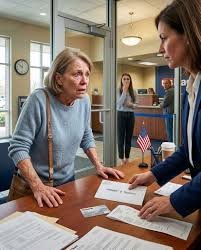
The teller turned the card over, verified my ID, and asked me to confirm my full name. Her fingers hovered over the keyboard as if the keys had suddenly become dangerous. “Ma’am,” she said carefully, “there isn’t $3,000 here.” I felt the world grow light around me. “Then, how much is there?” She swallowed and looked toward the glass office behind the counter. “I need to call my branch manager.”
I wanted to get angry. I wanted to laugh. I wanted to think that Javier had managed to humiliate me once again, even after five years. Instead, I gripped the counter and fixed my eyes on a small American flag next to the pen cup, because it was the only thing in the entire room that seemed completely still.
The branch manager came out holding a sealed envelope. My full name was handwritten on the front. When she placed it next to the card Javier had given me, I understood that the money wasn’t the real secret at all.
The manager pointed to a chair in her office. “I think it would be best if you sat down, ma’am.” I took a seat while she placed the envelope in front of me. It was yellowed with time, but the seal was still intact. “This letter was linked to the account,” she explained. “We had instructions to deliver it to you only if you came in person to withdraw the funds.”
The handwriting was Javier’s. I would have recognized it among thousands. My hands were shaking as I broke the seal. Inside was a letter and several printed sheets
“If you are reading this, it means at least five years have passed. And it also means you are still as stubborn as ever.” I had to stop. That was exactly the kind of phrase he would have said.
Javier wrote that during the final years of our marriage, he had been diagnosed with a serious heart condition. He didn’t want to tell anyone, not even the kids. He had gone through several surgeries, and the doctors didn’t guarantee him much time. I felt rage as I read it. Not because he was sick. Because he had decided to hide it. Because he had left me out of a truth that also affected my family.
The letter continued. He acknowledged mistakes. A lot of them. He spoke about his ego, the arguments, the times he had taken me for granted. He didn’t try to justify himself. He simply admitted it.
Then I reached the last page. The $3,000 had never been the balance of the account. It had been the initial deposit. For five years, an investment portfolio linked to that account had kept growing. The current figure appeared printed on the attached document. I read it twice. Then a third time. Not because I didn’t know how to read. Because my mind refused to accept it. There was over $280,000
I felt like I was running out of air. “Is this correct?” I asked. The manager nodded. “Yes. We have reviewed everything multiple times.” I leaned back against the chair. Five years of cleaning houses. Five years of counting coins to buy milk. Five years of believing that card was a handout. And during all that time, it hadn’t been that.
The final lines of the letter were brief. “I knew you would never touch the money out of pride. That’s why I chose this timeframe. I don’t expect you to forgive me. But I hope that, when the time comes to use it, you do so to live well. You spent too many years taking care of everyone else.” He didn’t sign it with “I love you.” He didn’t ask for another chance. It just said: “Javier.”
I sat there in silence. I didn’t cry right away. Sometimes the heart needs time to decide what it feels.
That afternoon, I went straight to the pharmacy. I bought the full prescription without calculating how much would be left in my account. Afterward, I ordered a cab home. It was the first time in years I didn’t check the price before getting in
That night, I called Elena and Daniel. Both thought something terrible had happened when they heard my voice. When I finished explaining, nobody spoke for several seconds. “Mom…” Elena whispered. “Are you okay?” I looked around my small room — the ceiling with water stains, the window that rattled, the shoebox on the dresser. And for the first time in a very long time, I answered truthfully. “I am now.”
Months later, I moved into a small but comfortable apartment in Cambridge. Nothing luxurious. Just warm, bright, and quiet. I also started a medical treatment I had been putting off for far too long. My health improved little by little. Not overnight. The way it happens in real life. One day I breathed better. Another day I walked further. Another day I laughed again.
I never did reconcile with Javier. It was already too late for that. But over time, I understood something. That letter didn’t erase the damage. It didn’t change the difficult years. It didn’t turn our divorce into a beautiful story. However, it gave me back something I thought was lost: the possibility of choosing my own future. And at 65 years old, I discovered I still had one.
One morning, while having breakfast by a sun-drenched window, I found the old bank card in a drawer. I looked at it for a few seconds. Then I smiled. For years, I thought it represented the end of my life with Javier. In reality, it had ended up being the beginning of a life that finally belonged to me.